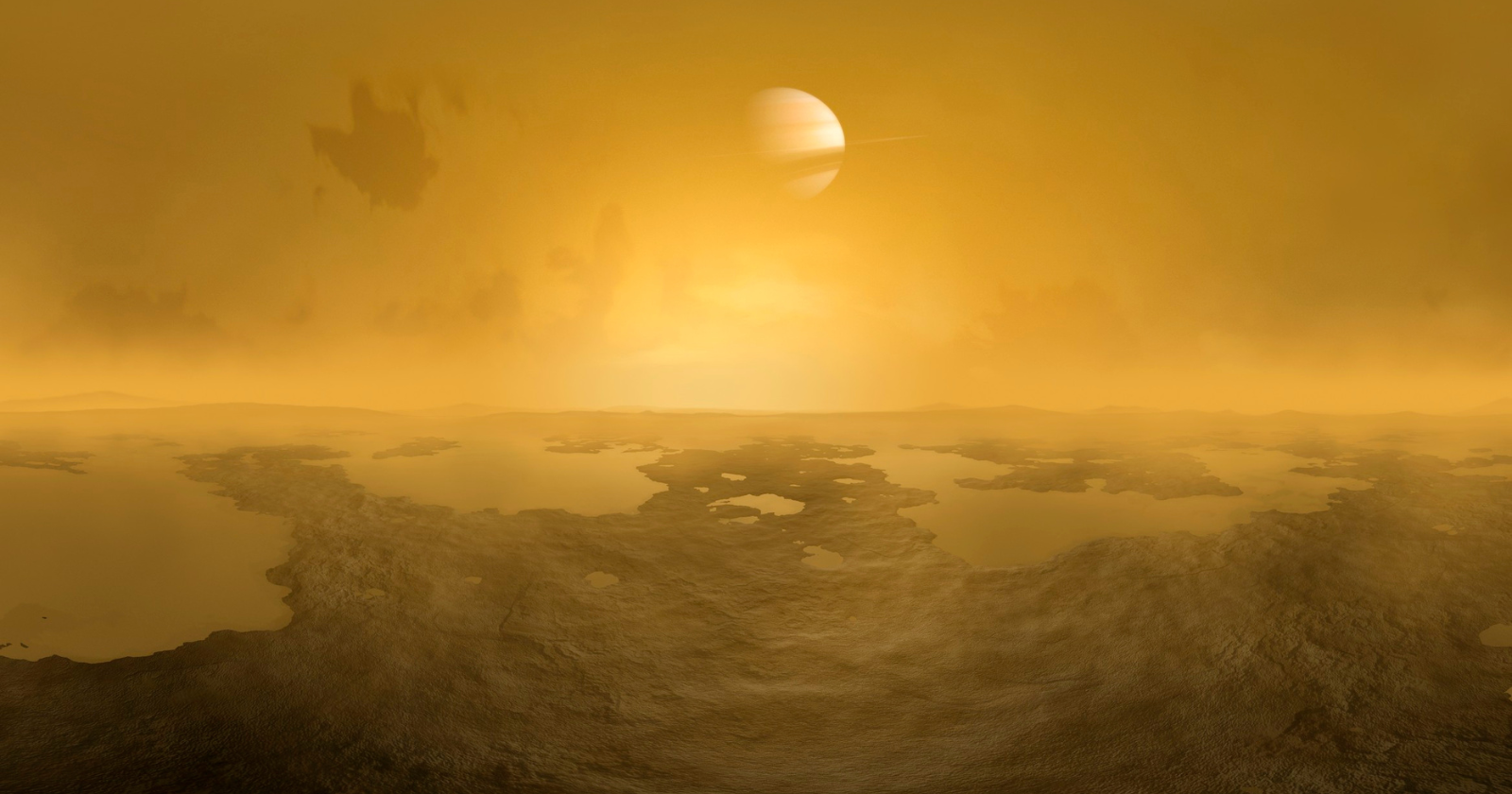
Picture a car-sized machine sitting on an orange, frozen plain. It powers up eight rotors, rises into a hazy sky and flies to a place no spacecraft has ever touched. After landing, it drills into the ground and analyses what it finds.
Underneath it are dunes of dark, carbon-rich material. Elsewhere on the moon, rivers empty into lakes and seas — but the water ice is as solid as rock and the flowing liquid is made largely of methane and ethane.
The machine is Dragonfly, and its destination is Titan, Saturn’s largest moon. A drone flying between sites on another world sounds extravagantly difficult. On Titan, however, flight may be the most practical way to explore.
Titan’s strangely familiar landscape
Titan is the only world besides Earth known to have stable liquids on its surface. Its temperature is approximately minus 179 degrees Celsius, cold enough for water ice to behave like stone. Methane and ethane, normally gases under everyday Earth conditions, can instead remain liquid.
These hydrocarbons produce a weather cycle resembling Earth’s water cycle. Methane and ethane evaporate, form clouds and fall as rain before flowing through channels into lakes and seas. Measurements from NASA’s Cassini mission indicated that some of Titan’s small northern lakes are more than 100 metres deep.
Cassini also revealed an unexpectedly Earthlike landscape of plains, dunes, river channels and shorelines, although nearly every familiar feature is made from unfamiliar materials. Planetary scientist Alex Hayes, a member of the Dragonfly science team, described Titan as “an explorer’s utopia”.
Why NASA is sending a drone
Titan is unusually favourable for powered flight. Its surface atmosphere is approximately four times denser than Earth’s by mass per unit volume, while Titan’s surface gravity is only about one-seventh of Earth’s. Together, those conditions allow rotors to generate lift comparatively efficiently.
Dragonfly will have eight rotors arranged in four pairs. Rather than drawing its flight power directly from a reactor, it will carry a Multi-Mission Radioisotope Thermoelectric Generator. The device converts heat from the natural decay of plutonium-238 into electricity, which will gradually recharge Dragonfly’s batteries. The batteries will then supply the much higher power required during flights and demanding science operations. Waste heat from the generator will also help keep the spacecraft’s equipment warm in Titan’s extreme cold.
Because sunlight at Saturn is weak and filtered further by Titan’s thick atmosphere, this radioisotope system is more dependable than solar panels. Dragonfly will spend much of its time conducting science and recharging before making another flight.
A Titan day lasts approximately 16 Earth days. Across its planned mission, Dragonfly could travel as far as 175 kilometres, farther than any previous spacecraft has travelled across the surface of another world.
The chemistry Dragonfly will investigate
Titan’s atmosphere produces an abundance of complex organic molecules. These carbon-containing materials settle onto the surface, where they may interact with water ice and, in some places, with liquid water produced temporarily by impacts or possibly by geological activity.
Dragonfly is not designed to announce whether life currently exists on Titan. NASA describes it as a mission to investigate the chemistry that may precede biology. Its instruments will examine Titan’s organic compounds, measure environmental conditions and assess how far prebiotic chemical processes have progressed.
The distinction matters. Organic molecules are ingredients associated with life, but they are not themselves evidence of living organisms. Dragonfly will investigate whether Titan contains environments where those ingredients have interacted in chemically interesting ways and whether any potential indicators of biological processes can be distinguished from non-biological chemistry.
One of its most important destinations is Selk impact crater. The ancient collision that formed the crater may have melted part of Titan’s icy crust, allowing liquid water to mix temporarily with organic material deposited on the surface. Such a mixture could have created a natural experiment in prebiotic chemistry.
“The science questions we have for Titan are very broad because we don’t know much about what is actually going on at the surface yet,” Hayes said when the mission’s science goals were published.
Dragonfly is now being assembled
NASA formally confirmed Dragonfly in 2024, allowing the mission to proceed into final design and construction. It is scheduled to launch no earlier than July 2028 aboard a SpaceX Falcon Heavy rocket and reach Titan in late 2034. Its nominal surface mission is expected to last approximately 3.3 years.
The spacecraft has moved well beyond the concept stage. Integration and testing began in 2026, and in July the team delivered its nearly four-metre fuselage for the installation of mechanical, electrical and thermal systems. NASA reported that the structure had already completed important vibration and load tests.
Dragonfly probably will not settle the question of whether life exists elsewhere. What it can reveal is how far complex carbon chemistry develops in an environment profoundly different from Earth.