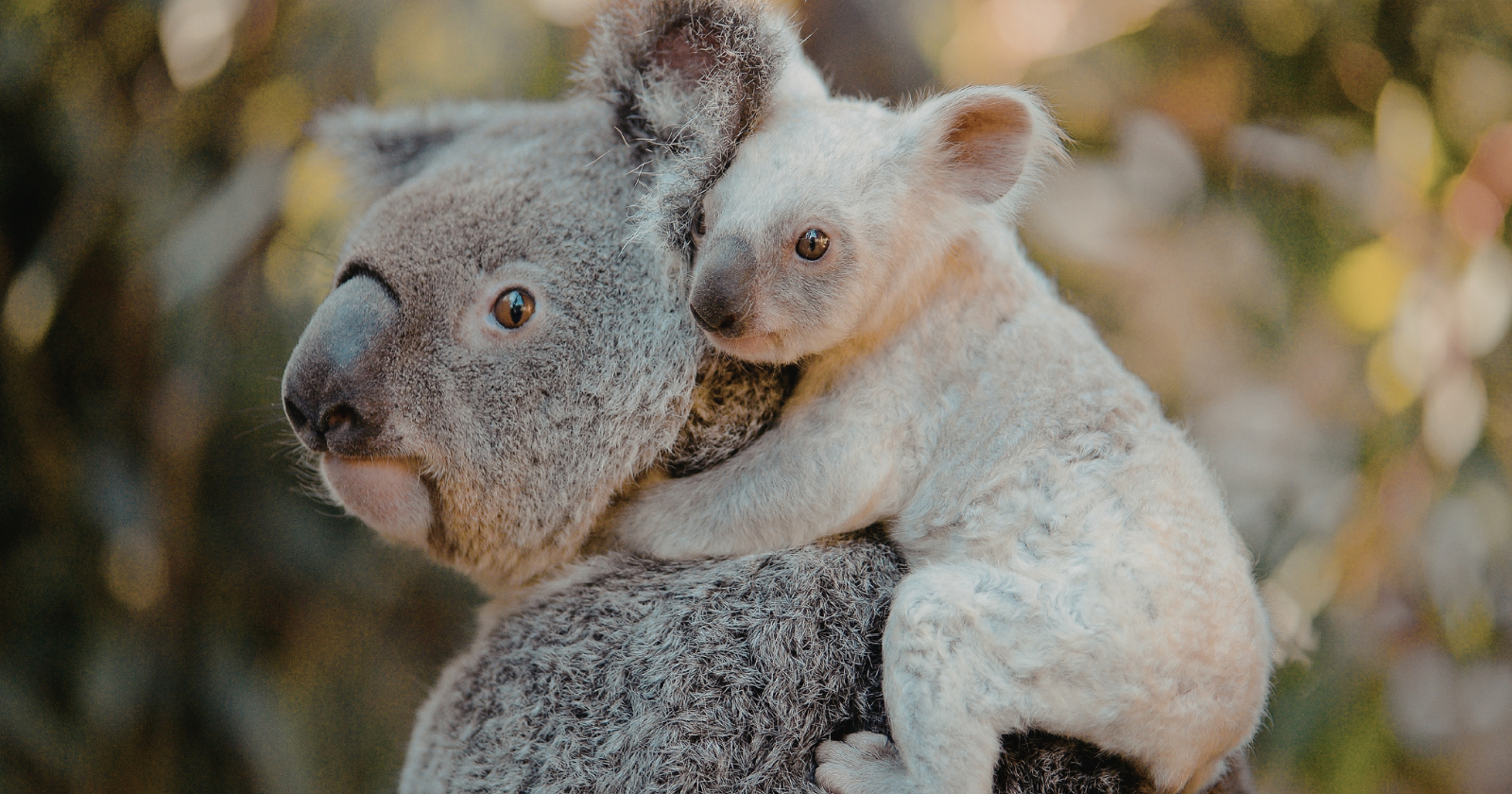
Press a koala’s fingertip onto glass and you get ridges, loops and whorls that look almost exactly like the ones on your own hand.
Not just at a glance, either. Maciej Henneberg’s research indicated that even careful analysis under a microscope could struggle to distinguish the patterns. It is an odd fact, and it holds up better than most odd facts do once you go looking for the source.
In the mid-1990, Henneberg, a biological anthropologist and forensic scientist noticed that koalas appeared to have fingerprints. He and his colleagues examined the prints and published what they found in a 1997 paper with the memorable title Fingerprint Homoplasy: Koalas and Humans.
What struck him was how little anyone had looked before. As he put it in 1996, “It appears that no one has bothered to study them in detail”.
The ridges on your fingertips aren’t decoration. They’re raised lines of friction-ridge skin, arranged into arches, loops and whorls, and they’re rare outside primates.
Most mammals get by without them. Koalas are widely described as the only non-primates known to have fingerprints. Plenty of animals have textured or individually distinctive pads, but koalas possess the papillary ridge patterns we recognise as fingerprints.
Why such ridges exist is still debated. One idea points to grip and moisture. A 2020 study coauthored by Mike Adams at the University of Birmingham found that human fingerprint ridges help regulate moisture at the contact surface, maintaining friction when fingers begin either wet or dry. Adams described it this way: “This dual-mechanism for managing moisture has provided primates with an evolutionary advantage in dry and wet conditions”. The study concerned primate fingers, not koalas, so it offers a possible explanation for ridge function rather than proof of why koala prints evolved.
The interesting part isn’t simply that koala prints have ridges.
Henneberg and his colleagues reported papillary ridges of a size, shape and arrangement very similar to those in humans, including arches, loops, whorls and triradii. Under magnification, the patterns can therefore be difficult to separate by sight. That is a stronger claim than saying both species have rough fingertips, and it is the reason the finding keeps being repeated.
What makes koala fingerprints a classic case of convergent evolution — where separate lineages independently arrive at a similar solution — is that their marsupial relatives do not share the same trait. Wombats are the koala’s closest living relatives, while kangaroos are more distant cousins, yet neither has comparable fingerprints. Henneberg therefore argued that the ridges arose independently in the koala line rather than being inherited broadly across marsupials.
His explanation was tied to how koalas move and eat. He suggested that the ridges evolved for “climbing vertically onto the smaller branches of eucalyptus trees, reaching out, grasping handfuls of leaves and bringing them to the mouth”. Grip and precise handling make a plausible evolutionary story, though it remains a hypothesis rather than a demonstrated cause.
When two groups of mammals, separated by more than 150 million years of evolution, both need to grip branches and handle small objects precisely, they can end up with remarkably similar fingertip ridges. The koala didn’t copy us and we didn’t copy it. Natural selection, working independently in two distant branches, arrived at much the same structure because the structure appears to work.