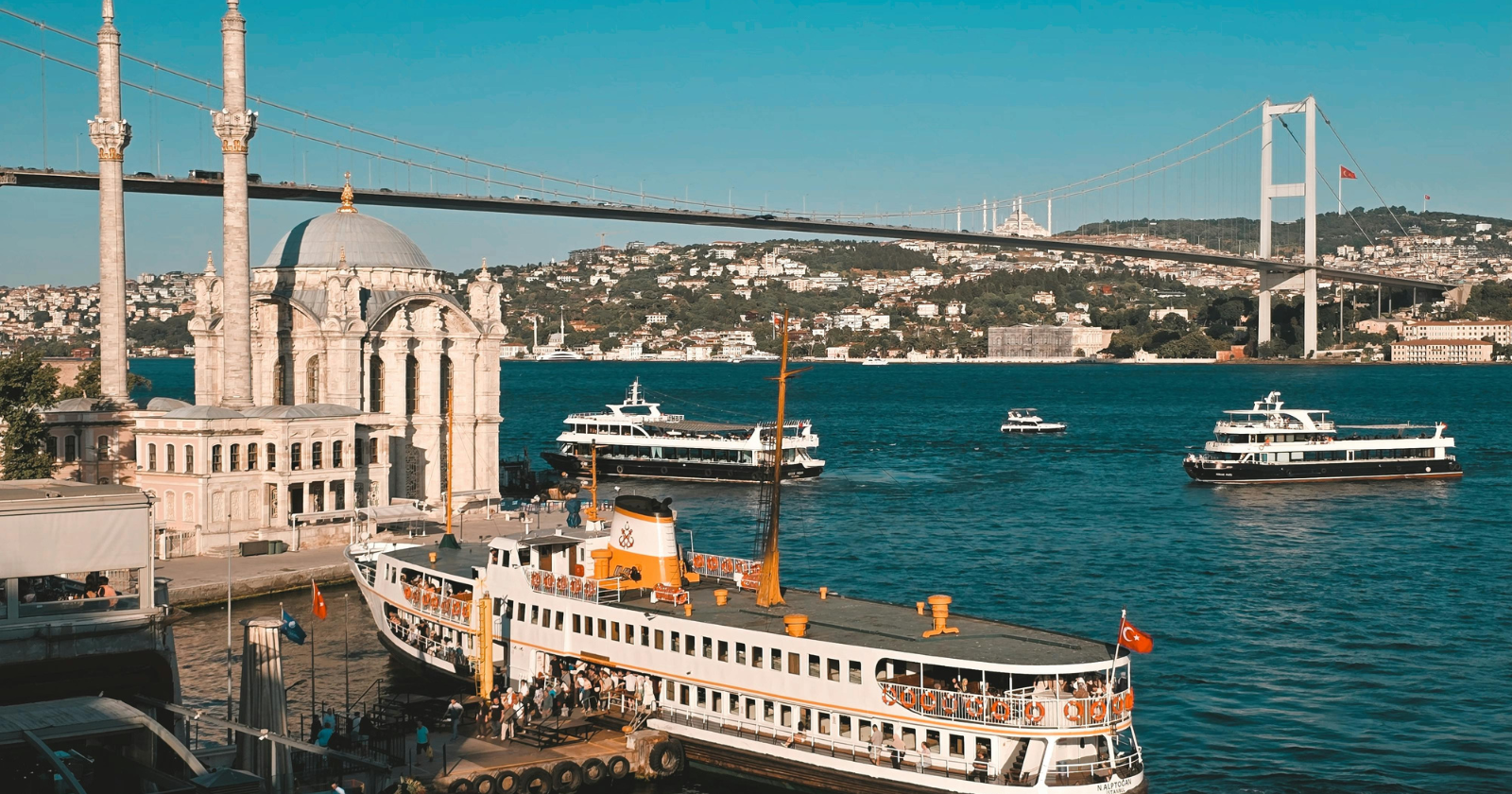
Picture someone leaving their apartment on a hillside above the water, coffee in hand, stepping onto a train. Four minutes later they get off in a different continent. No passport, no fuss, no sense of having crossed anything at all. They do it again on the way home.
For a lot of people in Istanbul, this is just the shape of an ordinary working day.
It sounds like a geography quiz answer, and it is one. You can hop from Asia to Europe before your coffee cools.
What does that tell us about the lines we draw on maps?
The city that broke the map
Istanbul is by far the largest city in the world shared by two continents, Europe and Asia. There are other transcontinental cities, including Atyrau and Suez, but none come close to Istanbul’s scale. This is a city of roughly 15 million people, and the continental boundary runs right through it.
The split is not even. Istanbul’s population reached 15,701,602 at the end of 2024, according to the Turkish Statistical Institute, and the two sides carry very different loads. Roughly 65% of residents live on the European side, and 35% on the Asian side. Most of the shops and offices sit in Europe, and many jobs remain concentrated there. Much of the more affordable housing has grown up in Asia. You can probably already see where the daily traffic comes from.
What the Bosphorus actually is
The thing doing the dividing is the Bosphorus, a narrow channel of water about 31 km long that links the Black Sea to the Sea of Marmara and runs entirely inside Turkey. It is water, but it is also a border. This strip of sea is treated as part of the accepted line between Europe and Asia, which is why crossing it counts as changing continents.
Until the first Bosphorus bridge opened in 1973, travelling by boat was the only direct way across, and that history still shapes the city’s rhythm. Ferries are woven into daily life in a way that’s hard to picture from the outside.
As Adil Bali, an expert on the history of Istanbul’s ferries, puts it, “It is one of the few cities in the world that can be crossed by sea, so the ferries are indispensable here.” That’s a romantic framing, but the point holds: those city ferries still carry at least 40 million passengers a year.
The commute that crosses a continent
Ferries are the old way. The Marmaray rail line runs through a tunnel beneath the strait, and its trains make the crossing in about four minutes. Not a scenic voyage between continents. Just four minutes of a normal train ride, mostly in the dark.
The scale is what gets me. Marmaray carries between 600,000 and more than 700,000 passengers a day, and in 2024 it set a single-day record of 743,596 riders. A report from the Council of Europe Development Bank describes how the tunnel changed the trip, lifting capacity to up to 75,000 passengers per hour in each direction, up from around 10,000 before.
So the intercontinental commute is not a novelty. It’s the plain logistics of getting to work for hundreds of thousands of people, most of whom, I’d guess, think about it about as much as anyone thinks about their morning train, which is to say not at all.
Why this matters beyond the geography trivia
Here is what I keep circling back to. If millions of people can cross between Europe and Asia without noticing, maybe the noticing was always the strange part, not the crossing.
Geographers have made this point for a long time: the boundary between Europe and Asia is debated, not a simple fact of geology. There is no ocean between them, no crack in the Earth’s crust, nothing underfoot that says “you are now leaving one continent.” It’s a single connected landmass, Eurasia, with a line drawn across it by historical and geographic convention rather than by a clean geological break. The Bosphorus got picked as part of that line, which is convenient and tidy and completely human-made.
Istanbul is where that idea meets a commuter train timetable. The city doesn’t disprove continents so much as show how soft the concept is once you stand on top of it. A person eating breakfast in Asia and clocking in in Europe an hour later isn’t doing anything out of the ordinary. They’re just moving through a city that happens to sit on a line somebody else decided mattered.
The continents are an agreement, not a discovery. Istanbul is the place where you can ride straight through the seam and feel nothing change, because there was never really anything there to change.