Picture the den in early summer. Some of the adult wolves have left to hunt, which can mean being gone for the better part of a day or longer and covering ground a person would struggle to walk.
The new pups are too small to follow and too helpless to leave truly alone. So they are not left alone. A pack member often stays behind, and that wolf may be an older brother or sister from a previous litter, on babysitting duty.
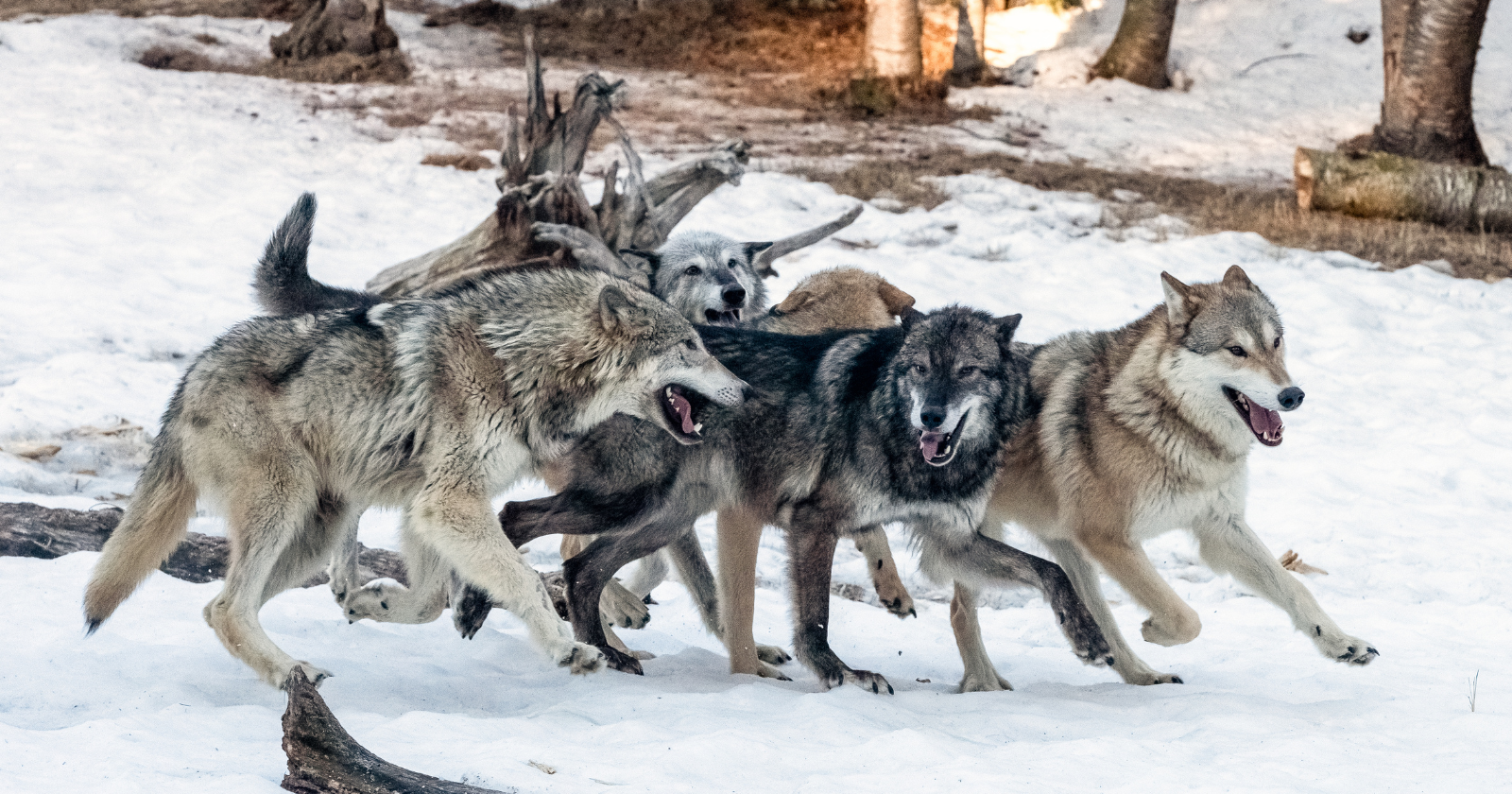
Wolves are one of a fairly small number of animals where the raising of the young is a group effort rather than a job for two. Biologists call it alloparenting, care given by animals other than the mother and father. In a wolf family it often falls to yearlings and other nonbreeding wolves that have not yet left to start families of their own. The Wolf Conservation Center describes them babysitting the pups, regurgitating food for them and playing with them.
The most striking part, to me, is the food. A yearling that has fed at a kill will travel back to the den and regurgitate meat for the pups, delivering a meal it carried home inside itself. It is not glamorous. It is also a genuinely generous act by an animal that could simply have eaten and kept walking. The parents do it too, but research on wild wolves found that all adult pack members, including yearlings, regurgitated food, so the pups can be fed from several directions at once.
There is a quiet division of labor worth noticing. In one Idaho study, nonbreeding females attended dens and rendezvous sites about twice as often as nonbreeding males, suggesting that older sisters may take a closer hand in caring for the new pups.
The younger wolves may also be gaining practical experience. By the time a yearling leaves to raise its own litter, it may already have spent a season or two feeding, guarding, and minding pups. It has, in the most practical way, learned the job before it needs it.
All of this can have a hard payoff. Spreading the care across the pack means the pups can be watched, fed, and defended while other wolves hunt, part of what makes a pack so resilient. In a long-term study of reintroduced red wolves, helpers were associated with higher pup mass and survival at low population density, although the survival benefit disappeared at high density. Gray-wolf research likewise shows that the relationship between pack size and surviving pups varies with ecological conditions. Extra hands are not automatically better in every place and every year, but they let a wolf family divide the essential work of guarding and provisioning.
What I like about it is how unfamiliar it makes a familiar animal look. We are used to thinking of wolves through the language of dominance and the lone hunter. The reality on the ground, in early summer, is a young pack member staying home to mind the babies while others hunt, and then bringing dinner back for everyone.
It is closer to the cooperative way humans have raised children across much of our history, with older children and other relatives helping to care for and provision the young.
The pups will grow, and in a year or two some of the babysitters will leave to become parents themselves, carrying the whole routine somewhere new. It is a small, well-run system, repeated from one generation to the next