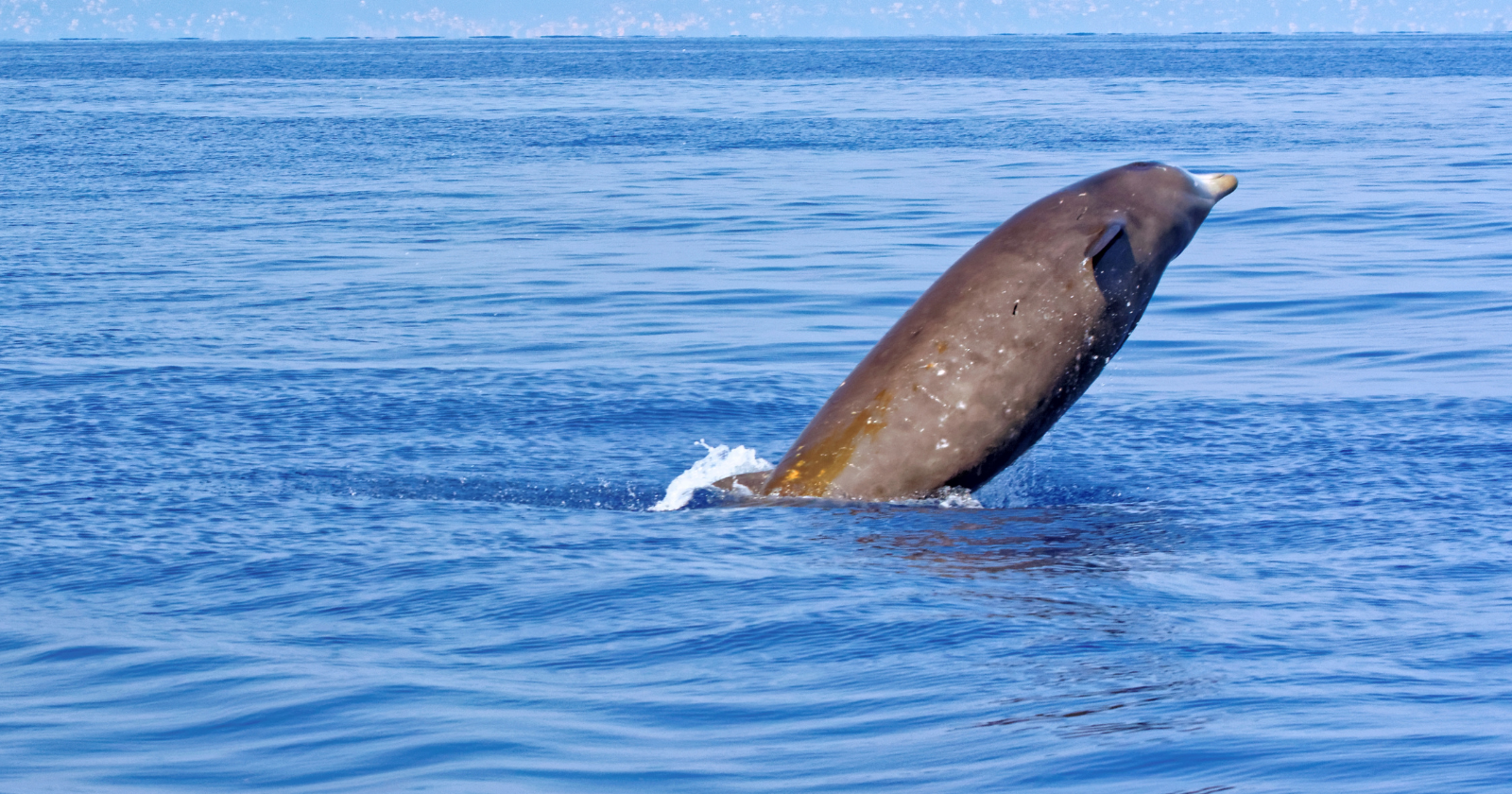
Here is a puzzle that still bothers the people who study it.
Take a Cuvier’s beaked whale, work out its body size and how much oxygen it can plausibly carry, and an earlier calculated aerobic dive limit gives you about 33 minutes.
Then the whale goes and stays down for three hours and 42 minutes. The gap between what the estimate predicts and what the whale actually does is enormous, and nobody has fully closed it.
The dive was logged in a study published in September 2020 in the Journal of Experimental Biology, led by Nicola Quick at Duke University’s Marine Laboratory with the Cascadia Research Collective and Spain’s Fundación Oceanogràfic. At 222 minutes on one breath, it is the longest dive ever documented for any mammal on the planet.
What strikes me first is how far it blows past the old published record, which the same species had already set: 137.5 minutes in a 2014 study. The new mark beat it by more than an hour.
What the researchers actually found
The team studied a large set of data gathered off Cape Hatteras, North Carolina, between 2014 and 2018: more than 3,600 presumed foraging dives from 23 satellite-linked tag records. They wanted to estimate the whales’ behavioural aerobic dive limit and test whether exceptionally long dives were followed by longer recovery periods.
The everyday numbers are impressive on their own. The median presumed feeding dive ran about 59 minutes, already well beyond that earlier 33-minute estimate. The record came from one animal, a whale carrying tag ZcTag066, that produced two extreme dives: one lasting 173 minutes, and then the 222-minute mark. Quick did not treat this as normal. “We didn’t believe it at first,” she said. “These are mammals after all, and any mammal spending that long under water just seemed incredible.”
I should say plainly that I’m not a marine biologist, and this is one study based on 23 tag records, not a settled account of the whole species. The researchers are careful about that too. But the surprise in their own words is real. “It really did surprise us,” Quick said, “that these animals are able to go so far beyond what predictions suggest their diving limits should be.”
How the body stretches its physiological limits
So how does a warm-blooded animal hold its breath for the length of a feature film?
Researchers have possible explanations, not a complete one.
The leading suspects: the whale has a low metabolic rate, high oxygen-storage capacity and a high capacity to buffer the by-products of aerobic and anaerobic metabolism.
Even together, those factors do not give researchers a firm calculated maximum of 222 minutes. The team estimated a behavioural aerobic dive limit of 77.7 minutes, while suggesting that the two extreme dives may be more indicative of the species’ true limits.
The strangest part is the recovery
Push a body past its limit and you’d expect a long rest afterward: the longer the dive, the longer the rest. Going in, that’s what the team expected to see. At the extreme end of the data, they didn’t.
Across the dives as a whole, longer dives were generally followed by longer intervals before the next deep dive. But among the longest 5 percent, the recovery times had no clear link to how long the dive lasted. One whale was back diving within about 20 minutes of a two-hour dive. Another waited roughly four hours after a dive of only 78 minutes. At the extreme end, the simple pattern the researchers expected was not there. As Quick put it, “Going into the study, we thought that we would see a pattern of increased recovery time after a long dive. The fact that we didn’t opens up many other questions.”
Closing thoughts
This is a species that also holds the depth record among marine mammals, reaching 2,992 metres — nearly two miles — below the surface.
It lives in a part of the ocean we barely visit, doing things far beyond what early calculations predicted. The earlier calculated aerobic limit was 33 minutes. The whale stayed down for 222. For now, the animal is comfortably ahead of the science trying to explain it.