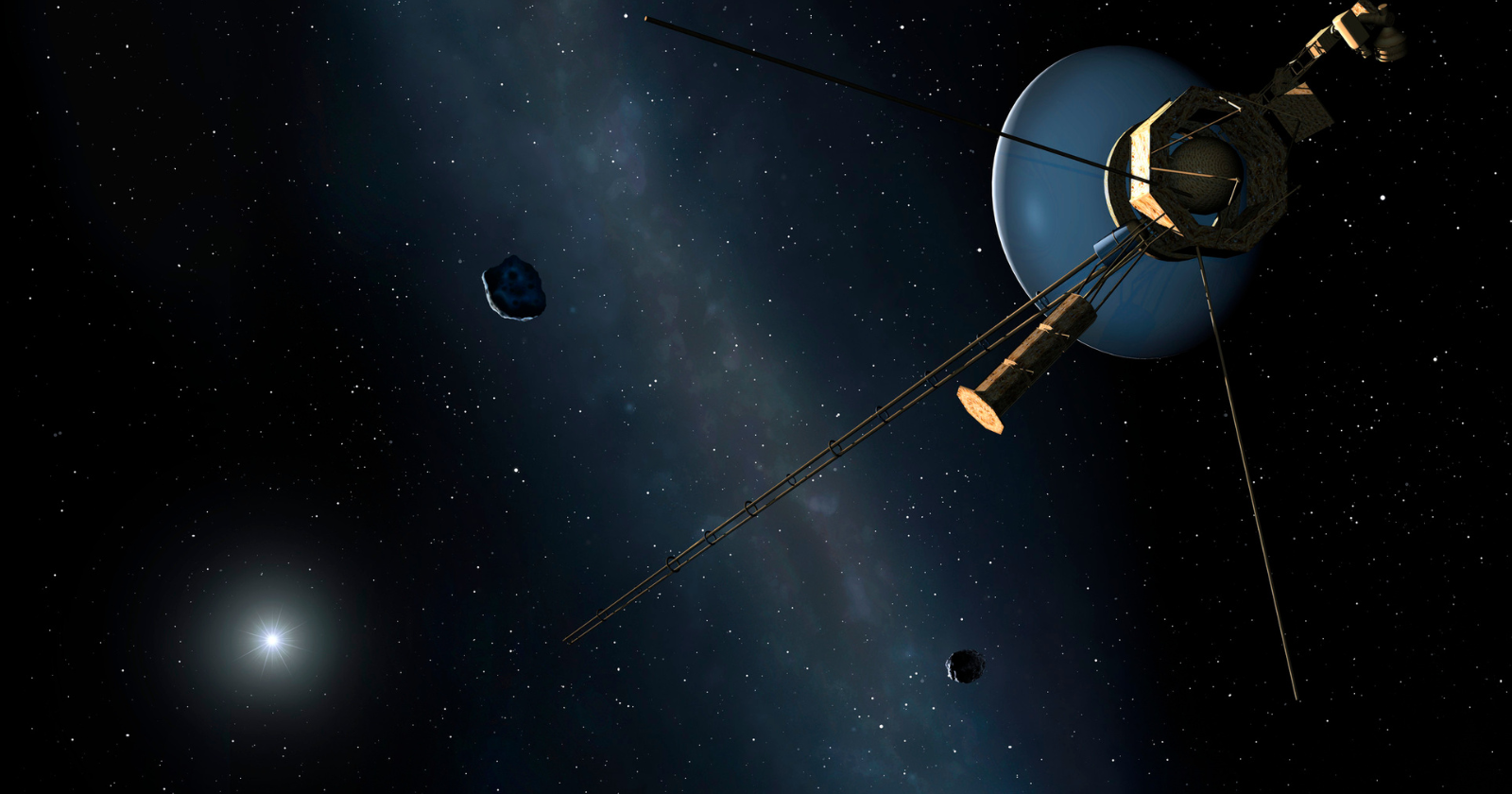
Voyager 1 is the most famous planet-hopper we have ever built but the thing most people don’t know is that it stopped hopping on purpose. Not because it broke.
In 1980, the people running the mission made a deliberate choice to spend the spacecraft’s planetary future on a single moon, knowing it would close the door on Pluto.
The moon was Titan and the price of a close look was that Voyager 1 would never fly past another world again.
The choice most people don’t know was a choice
The late-1970s Voyagers rode a rare arrangement of the outer planets that comes around roughly every 175 years. It allowed a spacecraft on the right path to swing from one giant planet to the next, using each planet’s gravity to bend its course and increase its speed. Voyager 1 reached Jupiter and Saturn, but an alternative path after Saturn could have taken it to Pluto.
Built into the mission plan was a fork in the road. As planetary scientist S. Alan Stern recounts, one path would have carried Voyager 1 from Saturn toward Pluto in the late 1980s. That option, Stern writes, “was mutually exclusive with Voyager 1 making a close flyby of Saturn’s large and complex, atmosphere-laden moon Titan.”
You could have the moon or the onward journey. Not both.
Some trajectory studies put a possible Pluto arrival in 1986. As it happened, no spacecraft reached Pluto until New Horizons arrived in July 2015, nearly three decades later. The option NASA gave up was not trivial.
Why NASA picked Titan anyway
The case for Titan was straightforward, and I find it hard to argue with even now.
Titan is the only moon in the solar system with a dense atmosphere, and a close pass was too good to skip. NASA’s Voyager FAQ puts the trade plainly: “Voyager 1 could have been aimed on to Pluto, but exploration of Titan and the rings of Saturn was a primary scientific objective.”
There was also the matter of risk. Stern explains that Titan carried less risk than a long cruise to Pluto and had the higher scientific priority at the time. A lower-risk close look at a nearby moon, versus years of cruising toward a distant, barely understood dot. Put like that, the choice almost makes itself.
What makes the decision more interesting is what they did not know they were giving up. Stern notes that Pluto’s atmosphere, small satellites, complex surface composition and the entire Kuiper Belt were then undiscovered. They were weighing a known prize against an unknown one, and they went with the known.
What the flyby cost
The catch was baked into the geometry. Voyager 1’s trajectory was designed to carry it close to Titan and behind Saturn’s rings, and Saturn’s gravity then bent its path northward. According to NASA’s Voyager FAQ, the encounter “caused the trajectory to be diverted upward out of the ecliptic plane such that no further planetary encounters were possible for Voyager 1.”
The ecliptic plane is the broad, flat region in which the planets orbit. Stay near it and planetary encounters can be chained together. Get bent far out of it and the opportunities disappear. Voyager 1 is travelling at about 35 degrees north of the plane, without propulsion capable of undoing that turn. Once it left Saturn, its planet-hopping was over.
At its closest, Voyager 1 passed about 6,490 kilometres from Titan’s centre on November 12, 1980, roughly 18 hours before its closest approach to Saturn.
The counterfactual, and why it still holds up
It is tempting to second-guess the decision: Pluto in the 1980s, versus one moon and a gravity turn that ended Voyager 1’s tour. But I keep landing on the same conclusion the team did.
The Pluto path meant years of cruising toward an object nobody had seen clearly, with plenty that could go wrong. Titan was close and scientifically compelling. NASA also did not have to sacrifice Uranus and Neptune. Voyager 1 had a twin.
Voyager 2 flew a separate path that preserved the option to continue to Uranus in 1986 and Neptune in 1989. Those planets have still only been visited once each, by that spacecraft. Choosing Titan for Voyager 1 therefore did not mean skipping the ice giants. It meant giving each probe a job: one got Titan and Saturn’s rings up close; the other got the far planets.
What the trade actually bought
The flyby that ended Voyager 1’s planetary flybys also helped make it what it is now. The same turn that took every future planet off the table put the spacecraft on a steep climb out of the planetary plane, a climb it is still making more than four decades later as the most distant human-made object.
They did not cripple the probe. They pointed it. A close look at the only moon with a dense atmosphere was bought with a trajectory that would never again line up with a planet. That was the deal in 1980, and they took it knowing exactly what kind of choice it was.