

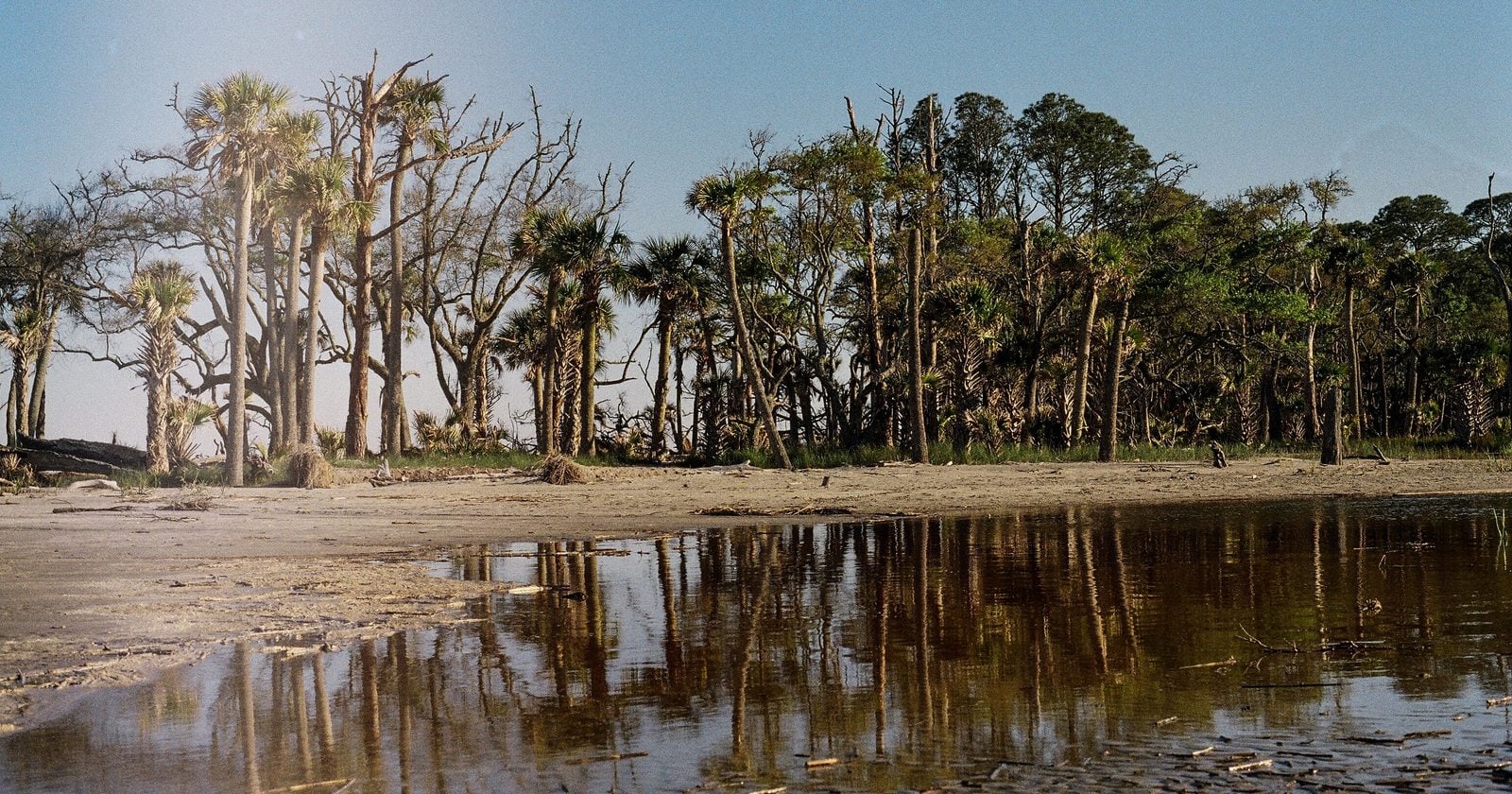
You own an entire barrier island, tens of thousands of acres of forest and salt marsh, and developers keep calling. An appraiser values it at around sixteen million dollars. You could sell to the highest bidder and watch the construction start.
Instead you hand the island to the state for half that price, on one condition: no one may ever build a way to drive there. That is roughly the deal Eleanor “Sandy” Torrey West made in 1978. The most interesting part was not the discount. It was a clause designed to hold long after she was gone.
The price got the headlines. The state paid $8 million, half the roughly $16 million appraisal, after West and her late brother’s children turned down developers. But a low sale price happens once. What she really bargained for was different, and it is still doing its job today.
What Ossabaw is, and why boat-only matters
Ossabaw sits off the Georgia coast south of Savannah, reachable only by water. The deal required that the island’s 26,000 acres of beach, marsh, and forest stay undeveloped. It is the state’s third-largest barrier island. Roughly 9,000 acres are dry land and 16,000 are marsh, which means most of it is exactly the kind of wet, soft ground a road would have to cross and drain.
West first landed there in 1924, at eleven, when her wealthy Detroit-area parents bought the island as a winter retreat. She inherited a half-share in 1960. Her grandson put the island’s pull on her plainly to the Associated Press: “She felt so extraordinarily lucky to have Ossabaw in her life. It completely changed her life from the moment she stepped foot on it,” Beryl Gilothwest said. She spent decades making sure the place could not be reached the way most places get reached.
An island you can only reach by boat is protected in a particular way. Access is the lever that most development turns on. Build a bridge and everything changes, because now the land is commutable, easy to divide into lots, worth more empty than wild. West seems to have understood that keeping the water in the way was worth more than any restriction written on paper.
The life estate that let her stay until 2016
The sale did not push her off. As part of it, West received a life estate deed to 23 acres around the pink Spanish Colonial Revival mansion, with the right to live there for the rest of her life. And she did, as the island’s only permanent resident from 1987 until 2016.
Then the practical limits arrived. In 2016, at 103, poor health and dwindling money forced her to move to assisted living near Savannah. She died on January 17, 2021, her 108th birthday.
The asymmetry in the arrangement is worth noting. The life estate was, by design, temporary, tied to one person’s life and ending when hers did. She got to stay, but only for as long as she could. The part of the deal she cared most about was written to work the other way.
What a no-bridge clause protects that a sale price cannot
The 1978 sale made Ossabaw Georgia’s first State Heritage Preserve, through an Executive Order that Governor George Busbee signed on June 15, 1978. The Order limits the island’s use, in its own words, to “natural, scientific and cultural study, research and education, and environmentally sound preservation, conservation and management of the Island’s ecosystem.”
It goes one step further. The Ossabaw Island Foundation notes that the Order “also prohibits construction of a bridge or a causeway connecting Ossabaw to the mainland or other barrier islands.” To this day, the island can only be reached by boat.
A rule about how land can be used is strong, but phrases like “environmentally sound” are the sort of thing lawyers and future administrations can argue over. A flat ban on a bridge or causeway is much harder to soften. There is no ambiguity in it, no room for a later reading that lets a road slip through. Our read is that plain prohibition is the sturdiest part of the whole agreement, because it removes the one change that would strengthen every other pressure on the island at once.
A deal written to outlive the person who signed it
Set the two halves of West’s arrangement against each other and the design shows. The right to live in the house was tied to her and ended with her. The no-causeway rule has no expiry date. It was built to keep working when she no longer could, and it has: she left in 2016, died in 2021, and the water still sits between Ossabaw and the mainland by law.
Elizabeth DuBose, executive director of the Ossabaw Island Foundation, offered a plain tribute after West’s death: “Ossabaw Island, as we know it, exists because of Mrs. West, and Georgia is a better place because of her life’s work,” she said. It points at something true about how these agreements last. A person can protect a place for a while by living on it. To protect it past a lifetime, you have to write the protection into terms that do not depend on you being there.
West took half the money and kept a house she could only hold until she died. In exchange she got a line in a state Executive Order that says no one drives to Ossabaw. Nearly half a century on, with her gone, that line is the part of the bargain still standing guard.