

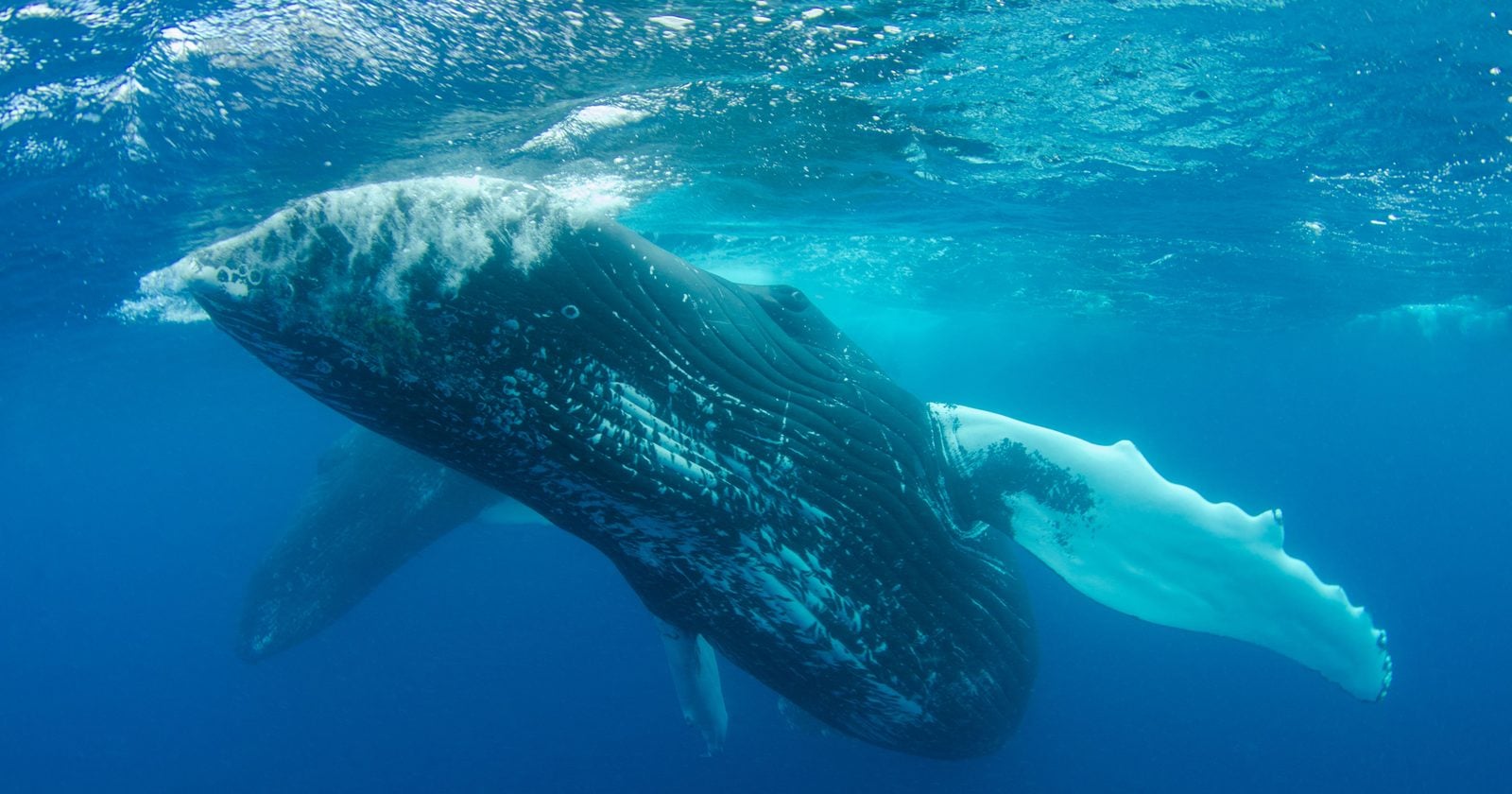
A man’s voice reads a date onto a plastic disc. “The date, 7 March, 1949,” he says, as reported by Smithsonian Magazine. Underneath the announcement there is something else: a low, looping sound with a shape to it, rising and falling. It came up through the water off Bermuda into an experimental rig the researchers had lowered over the side.
They did not know what it was. They kept it anyway.
What they had captured, as noted by Woods Hole Oceanographic Institution, was the song of a humpback whale and it sat in a drawer for the better part of a century before anyone could say so.
A sound nobody could place
The recording came out of ordinary work. In March 1949, researchers aboard WHOI’s research vessel, the R/V Atlantis, were off Bermuda testing sonar for the U.S. Office of Naval Research.
The gear was makeshift by later standards: an early underwater setup and a Gray Audograph, an office dictation machine that etched sound onto thin plastic discs. Into that they fed noises coming up from below that they could not explain.
WHOI’s announcement in February 2026 identified that March 7, 1949 disc as what may be the earliest preserved recording of a whale. The hedging in that sentence matters, and we’ll come back to it. The striking part, for now, is the gap. The people at the rail heard the sound as they made it. The people who understood it were born, in some cases, decades later.
Why it sat unheard for seventy-seven years
The disc survived partly by luck of material. Magnetic tape from that era tends to break down; plastic holds up better. As Ashley Jester, WHOI’s director of research data and library services, put it, “these audograph discs survived because of their material and careful preservation.”
The 1949 disc is one of more than 200 audograph discs in WHOI’s archives, only a handful of which have been listened to so far. Digitizing the collection was funded by a $10,000 award from the National Recording Preservation Foundation. It took someone deliberately going back through old plastic, disc by disc, for the unexplained sound of 1949 to become the humpback song of 2026.
Made before we knew what whale song was
What makes the timing land is what came after it. The idea that humpbacks sing structured, repeating songs is usually traced to the 1960s. Navy engineer Frank Watlington recorded humpbacks off Bermuda in 1964 and shared his tapes with Roger and Katharine Payne. That work led to the album “Songs of the Humpback Whale,” which put the idea into the public mind that these animals compose.
The 1949 disc predates all of that by fifteen years. The researchers who saved it had no framework to hear it with. To them it was noise worth keeping, not song worth studying, because the idea of humpback song as a thing to study did not yet exist.
That gap is also what gives the old recording its value now. Laela Sayigh, a marine bioacoustician at WHOI, framed the scarcity plainly: “Data from this time period simply don’t exist in most cases,” she said. Her point, as we read it, is not that no mid-century ocean audio survives anywhere, but that this window is close to blank, which is what makes a single clean disc worth so much.
Sayigh suggested the recording “can provide insight into how humpback whale sounds have changed over time, as well as serving as a baseline for measuring how human activity shapes the ocean soundscape.”
Peter Tyack, an emeritus research scholar at WHOI, made the same point about what the disc lets you hear beyond the whale. The recordings, Tyack said, “not only allow us to follow whale sounds, but they also tell us what the ocean soundscape was like in the late 1940s,” adding, “That’s very difficult to reconstruct otherwise.”
Why “may be the oldest” is the careful phrasing
WHOI has been careful, and we think that care is worth keeping. “May be the earliest preserved recording of a whale” is not the same claim as “is the oldest whale recording.” Older discs could be sitting unlistened-to in the same collection, or in someone else’s. The institution is describing what it has found and verified, not making a claim about everything that ever existed. When a headline flattens that into a superlative, it drops the part of the sentence that’s actually accurate.
That caution reflects how thin the evidence is. For context, WHOI points to other archives, including the Ocean Alliance collection of more than 2,400 recordings of whale and ocean sound from the 1950s through the 1990s. Even so, the 1940s remain close to silent in the record. A hedge isn’t weakness in a claim like this. It’s the accurate shape of what’s known.
The case for keeping what you can’t explain
Nobody in 1949 filed that disc thinking they’d captured the oldest whale song on record. They filed it because it was data, and you keep data. The understanding arrived seventy-seven years late, delivered to people the original researchers never met.
Jester put it plainly. “These recordings remind us why we collect data, even when we don’t immediately know what it means,” she said, and framed it as a duty across time: “preserving data when it is created is an investment in the future of science.”