

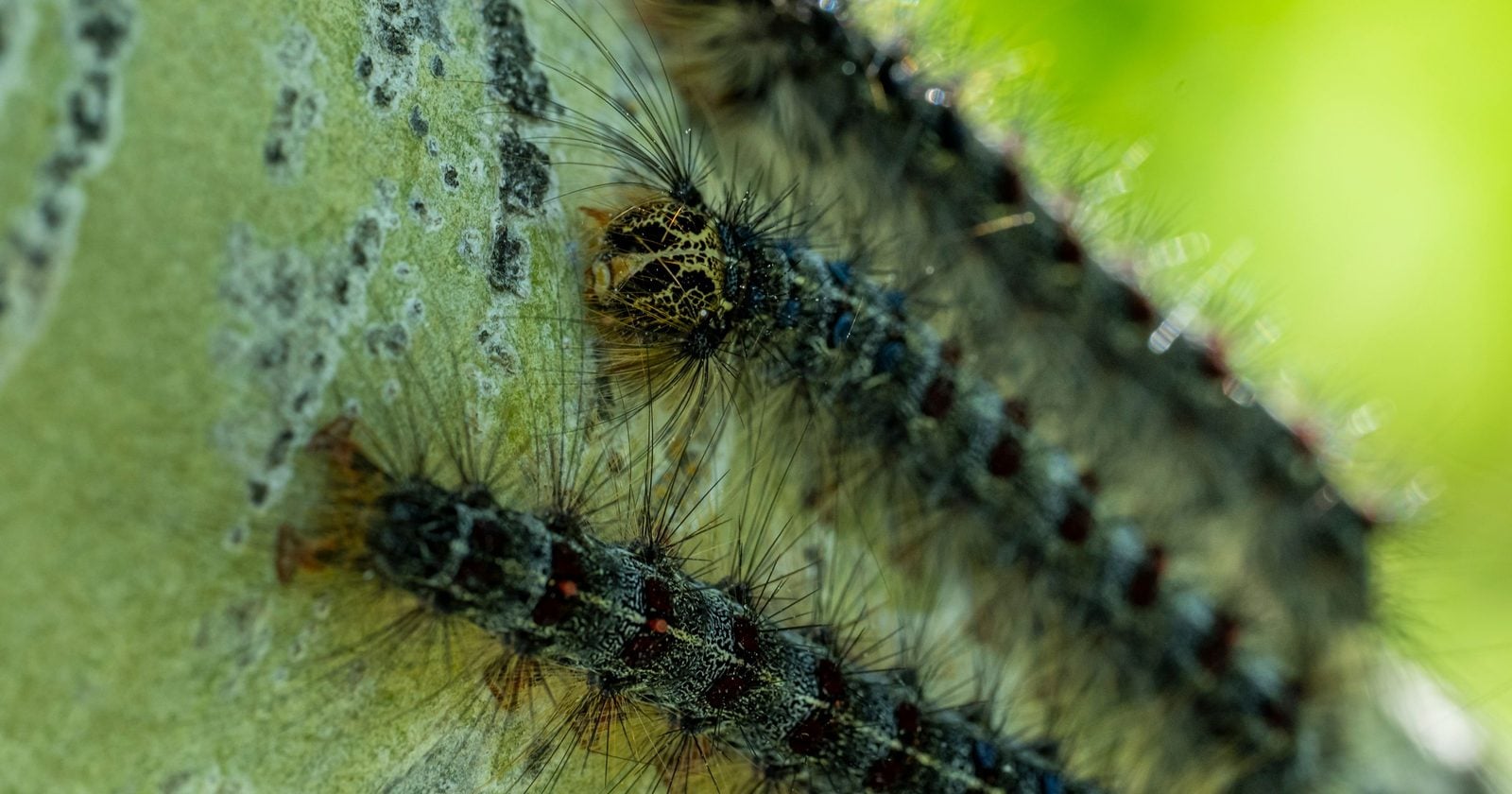
One amateur naturalist, working in a modest backyard outside Boston, kept a colony of caterpillars behind his house. A windstorm scattered some of them into the woods and a little over a century later, the descendants of those loose larvae had become one of the most expensive forest pests on the continent, able to chew bare more than a million acres of trees in a single bad year.
How does one careless moment on a residential lot in 1869 turn into that?
The short answer: it took twenty years to look like anything at all. That delay is what makes the story worth telling. So let us walk it forward from the yard.
Who Trouvelot was, and what he was trying to do
The man in the yard was Étienne Léopold Trouvelot, a French amateur naturalist and artist who had settled in Medford, Massachusetts. He was not trying to unleash anything. He was experimenting with silk production. Trouvelot wanted to breed a silk-spinning caterpillar more resistant to disease than the domesticated silkworm.
For that he turned to the European gypsy moth, a species the Entomological Society of America formally renamed the “spongy moth” in 2022.
As the education service EEK tells it, some of Trouvelot’s moths escaped in 1868–1869 and subsequently multiplied in a vacant lot next to his home in Medford, Massachusetts. Not a secret rogue experiment. A hobbyist’s version of a reasonable farming bet, gone wrong in the most ordinary way imaginable.
The escape
It is often said that eggs got loose. The record does not quite support that. Trouvelot had imported clumps of eggs, but what escaped were the caterpillars he was actively raising behind his house.
According to historical accounts, a windstorm damaged his nets and scattered the caterpillars. Smithsonian magazine’s account of the episode traces the whole invasion back to insects escaping from nets and cages in that backyard.
Two things about the insect made the accident far worse than it should have been. It had few natural predators in North America. And the female of this species cannot fly, which sounds as though it should have limited the spread. But the young caterpillars compensate by floating on threads of silk carried by the wind, giving the moth almost nothing eating it and a quiet, wind-driven way of moving across the landscape.
The twenty-year fuse
For roughly two decades, not much visibly happened. That is the part that trips up our intuition. We expect consequences to arrive on the same timescale as the mistake, and invasions rarely oblige. The population built generation after generation until it crossed a threshold.
The first recorded major outbreak came around 1889, about twenty years after the escape. Caterpillars stripped the leaves off fruit and shade trees across a 360-square-mile area around Medford.
Massachusetts launched a campaign to wipe the moth out, and the methods of the day were blunt. Ken Gooch, forest health program director at the Massachusetts Department of Conservation and Recreation, described that early era to the Daily Hampshire Gazette: “They did an incredible amount of really, really toxic pesticide spraying.”
The effort failed. The moth kept moving, spreading through the Northeast, the Mid-Atlantic and the Midwest over the following century. Reporting from Grist puts that historical march at roughly 13 miles per year for over a century, and the total damage between 1970 and 2013 at 81 million acres stripped of leaves.
Why it still matters
The caterpillars are not fussy eaters. The USDA notes they feed on more than 300 species of trees and shrubs, which is a large part of why the damage scales the way it does.
Losing leaves for one summer does not usually kill a mature tree. Repeated years do real harm. Brian Eshenaur, a plant pathologist with Cornell University’s Integrated Pest Management Program, explained the strain to Grist: “When trees are defoliated like this right at this time of year, they are using reserves that are in the trunk and in the roots to put out a second flush of growth.” A stripped tree burns through its stored energy to grow a new set of leaves. Drain those reserves year after year and the tree weakens.
The same reporting notes that after two straight years of feeding, up to 80 percent of the trees in a hardwood forest can die. That is a cited figure, not a guarantee, and how far it plays out depends on drought, tree species and how healthy the forest was to begin with.
The financial toll is large too. Missouri’s Department of Conservation puts the yearly cost of damage nationwide at an estimated $868 million.
Wiping the moth out is off the table now. The goal is containment, run through the federal Slow the Spread program. It pairs a network of traps with two other tools: chemical scents that disrupt mating, and treatment sprayed from aircraft. A natural ally also arrived on its own in 1989, when a fungus, Entomophaga maimaiga, was found attacking the caterpillars and has since helped knock back some outbreaks.
What stays with us is the shape of the timeline. Slow-fuse invasions teach the hardest lesson precisely because there is no alarm at the moment it matters. A colony scattered by a storm in 1869 sat almost invisibly in the woods for two decades before it announced itself across 360 square miles. More than 150 years later, a multi-state partnership is still spending money and effort to hold the line against it. The gap between the small careless moment and the long tail of its consequences is enormous, and nothing about the yard in 1869 would have let anyone see it coming.