

Look at Jezero crater from orbit and one feature stands out: a pale band along the inside of its western rim. For years nobody could agree on what it actually was.
Depending on who was right, the “Margin unit” was either sediment left beside an ancient lake or igneous rock that water later altered. Two readings, two different stories about Mars, and the same pale stripe underneath both.
A study published in January 2026 by a team led from Imperial College London found an answer that gives both camps something.
The pale band nobody could agree on
Jezero is the crater NASA’s Perseverance rover has been exploring since 2021, chosen because it once held a lake and river delta. Around 3.5 billion years ago, the crater held a large lake. The Margin unit lies along the inner margin of the western crater rim and is rich in olivine and carbonate, minerals that carry clues about how the rock formed and what happened to it later.
Those minerals are why the origin was hard to pin down. The unit could preserve sedimentary deposits associated with the lake, or it could have begun as olivine-rich igneous rock that was later altered by water.
What the January 2026 study did
Perseverance spent about 350 sols (martian days) investigating the Margin unit during its fourth science campaign. The study, led by PhD researcher Alex Jones and published in the Journal of Geophysical Research: Planets, analyzed Mastcam-Z mosaics and 3D outcrop models, supported by SuperCam observations and detailed close-up images.
The move that broke the deadlock was refusing to treat the whole unit as one thing. The team split it into eastern and western sub-units.
The Western Margin Unit is mostly structureless to parallel-layered rock draped against the crater rim; its origin remains uncertain, but the study says it may be most consistent with a variably carbonated olivine cumulate. Water also extensively altered these rocks after they formed. Study author Sanjeev Gupta said the transformation “indicates that water circulated below the surface of the Margin unit, altering the rock over vast timescales.”
The Eastern Margin Unit is different: it contains well-stratified, medium-grained sandstone with angular to rounded grains, cross-stratification and erosion surfaces. That mixed picture fits a companion analysis by Ravanis and colleagues, which found that the Margin unit may be consistent with igneous deposits that experienced varying degrees of aqueous alteration, with possible sedimentary reworking in the eastern Margin. As Jones put it, “these findings show that the history of water in Jezero crater was far more complex in both time and space than we imagined.”
The beach in the east
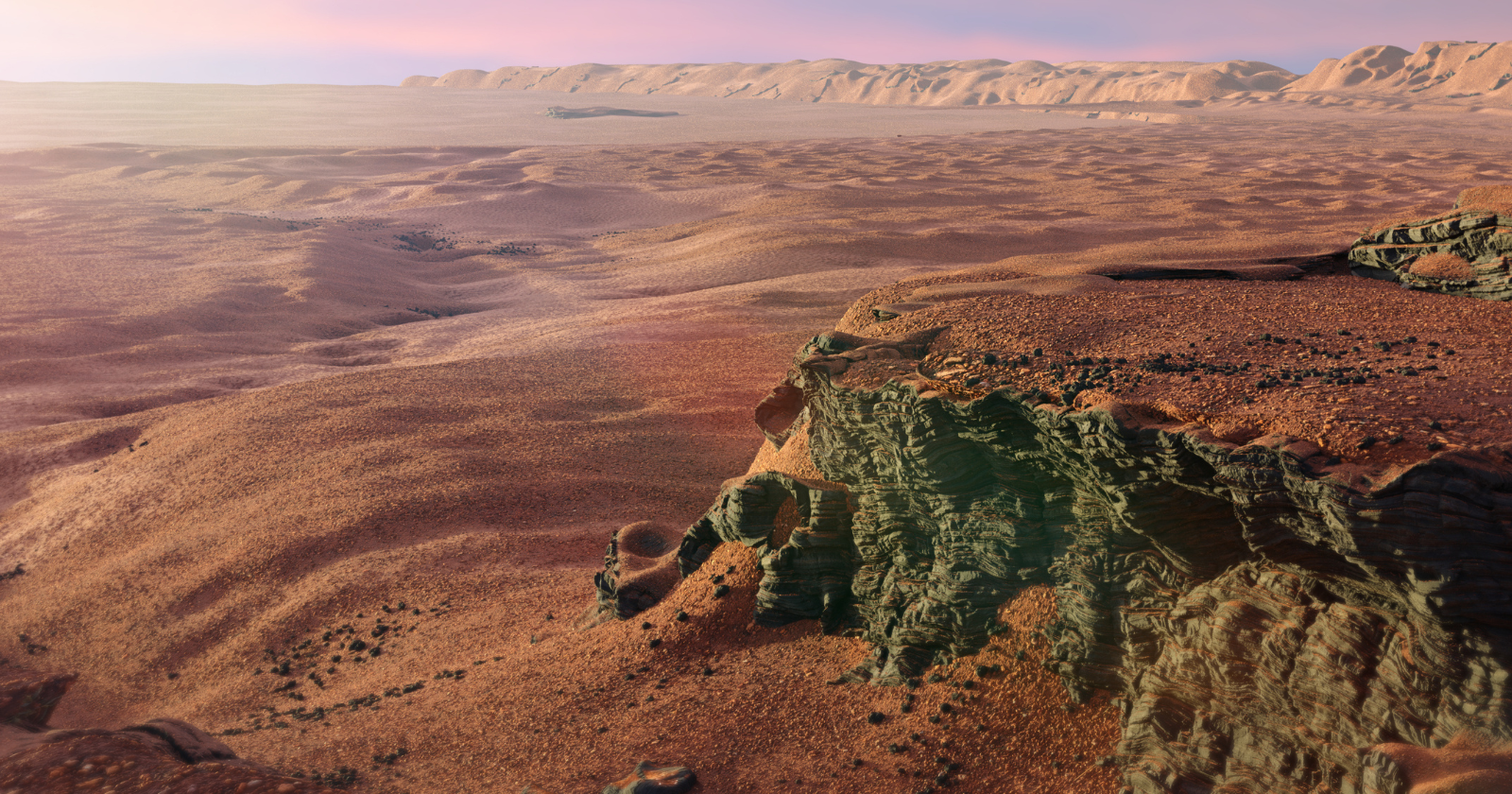
The eastern stretch is where the study gets its headline. In those lower outcrops the team found layered sandstone containing rounded, sand-sized grains of olivine and carbonate. The favored depositional model is a lakeshore zone where material from the adjacent western unit was locally reworked by waves along an ancient shoreline. Jones’s summary was blunt: “We are looking at what was once a beach.”
To be clear, this is an interpretation of the rock record, not something the rover watched happen. The reconstructed story is that “the waves of the Jezero lake eroded and reworked the local, igneous bedrock, rounding the grains and depositing them as a sandy layer along the shore,” in Jones’s account. If that interpretation holds, it ties the two ideas together neatly: igneous material was later reworked into shoreline sediment.
There’s a timing wrinkle too. Jones notes that “this ancient beach sits underneath the Jezero river delta,” which suggests lake conditions existed before deposition of the overlying delta. The team says that extends the window of potentially habitable surface-water conditions at Jezero. That means a candidate environment for habitability, not evidence that anything actually lived there.
So who was right?
Both, in different places — with an important caveat that the western unit’s original emplacement is still uncertain.
From orbit, the Margin unit could be treated as one continuous-looking geological problem. On the ground, grain by grain, it turned out to contain at least two distinct sub-units recording different histories of water and rock.
None of this is fully settled. The beach interpretation rests on sedimentary structures and textures seen by Perseverance, while direct laboratory analysis could test the rocks in much greater detail. Perseverance collected three core samples from the Margin unit. NASA describes those samples as being collected for possible return to Earth by a future mission.
What makes the finding satisfying is that “both sides were partly right” is not a polite dodge. The study argues for a genuinely mixed history: rocks along one part of the margin may preserve an altered igneous origin, while sediments nearby were reworked along an ancient lakeshore.
That’s a messier picture than either single-origin explanation.