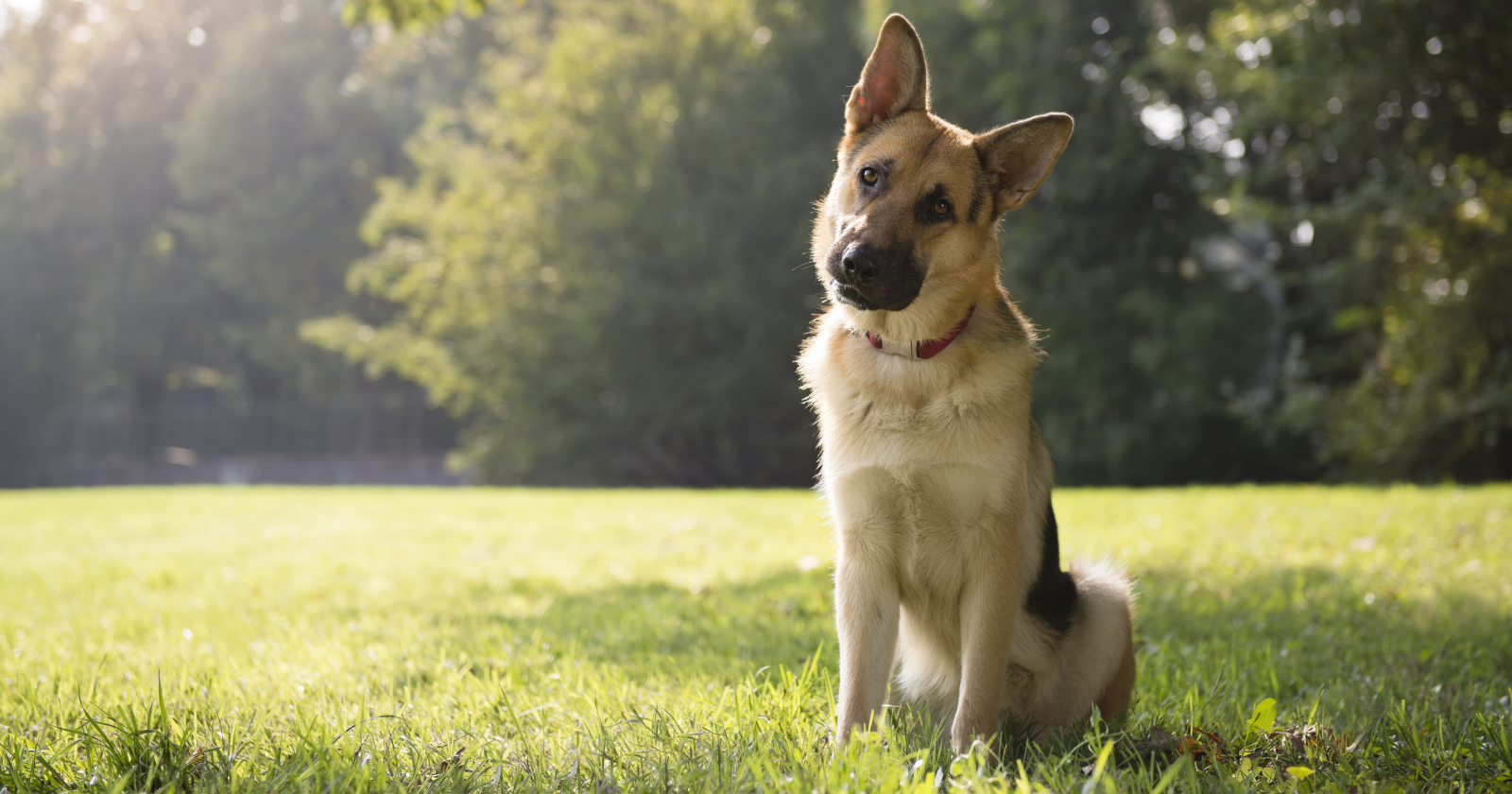
When their owners asked for a specific toy by name, a small group of unusually talented dogs tilted their heads about 43% of the time. A larger group of typical dogs did it just 2% of the time.
That is headline finding from a 2021 study by researchers at Eötvös Loránd University in Budapest.
A quick note before going further: we are not animal behaviourists or cognitive scientists. This is a piece of reading and reflection on one exploratory study, not advice about your own dog. The research here is observational, built on a very small group of animals, and a pattern spotted across a handful of dogs is not a rule about all of them.
The head tilt is so familiar it hides in plain sight. Many owners have seen it, almost everyone finds it endearing, and until recently almost no one had actually measured it. The paper itself says no earlier study had described the behaviour in the same way. It did not even start as a head-tilt study. The data were collected while the dogs took part in research on learning object names, and the team kept noticing the tilt during tests. As lead author Andrea Sommese put it, they realised it often happened when the dogs were listening to their owners.
What strikes me is how accidental the whole thing was. The pattern seemed too consistent to be coincidence, which is the kind of hunch that turns a side observation into an actual experiment.
The setup was simple. The team watched 40 dogs during tests in which owners asked for a toy by name. Seven were gifted word learners, and all were border collies. The other 33 were typical dogs that, after three months of training, could not learn the names of two toys above chance. The gifted dogs, by contrast, learned more than 10 toy names during that period. One female border collie named Whisky selected the correct toy in 54 of 59 trials.
The split in tilting behaviour was hard to ignore: 43% of the time for the gifted dogs, 2% for the typical ones. There was another quirk too. Each gifted dog kept a preferred tilt direction over months, and did so regardless of where the owner was standing. With only seven dogs, that consistency is best read as a curious detail rather than a fixed law but it’s interesting nonetheless.
So what is the tilt doing? The team’s careful answer is that it seems to mark a mind working on something meaningful.
In the paper, the researchers frame it as a link rather than a certainty, connecting the tilt to the effort of processing something familiar and important. In plainer terms: when a gifted dog hears a toy name it knows, it may be pulling up a mental picture of that toy, and the tilt may be what that effort looks like from the outside.
Why do the typical dogs rarely do it in this test? Sommese offered a hypothesis worth keeping tentative. “Probably it doesn’t happen in the typical dogs because typical dogs don’t associate a name to a particular toy, so they cannot recall a memory,” he suggested. No stored name, nothing to retrieve, no tilt. It is a clean story, but still a proposed explanation, not a proven one.
A few things are worth keeping in mind. The tilt did not help the gifted dogs get answers right. They were just as likely to fetch the correct toy whether or not they tilted their heads. The gesture looks more like a window onto thinking than a tool that improves it.
The study also tested one narrow situation: fetch the named toy. That matters for what you can conclude about your own dog. As Sommese cautioned, “We are not claiming that only gifted dogs tilt their heads while typical dogs never do it.” A dog that does not know toy names may still tilt for other reasons. This research just did not measure those.
Outside researchers are treating it as a first thread to pull. Monique Udell of Oregon State University, who was not part of the study, said future research could explore what other sounds or contexts trigger canine head-tilting. Whether the gesture tracks word-learning skill, attention or memory is exactly the sort of question the study leaves open.
If you are concerned about your dog’s behaviour or health, a vet is the right person to ask.