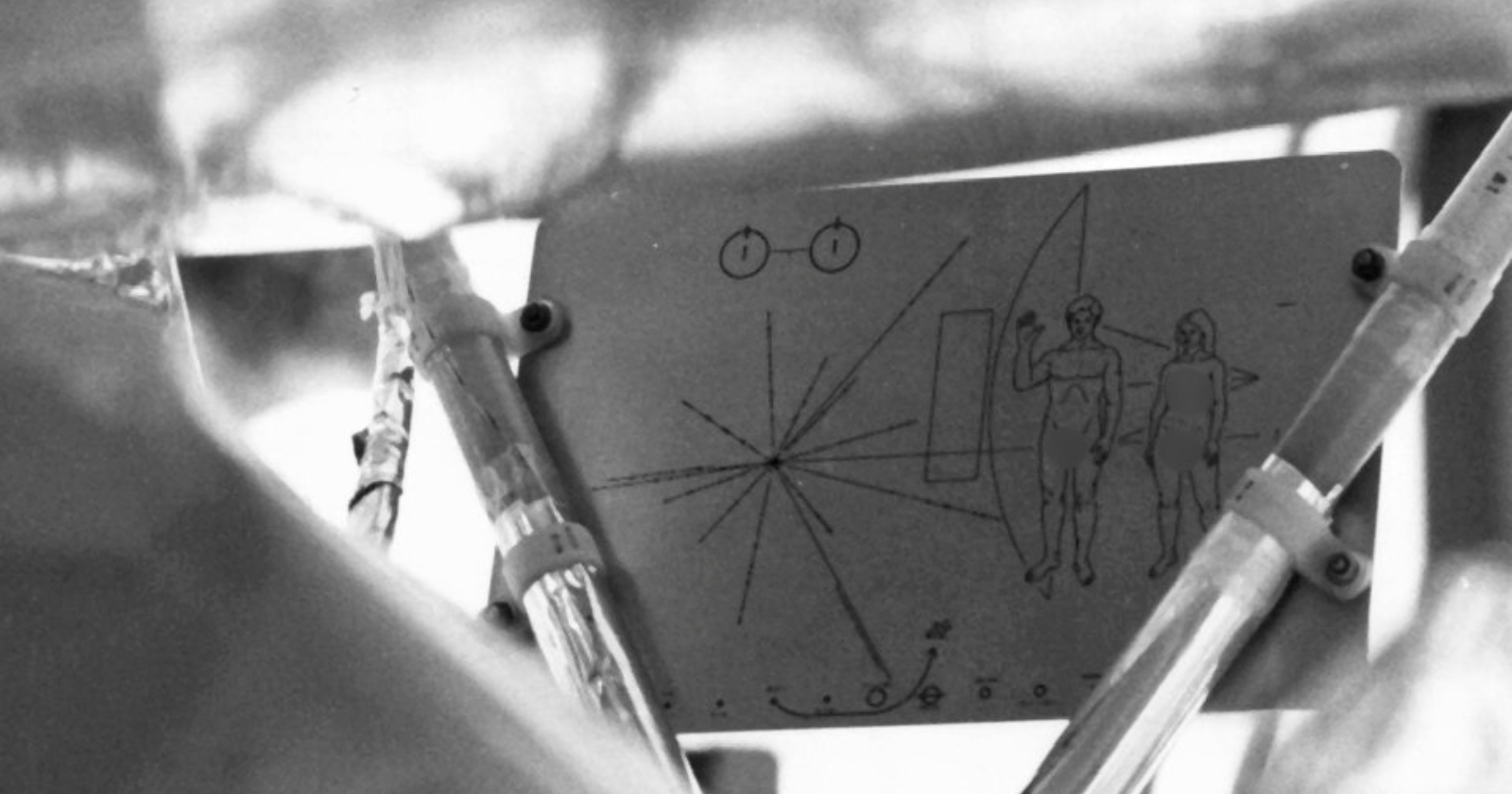
In late 1971, after NASA approved the idea of sending a message aboard Pioneer 10, Carl Sagan was given just three weeks to prepare it. Working with astronomer Frank Drake and artist Linda Salzman Sagan, he helped create a six-by-nine-inch gold-anodized aluminum plaque that was bolted to the spacecraft’s antenna support struts. The Pioneer plaque showed a hydrogen atom, a pulsar map locating the Sun in the galaxy, a diagram of the Solar System, and, on the right, a line drawing of two nude humans — a man and a woman — with the man’s hand raised in greeting. Pioneer 10 launched in March 1972 and became the first spacecraft placed on an escape trajectory out of the Solar System. Pioneer 11 followed the next year carrying an identical plaque.
However, when images of the plaque ran in American newspapers, the reaction was not the one NASA had hoped for. One paper printed the picture with the man’s genitals removed. Another removed both the man’s genitals and the woman’s nipples. Linda Sagan had drawn the figures nude on the grounds that any choice of clothing would represent only some cultures, and that an anatomically accurate human was more useful to an alien biologist than a culturally dressed one. The reaction told NASA something else.
Five years later, NASA was preparing to launch Voyager 1 and Voyager 2, and Sagan was again chairing the committee assembling humanity’s interstellar message. This time it was not a small engraved plate. It was a 12-inch gold-plated copper phonograph record carrying greetings in 55 languages, sounds from Earth, music ranging from Bach to Chuck Berry, a recording derived from Ann Druyan’s brain activity, and more than 100 still images encoded as analog video. The team wanted to do what Pioneer’s line drawing could not. They wanted to include an actual photograph of two unclothed humans, a man and a pregnant woman holding hands, so an alien finder would see what humans actually look like.
NASA vetoed it. Jon Lomberg, an artist on the team later described the rejected image in the team’s 1978 book Murmurs of Earth as “a man and a pregnant woman quite unerotically holding hands.”
What the team got instead was a silhouette. The same composition — man and pregnant woman, holding hands — but rendered as a pure black outline against a white background, with no skin, no faces, no genitals, and nothing for a newspaper to airbrush. The fact that humans gestate their young inside the body of the female, and what that gestation looks like — was preserved by drawing the fetus visibly inside the woman’s outline.
One nude couple did make it onto the record. A separate image, a Diagram of Vertebrate Evolution drawn by Lomberg, shows an anatomically correct man and woman alongside earlier vertebrates as the endpoint of the sequence. NASA approved it, presumably because the context was scientific rather than photographic. In that version, the woman raises her hand in greeting; the man stands at her side.
Voyager 1 is now approaching 26 billion kilometers from Earth, the most distant human-built object in existence. Voyager 2 is some distance behind it. The records may remain playable for hundreds of millions of years, perhaps up to a billion, if they avoid major damage. Whoever, if anyone, eventually finds them will see the silhouette and the fetus and the vertebrate diagram and, presumably, work out the basics. They will not see what Sagan’s committee originally wanted them to see.