

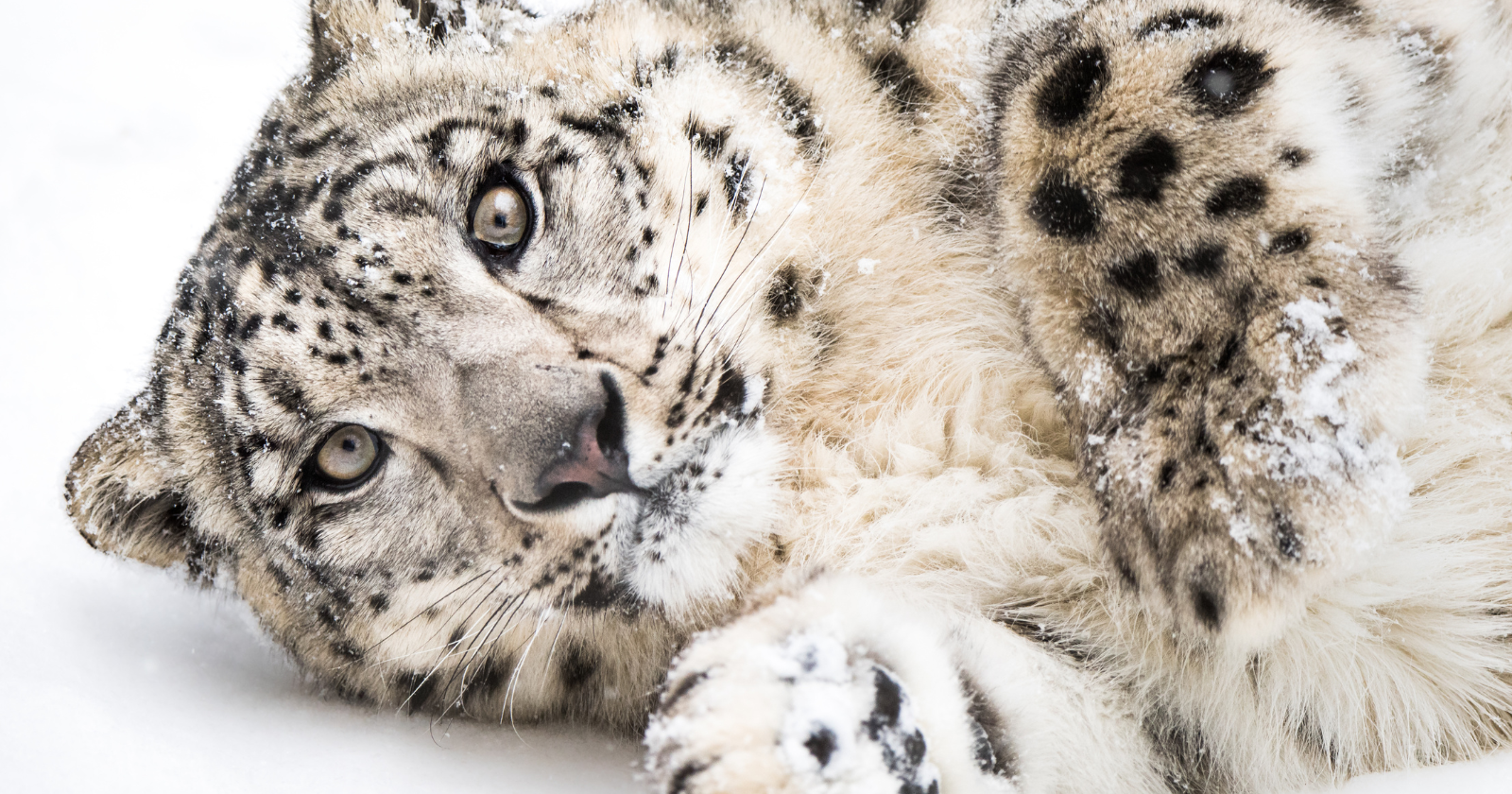
When researchers put GPS collars on four snow leopards in eastern Nepal and let the data run, the areas each cat roamed came back 6 to 97 times larger than earlier estimates for the country. Many times bigger, not a little bigger. The maps conservation planners had been using weren’t slightly off. They were describing a different animal.
The study behind these numbers is Nepal’s first GPS tracking study of the species, led by Samundra Subba of WWF Nepal and published in early 2025. Four collared cats is a small sample by any standard, and we’ll come back to what that does and doesn’t let us say.
We are not wildlife biologists or conservation scientists. What follows is our reading of one tracking study and the people who worked on it, not expert analysis. The findings come from tracking a handful of animals, and a pattern in four cats is a clue about the species, not a settled law of how every snow leopard behaves.
The number that broke the map
Earlier range estimates for snow leopards in Nepal leaned on older radio-tracking methods. Those only pick up an animal’s signal when a researcher is nearby with a receiver. You get scattered readings, long gaps, and a home range drawn from the dots you happened to catch. That method tends to undercount, because the animal keeps moving through the spaces where nobody was listening.
Swap that for a collar recording a satellite position every four hours, day and night, for months at a stretch, and the shape of the animal’s life fills in. The revised ranges weren’t a correction of a few percent. Going from the old estimate to something up to 97 times larger means the earlier figures had captured only a sliver of where these cats actually went. The map didn’t need adjusting. It needed redrawing.
What a four-hour ping actually captures
The mechanics are almost ordinary, which is part of what makes the result land. Between 2013 and 2017, four snow leopards in the Kangchenjunga Conservation Area wore collars set to record a location every four hours. Over the study those collars produced 4,707 location points.
The coverage was uneven. Individual tracking periods ran anywhere from 20 to 659 days, so one cat left a rich, nearly two-year trail while another dropped off after a few weeks. Even so, the sheer number of readings is the point. A ping every four hours doesn’t wait for a researcher to be in range. It logs the cat crossing a ridge at midnight and doubling back at dawn, for as long as the collar holds a charge. The result isn’t a series of sightings stitched together. It’s closer to a continuous track. One collar even recorded a cat at 5,848 meters, the highest elevation ever documented for the species.
Cats that don’t read borders
The Kangchenjunga area sits against India on one side and China on the other, and three of the four collared cats treated those borders as if they weren’t there. On average they spent 10% to 34% of their time across the line in India or China, with 28% to 50% of their home ranges spilling into India alone. For one female, nearly half her territory sat on the Indian side.
Subba put it plainly. “National borders are human constructs,” he told Mongabay, “snow leopards don’t recognize them.”
That condition matters more than it might seem. A 2024 study of snow leopard movement tracked a young female traveling nearly ten kilometers along a border fence on the Mongolia-China frontier, unable to cross, before turning back toward where she was born. Same species, same instinct to roam, different outcome because a human structure sat in the path. The Kangchenjunga cats had the luck of an open border.
Why one country’s protected area isn’t enough
Follow the movement data to its conclusion and the case for cross-border conservation makes itself. If a cat spends a third of its life in a neighboring country, then protecting only the Nepali part of its range protects only part of the animal. Poaching, a collapse in the animals it hunts, or a lost travel corridor on the Indian or Chinese side reaches back across the line whether or not the management plan admits it.
Subba said the team “now have solid proof” of movement patterns long assumed but rarely tracked. We’d soften that word slightly. Four collared cats, three of them crossing borders, is strong evidence for a long-held assumption rather than final proof. But it is the first hard tracking evidence Nepal has, and the direction it points is not ambiguous.
Charudutt Mishra of the Snow Leopard Trust, who was not part of the study, read the border-crossing as good news. “What I find heartening in the results,” he said, is that the collared cats “did not encounter any significant man-made barriers to their cross-border movement.” He added his own caveat: this openness is not the norm, since borders are so often fenced. Mishra also put the timescale in perspective. “Snow leopards have lived in those mountains long before any country existed,” he noted, “and long before humans colonized these high mountains.” The lines on the map are recent. The cats’ routes are not.
There’s a genetic argument underneath the political one too. Li Xeyang of the Shan Shui Conservation Center, also not involved in the work, argued that these long journeys “are essential for maintaining healthy gene flow and population resilience.” When cats from different areas meet and breed, the population keeps a healthy mix of genes, and that mix is what helps a species survive shocks. A population cut off from its neighbors slowly loses that variety. Li’s hope is that the countries these cats live in “can turn political borders into ecological bridges” rather than walls. That’s a hope, not a result, but the movement data at least shows the bridges already exist where nobody has blocked them.
The limits of four collars
A striking number can carry more weight than it should, so it’s worth being honest about the sample. Four cats is not a population. One of them wore a working collar for only twenty days. The revised home ranges, dramatic as they are, come from a handful of animals in one conservation area, and Nepal’s estimated 397 snow leopards range across terrain this study never touched. What these collars show is what these four animals did. Extending that to every snow leopard in the Himalaya is a reasonable inference, not a proven fact.
What the small sample does deliver is a proof of concept and a hard floor. Before this, Nepal’s range maps were built on a method we now know badly undercounts how far these cats travel. That alone reframes the problem, even if the exact multiplier shifts with the next batch of collars. And on the specific question of border-crossing, the data doesn’t need a large sample to make its point. If even a few cats routinely live across three countries, then a plan drawn to one country’s edge was always going to leave gaps.