

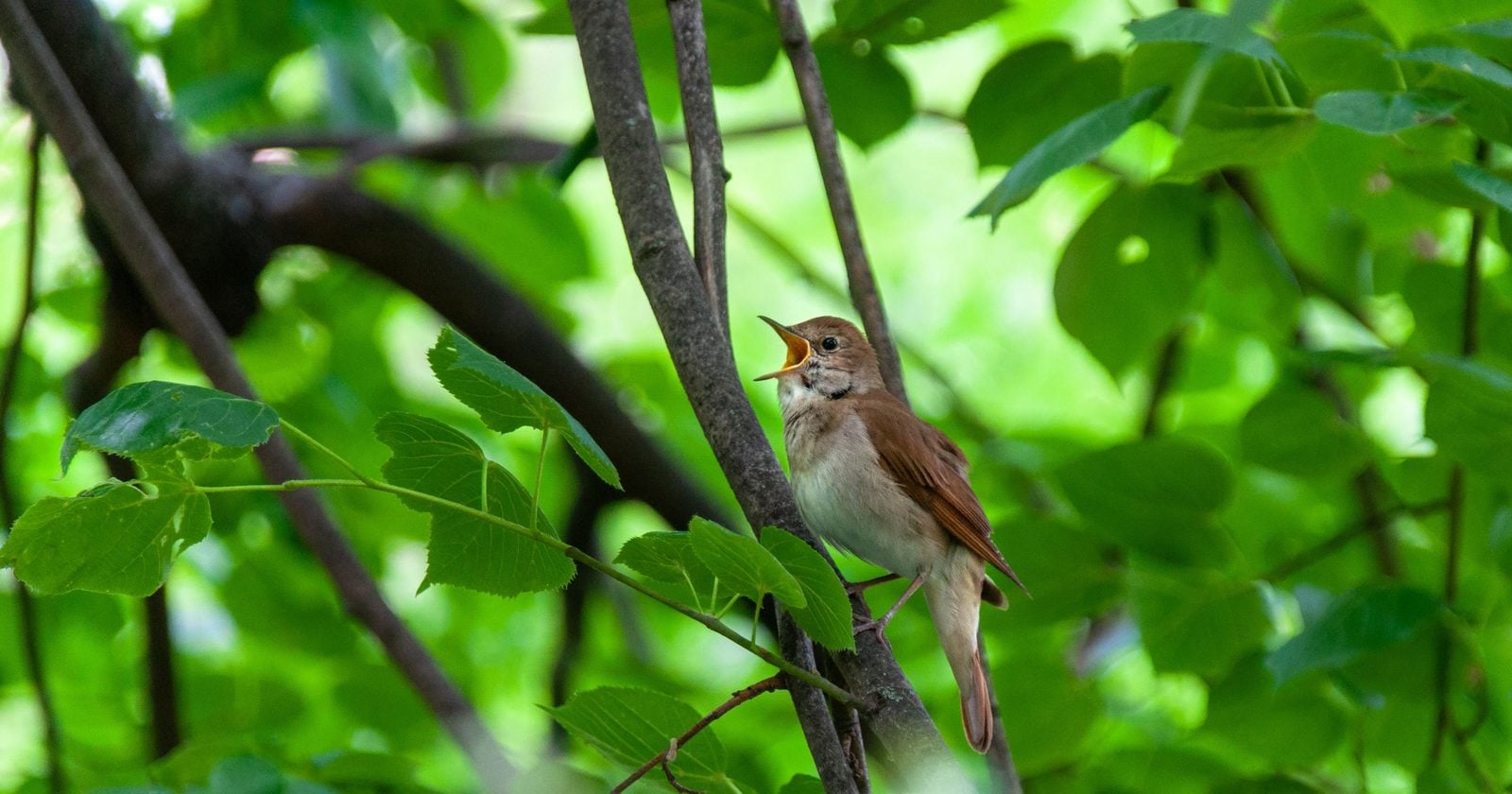
Walk through a European city in spring and you may hear it before you place it: a bird throwing out a stream of song that somehow carries over the buses and the sirens. It’s easy to assume the bird is just loud by nature, and the traffic happens to sit underneath it. But there’s a more interesting possibility.
What if the bird is actually adjusting, pushing its voice up to stay heard as the din around it climbs?
That’s the question a study out of Berlin set out to answer, and the answer turned out to be yes. Male nightingales in the city’s noisiest spots sang louder, and the same bird sang more softly when the traffic died down.
What the Berlin study measured
In the springs of 2001 and 2002, biologist Henrik Brumm recorded wild male nightingales singing across Berlin. He measured two things at once: how loud each bird sang, and how much traffic noise filled its territory. The result, published in his 2004 paper in the Journal of Animal Ecology, was clear. As Brumm reported, males in noisier locations sang louder than birds in quieter spots.
The gap between the loudest and softest birds reached about 14 decibels at the extremes. This was a small study, fifteen males in total across two years, so it’s a strong clue rather than a sweeping law about all songbirds. But the pattern held. The loudness tracked the noise.
The weekday-versus-weekend tell
A pattern like that leaves a nagging question. Maybe louder birds just happen to end up in louder places, for reasons that have nothing to do with adjusting. What makes the Berlin data more convincing is a smaller detail in the method.
The main recordings ran on working days, in the early morning between about 5am and 10am, right through rush hour. Brumm also recorded three of the birds on weekend mornings, when traffic and general noise dropped off. The bird hadn’t moved and its territory hadn’t changed. But on the quieter weekend mornings, when traffic and background noise fell, those same birds sang more softly. That within-individual shift strengthened the case that the birds were adjusting their volume in response to the noise around them.
Why this counts as evidence, not just a nice story
There’s a name for this in humans: the Lombard effect, the reflex of raising your voice as the room gets louder. It’s long documented in people. You do it in a crowded bar without deciding to.
Brumm’s nightingales showed the same reflex in a wild animal going about its ordinary life. As his 2004 paper put it, this was the first evidence of an animal adjusting its song volume to noise in its natural environment.
The study shows nightingales turn up their volume when the noise around them rises. It doesn’t show they always win the contest, or that turning up is enough. Those are separate questions, and arguably the more interesting ones.
What singing louder costs the bird
If a bird has to shout all day to be heard, you’d expect that to cost something. Earlier work pointed that way. Oberweger and Goller measured oxygen consumption while zebra finches, canaries and European starlings sang, and in starlings a 16-decibel increase in song intensity was accompanied by oxygen consumption rising 1.16-fold. That came from a single 2001 study, but it fit the hunch that louder singing carried an energetic cost.
A later study complicated things. Zollinger, Goller and Brumm tested zebra finches and found that raising song amplitude by more than 20 dB did not consistently produce a significant increase in oxygen consumption. The authors were careful about the result: the oxygen-consumption comparison rested on only three birds, louder songs did require significantly greater pressure in the birds’ air sacs, and they warned that other costs of singing loudly might not show up in oxygen use.
So we don’t actually know what it costs a nightingale to sing over Berlin. There is probably some added physiological cost to singing louder, but how large it is remains unclear.
Brumm’s nightingales showed that they can adjust their song amplitude to background noise. But that response cannot increase without limit, and the 2004 study did not establish how close wild nightingales are to their maximum possible amplitude. So the adaptation is real; whether it will remain sufficient as urban noise rises is a separate question.