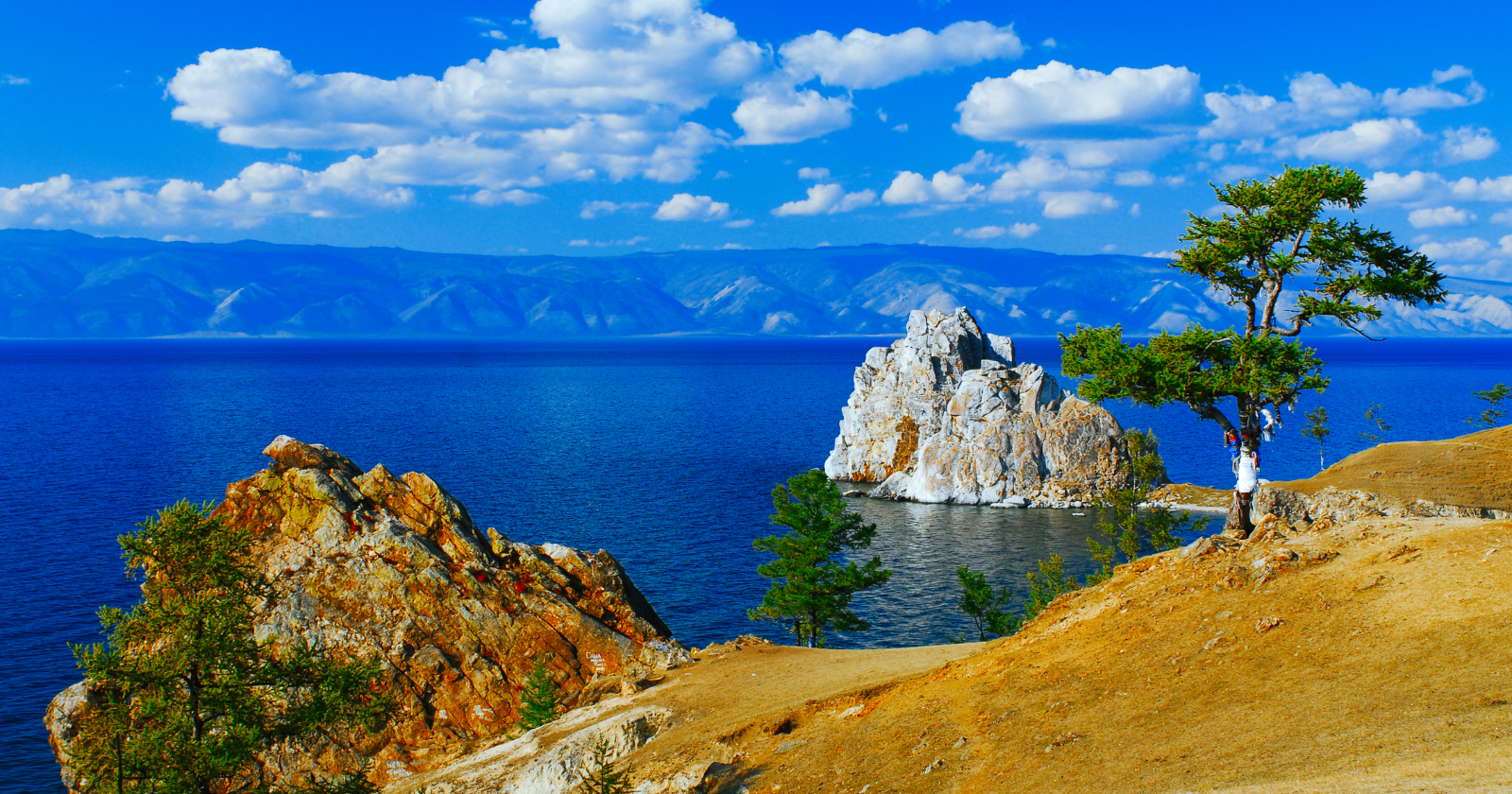
One lake, in the south-east corner of Siberia, holds roughly a fifth of all the unfrozen surface fresh water on the planet. Not a fifth of Russia’s, not a fifth of Asia’s. A fifth of the whole world’s supply, in a single body of water stretching nearly 400 miles through Siberia.
The lake is Baikal, and the more you look at it the stranger it gets.
The numbers behind the volume
Start with how much water is in it. The US Geological Survey puts Baikal’s volume at about 5,521 cubic miles. The five North American Great Lakes together hold about 5,439 cubic miles. Lake Superior, Michigan, Huron, Erie, and Ontario, poured together, come out to slightly less than one Baikal.
That water sits in a very deep hole. Baikal’s floor drops to 1,637 meters, making it the deepest lake on Earth by a wide margin. Depth is what lets a lake with a fairly ordinary surface area hold so much. Baikal is long and narrow, not especially wide, but it goes down more than a mile.
Put those two facts together and you get the headline figure. UNESCO describes Baikal as containing “nearly 20 percent of the world’s unfrozen freshwater reserve”. More precisely, the figure refers to fresh water at the surface, rather than the much larger amount stored underground.
A rift that has been pulling apart for 25 million years
The reason Baikal is so deep is that it did not form like an ordinary glacial lake. It sits where the Earth’s crust is slowly tearing apart. The Baikal Rift Valley marks where the Amur plate is pulling away from the Eurasian plate, a process that has continued for roughly 25 million years. That slow separation opened a basin, and the basin filled with water.
It is still opening. National Geographic reports that the Amur plate is moving eastward at about four to five millimeters a year. This is a lake being made by geology, millimeter by millimeter, going back long before there were recognizable humans to see it.
That age matters for what lives there. Many familiar northern lakes are geological blinks, formed after the last ice age and gradually filling with sediment. Baikal has existed for about 25 million years, and life has had all of that time to adapt to it.
What lives down there
The result is one of the most distinctive collections of life anywhere. Baikal contains more than 2,500 known animal species, and about 75 percent are endemic, meaning they live nowhere else on Earth. The most famous is the nerpa, the only seal species found exclusively in fresh water, living thousands of miles from any ocean.
What strikes me is how a place this old and vast can still be fragile. A team including George Swann and Anson Mackay examined sediment records and found signs of change at the base of the food web, among tiny algae called diatoms. Their study found a decline in several endemic species in the south basin alongside an increase in cosmopolitan species better suited to warmer surface water. The researchers were careful about the scope: the changes appeared in the south basin, while the north basin showed no comparable diatom response.
The leading explanation is warming. The study notes that Baikal has experienced rising water temperatures, shorter ice cover and stronger thermal stratification since the mid-20th century. Its authors concluded that the south-basin changes were consistent with predicted responses to warming, while stopping short of claiming that the same shift had occurred throughout the lake.
The case for caring about one lake
There is a tension here I keep coming back to. On one hand, Baikal feels permanent to the point of indifference. It has outlasted whole geological epochs and will keep widening long after us. On the other hand, the pressures on it are recent and fast.
In its 2025 conservation assessment, IUCN rated Baikal’s outlook as a significant concern, citing ongoing pollution, large-scale tourism development, poor sewage treatment causing nearshore eutrophication, climate change and harmful water-level regulation. The assessment says the clearest signs of rapid ecological degradation are concentrated in the coastal zone, including the decline of endemic sponges and outbreaks of algae not typical of Baikal.
The warning is now stronger than a precaution about what might happen. In 2025, UNESCO called for urgent action to eliminate direct wastewater discharges into the lake and upgrade outdated treatment facilities. At the same time, IUCN says the lake’s major natural values remain largely intact, which means there is still something substantial to protect rather than merely document after the damage is done.
The scale cuts both ways. A fifth of the planet’s unfrozen surface fresh water is an almost incomprehensible reserve, the kind of number that makes any single threat sound trivial. But it is also a fifth concentrated in one rift, shaped by one climate and edged by one shoreline. The size that makes Baikal feel invulnerable is exactly what makes it worth watching closely. Twenty-five million years bought this lake its strangeness. It did not buy immunity.