

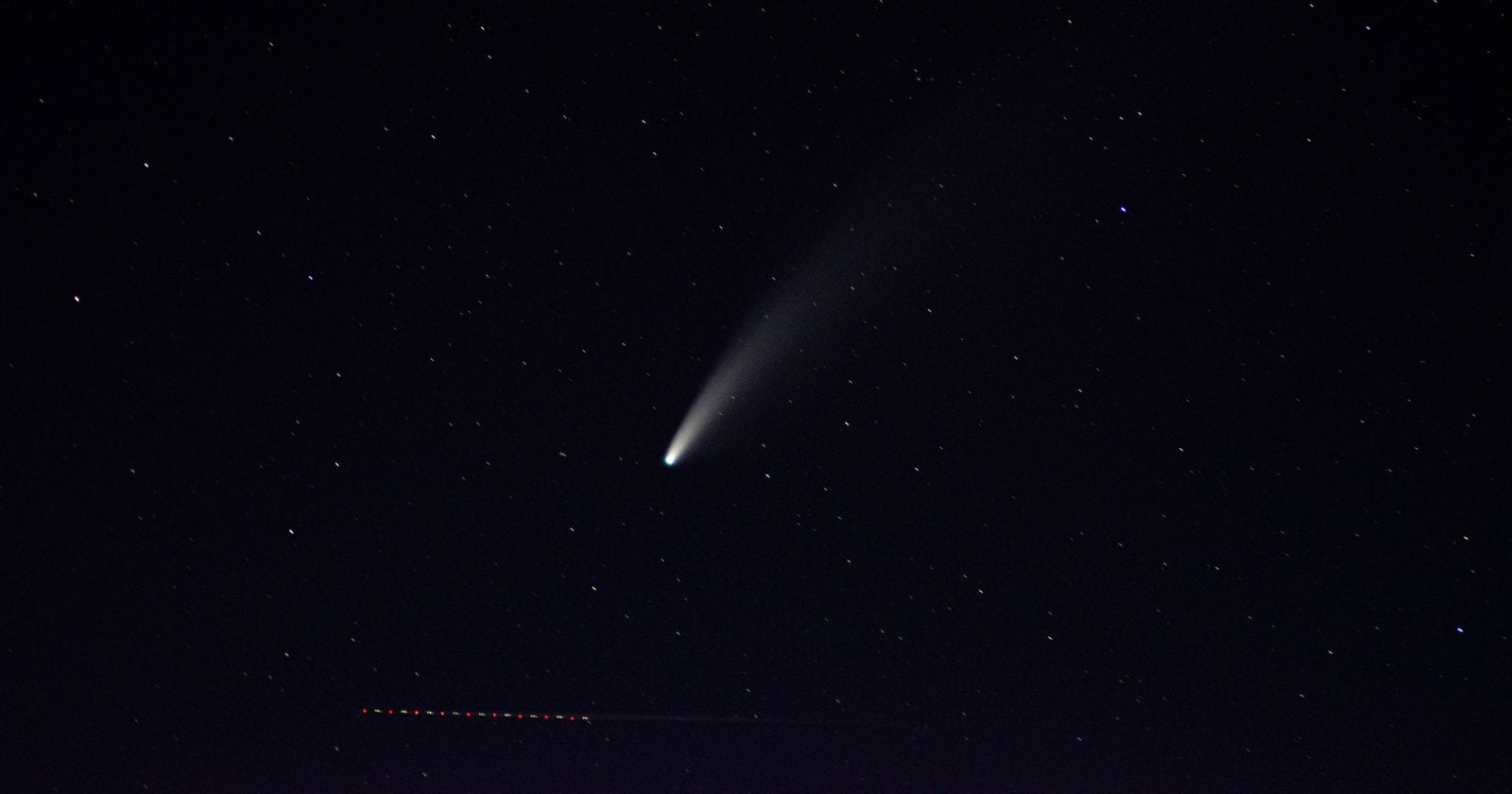
Build a spacecraft to stare at the Sun, and you end up with the greatest comet finder in the history of astronomy. Nobody planned it that way.
The Solar and Heliospheric Observatory, or SOHO, launched on December 2, 1995. A joint ESA and NASA mission, it was built to watch the Sun. Comets were not part of the job. And yet SOHO has now spotted more of them than any observer, human or robotic, ever has.
How does a Sun telescope end up beating every comet hunter who came before it? The answer is a mix of lucky physics and a small crowd of volunteers.
How a Sun-watcher spots comets
SOHO sits about 1.5 million kilometers from Earth, in the direction of the Sun, where it gets a clear, uninterrupted view. Its key instrument for this story is called LASCO. It works by placing a small solid disk in front of the Sun to blot out the blinding surface, creating a kind of artificial eclipse. That lets the faint outer atmosphere around the Sun show up.
The same trick is well suited to catching comets. A certain kind, called a sungrazer, dives in close enough to skim past the Sun. Against LASCO’s blacked-out disk, these faint moving smudges stand out. Most belong to a single family, fragments of one giant comet that broke apart long ago. When Zdenek Sekanina and Rainer Kracht went through the LASCO archive, they found most of the comets SOHO turns up come from this one family, appearing at a rate of roughly one every couple of days.
Before all this, the record was thin. Karl Battams, the space scientist who leads the Sungrazer Project at the U.S. Naval Research Laboratory, put it plainly: “Prior to the launch of the SOHO mission and the Sungrazer Project, there were only a couple dozen sungrazing comets on record – that’s all we knew existed.” As SOHO mission scientist Joe Gurman told Space.com, “we expected it might from time to time see a bright comet near the sun. But nobody dreamed we’d approach 200 a year.”
The people doing the finding
The comets are mostly not being picked out by professional astronomers. They are found by ordinary people around the world, going through SOHO’s images, which the mission posts online for free.
Soon after launch, amateurs began emailing in sightings. In the early 2000s the effort became the NASA-funded Sungrazer Project, run out of the Naval Research Laboratory. Anyone can download the pictures and report what they see.
The barrier to entry is close to nothing. The project says there are no requirements beyond an internet connection and a computer. No degree, no telescope, no lab. Battams has described the participants as a “very broad cross section”, since the program is open to anyone interested.
The method itself is simple. As Battams described it, it comes down to “flicking through the images and looking for something tiny and faint and moving in a different direction to the stars.” Doing it reliably takes practice, but the entry ramp really is that gentle. You watch the free frames go by, one after another, and wait for a speck to move the wrong way.
Reaching 5,000
On March 25, 2024, a participant named Hanjie Tan spotted what was later confirmed as SOHO’s 5,000th comet. Tan is an astronomy PhD student in Prague now, but he started with the project as a teenager. “Since 2009, I’ve discovered over 200 comets,” he said, having joined at 13 years old. On the thrill of catching one, he added: “It’s really exciting to be the first to see comets get bright near the Sun after they’ve been traveling through space for thousands of years.”
The proportions are striking. NASA officials have put the share of SOHO’s comet finds made by citizen scientists at around 95 percent. NASA’s own account of the 5,000th describes the international volunteers who found most of them as people “many with no formal scientific training.” Step back further and the Sungrazer Project reckons it accounts for well over half of all comets humanity has ever catalogued.
For the scientist who has run the operation for years, the number is hard to take in. “The fact that we’ve finally reached this milestone – 5,000 comets – is just unbelievable to me,” Battams said.
An accident that may be winding down
SOHO has long outlived its original plan, extended again and again. The Sungrazer Project has noted that it takes roughly four to five years to add each new thousand comets, and that 5,000 is probably its last major comet milestone, given the mission’s expected end. A newer instrument will eventually take over the solar-watching job that was always SOHO’s real assignment.
What we keep coming back to is how little of this was designed. The engineers who built LASCO were solving a solar-physics problem, not planning a global comet census. The thing that made the comet haul possible was almost mundane: the images went online, for free, for anyone. That one decision turned a Sun-watcher into a discovery machine and handed the actual discovering to teenagers, retirees, teachers, and hobbyists on six continents.
The Sun-watching was the mission. The greatest comet catalogue ever built came as a side effect, because the data was left open for people nobody screened, credentialed, or paid to go looking.