

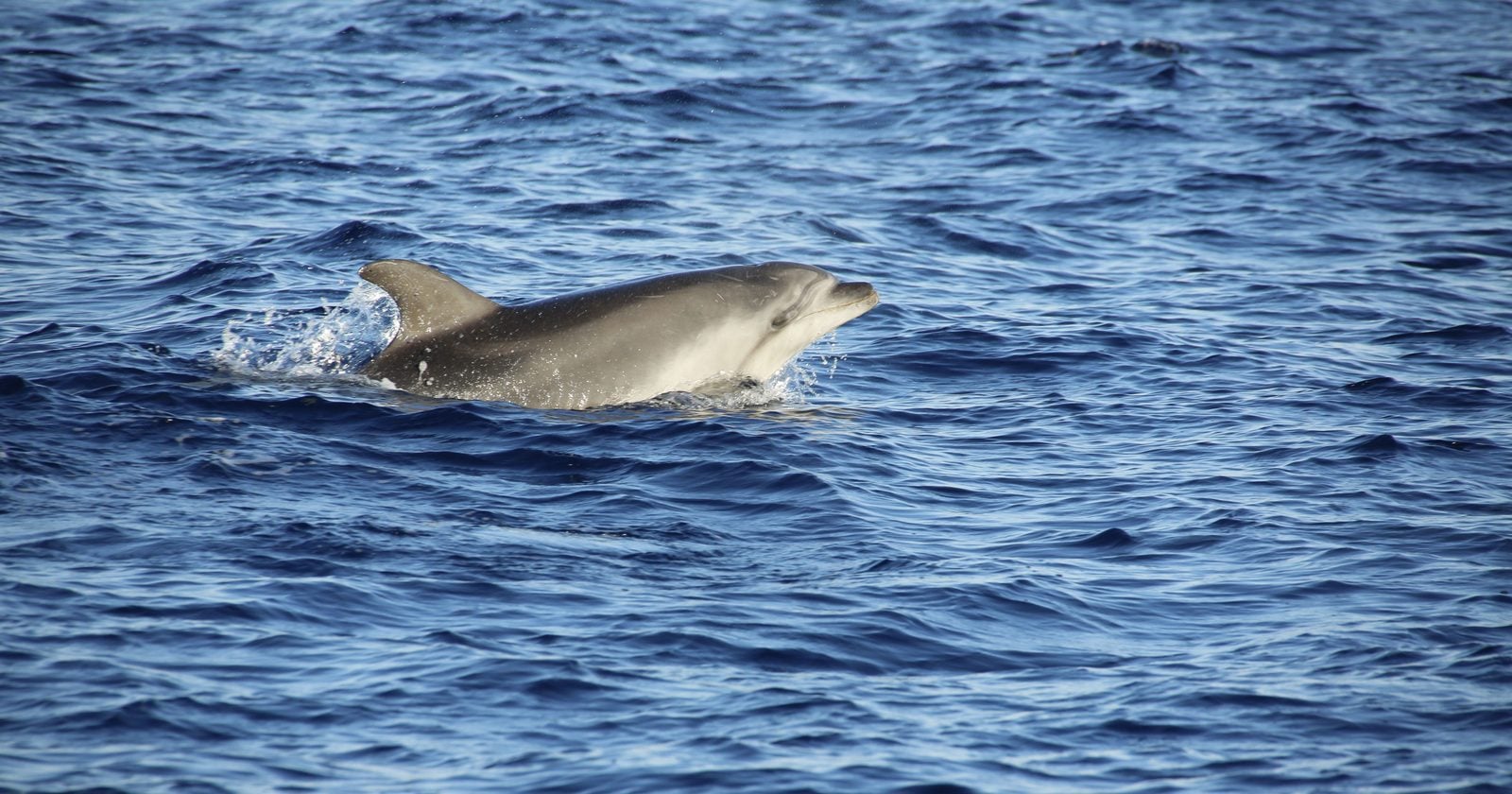
A drone was hovering over calm water off Hervey Bay, on Australia’s east coast. An adult dolphin rises with a large empty shell balanced on her snout, a fish trapped inside. The fish makes a break for it, she drops the shell to chase it, and about three minutes later her calf swims up to that same abandoned shell and tries the whole thing again.
That short sequence is what a team of researchers filmed on 1 October 2025. It has reopened a question scientists thought they had mostly answered: how does one dolphin learn a trick like this from another?
The three minutes off Hervey Bay
The mother in the footage is called Maserati, her calf Bentley. Discover Magazine reported it as a lucky sighting caught by a research drone. The lead author, Dr. Alexis Levengood of the University of the Sunshine Coast, described the moment plainly. Levengood said, “We saw the mother surface with a shell, the fish inside escaped and the dolphin dropped the shell to chase the fish.”
Then came the part that made the clip worth a paper. Levengood continued, “Then, minutes afterwards, the dolphin calf picked up the shell and held it the same way as its mother.” The calf held the shell the way its mother had, which is exactly what you would want to see if a young dolphin were copying a parent.
This was also the first Hervey Bay sighting to catch the full behavior on film. An earlier one on 6 July 2025 involved a different adult, nicknamed Stevie Nicks, who lifted a bailer shell above the surface several times before rain ended the follow after nine minutes.
The Maserati and Bentley clip is the one carrying the argument.
What shelling is, and why it counts as a tool
The behavior has a name: shelling. A dolphin drives a fish into a large empty sea snail shell, then uses the shell to trap and deliver the meal. The clearest description of how it works comes from earlier Western Australian research. Dr. Simon Allen, a co-author of that work, put it this way: “The dolphins chase the fish into the shell, then insert their beak into the opening and lift the shell to the surface, shaking it about until the trapped prey falls into their jaws.”
The shells are bailer shells, which can grow to roughly the size of a football. Using one to corral and drain a fish is what makes shelling a form of tool use: an object handled to get a job done, rather than a body part alone. It is uncommon among wild animals, and rare even among dolphins. In the long-studied Shark Bay population, fewer than two percent of known individuals do it.
The Shark Bay picture: learning sideways
Until this year, almost everything known about how shelling spreads came from Shark Bay in Western Australia, roughly 4,000 kilometres away on the opposite coast. A 2020 study there looked at 42 shelling events by 19 individuals and asked whether the skill travelled down family lines or across social ones.
The answer surprised them. The skill moved mostly between peers, spreading through the social network the way slang moves through a friend group, rather than from parent to child. As Levengood summarised it, “Work done in Shark Bay showed that shelling was learned from peer to peer or moved horizontally through the social network.” The authors reckoned shelling was 10 to more than 300 times more likely to spread this way than through genetics or trial and error.
Michael Krützen, a senior author on that study, called the sideways spread the interesting part. Krützen said it “sets an important milestone, and highlights similarities with certain primates, who also rely on both vertical and horizontal learning of foraging behavior.” One thing to keep in mind: the Shark Bay dolphins are a different species, the Indo-Pacific bottlenose Tursiops aduncus, so what holds on one coast does not automatically hold on the other.
The Hervey Bay picture: a possible route down the family line
This is what makes Maserati and Bentley interesting. A mother shells, drops the shell, and within minutes her own calf picks it up and copies the way she held it. If that reflects real learning, the skill is passing straight from mother to offspring, the opposite of the sideways pattern seen in Shark Bay.
Levengood is careful about how far to push it. She said, “Our footage provides the first potential evidence of maternal social transmission – a process by which offspring learn behaviour by observing the actions of its mother. It challenges the belief that dolphins learn this tool use from their peers.” Note the hedge in her own words: first potential evidence.
So the two coasts are, at least on paper, in tension. The 2020 west-coast work says peer to peer. The 2025 east-coast clip hints at mother to calf. Neither cancels the other. Both routes may well operate, in different populations or even the same one.
What would actually settle it
A calf handling a shell just after watching its mother is suggestive, but a single calf on a single afternoon is not a pattern. Moving it from “potential evidence” toward something firmer would take the unglamorous part of the work: many more follows, in both bays, tracking known mother-calf pairs over years to see whether calves reliably take up shelling from their mothers, and whether that route shows up alongside the peer-to-peer spread already documented in the west.
The current state of play is that a lucky drone sighting has not answered how dolphins learn to shell. It has done something arguably more useful for a young field. It has taken a question that looked mostly settled and shown there is at least one more way the answer could go.