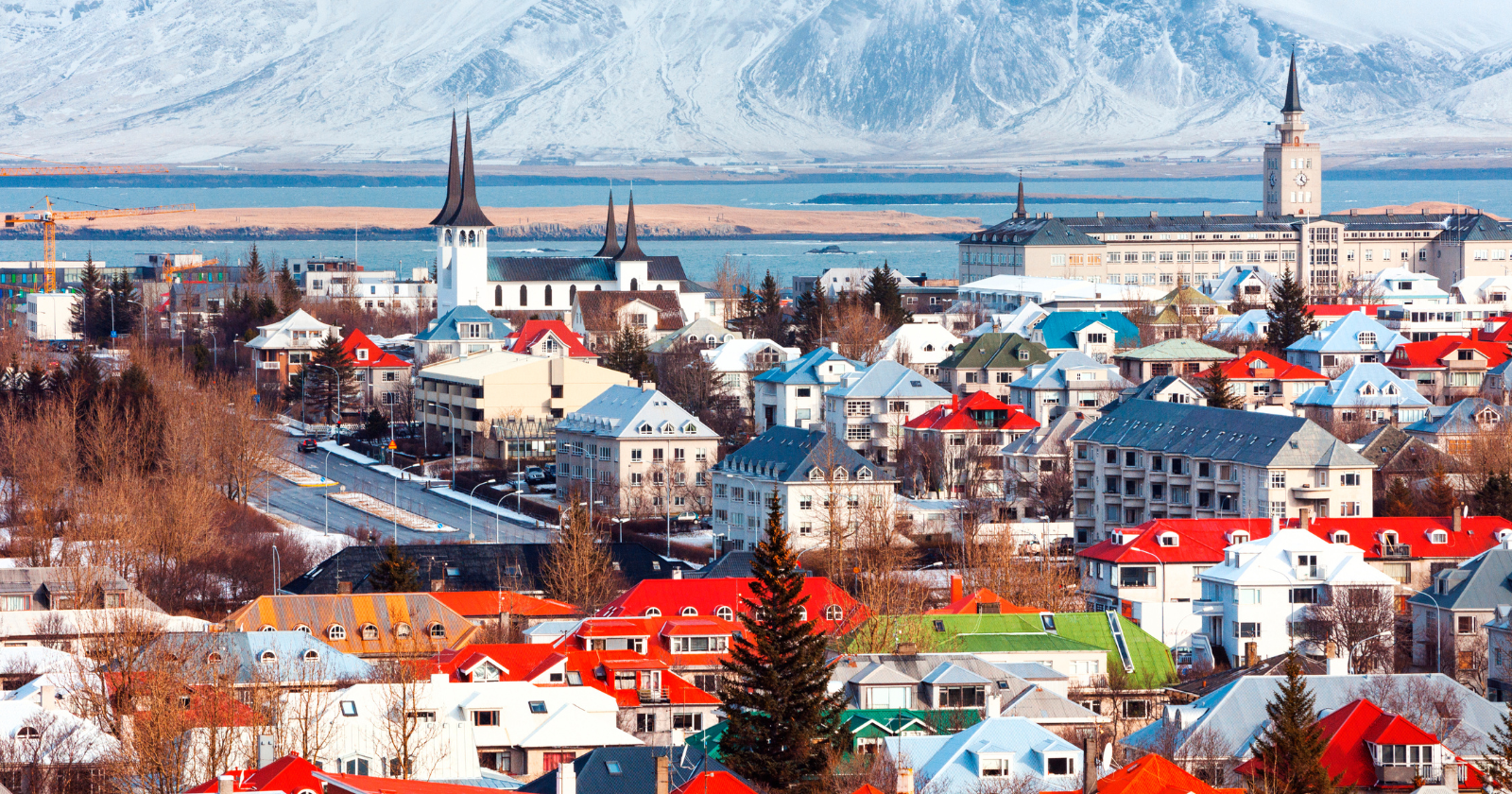
Ask most people what they picture when they think of Iceland, and you get some version of cold: black lava fields, glaciers, wind off the North Atlantic and long, dark winters.
What that image hides is that Iceland has built one of the cleanest and most extensive heating systems in the world. Most homes are warmed not by burning coal, oil or gas, but by hot water drawn from beneath the island.
The interesting part is not simply the geology. The geology was there for centuries, while Iceland remained poor. What changed was the country’s ability and willingness to build the wells, pipes and institutions needed to use it.
A century of poverty on volcanic rock
Iceland sits on the Mid-Atlantic Ridge, where the North American and Eurasian tectonic plates are slowly pulling apart. That helps explain the island’s intense volcanic activity and why useful heat lies relatively close to the surface. The Natural Science Institute of Iceland counts around 41 volcanic systems that remain active today.
For most of Iceland’s history, however, that heat created little prosperity. The economy rested largely on farming and fishing, while many people lived in turf houses whose thick walls provided useful insulation but whose interiors could be damp, smoky, dark and crowded.
How poor was the country? Poor enough that its later rise became a central part of Iceland’s national story. David Oddsson, then Iceland’s prime minister, told an audience in 2004 that “after being one of the poorest countries in Europe for centuries, Iceland managed to become fairly prosperous in an incredibly short time.”
That was a politician describing his own country, and Iceland’s economic development cannot be credited to geothermal energy alone. Modern fishing fleets, trade, industrialisation, education and improvements in public health all mattered. But geothermal heating became an important part of the transformation by reducing dependence on costly imported fuel.
How geothermal heat became part of the new economy
The transition began on a small scale. Reykjavík started piping naturally heated water into buildings around 1930 rather than relying entirely on imported coal. National Geographic reports that in 1933 only about 3 percent of Reykjavík’s population received geothermal heating. Most residents still burned coal, leaving the capital coated in soot and coal dust.
The network expanded gradually, but the change was neither immediate nor complete. In 1970, about half of Icelandic homes were still heated with oil. When the oil crisis struck in 1973, that dependence on costly imported fuel helped drive a much faster expansion of geothermal heating.
A historical study by Odinn Melsted details how Iceland largely removed fossil fuels from its heating sector between 1930 and 1980. The change required more than accessible hot water. It depended on drilling technology, public financing, municipal utilities and a willingness among households to abandon individual fuel-burning systems and help pay for shared infrastructure.
Thorleikur Johannesson, an Icelandic geothermal engineer, described the sheer grind of the process in a 2016 talk at Cornell. Johannesson put it plainly: “It was street-by-street, house-by-house, and we did it. Some people take it for granted, as it hasn’t always been like this. It took 90 something years to get where we are.”
That is his own broad characterisation rather than a precise dating of the transition, but it captures its shape. Iceland’s heating system was not created by one dramatic decision. It was built incrementally, neighbourhood by neighbourhood, over generations.
Virtually all the electricity, and very little carbon from heating
The result is remarkable. National Geographic reports that Iceland generates virtually all its electricity from renewable sources. The mix varies from year to year, but it is dominated by hydropower and geothermal energy, with hydro supplying roughly seven-tenths of generation and geothermal providing most of the rest.
That does not mean Iceland’s entire energy system is renewable. Fossil fuels are still used in transport, aviation, fishing and other parts of the economy. But electricity generation and domestic heating have been transformed more thoroughly than in almost any other country.
For heating, the Atlantic Council notes that nine out of ten Icelandic homes are heated directly with geothermal energy.
The environmental and economic effects have been substantial. An Atlantic Council analysis reported that direct carbon dioxide emissions attributed to space heating in Reykjavík fell from roughly 250,000 tonnes a year to essentially zero as fossil-fuel heating was displaced. That figure refers specifically to emissions from heating buildings, not to Reykjavík’s total emissions or the complete lifecycle impact of geothermal infrastructure.
The same analysis cited an Icelandic government estimate that the avoided costs and broader economic benefits of geothermal district heating could be worth as much as 7 percent of Iceland’s GDP.
What is clear is that Iceland replaced a large stream of imported coal and oil with domestic energy drawn from beneath its own towns and valleys.
What the rest of the world might take from it
The tempting lesson is that Iceland simply got lucky. Most countries do not sit above such accessible geothermal resources, and Iceland’s combination of volcanic geology, abundant water and small population cannot be reproduced everywhere.
But favourable geology was only the starting point. The same heat existed beneath Iceland long before it became economically useful. Turning it into a national heating system required drilling programmes, public investment, technical expertise, municipal cooperation and decades of political support.
Johannesson made that point as well. In his view, “most of the politicians in Iceland – and I mean most of them – have been pro-geothermal, and we think it is important to have the politics on our side.”
That is his assessment rather than a formal tally of Icelandic political opinion, but it points to one of the transition’s important features. Infrastructure projects measured in generations need institutions capable of carrying them through changes of government.
Most countries cannot copy Iceland’s geology. They can copy parts of the process: identify the resources they do possess, invest in shared infrastructure and sustain the effort long enough for the benefits to compound.
Iceland’s success was not simply a gift from the rock beneath it. It came from spending decades learning how to use that gift, street by street and house by house.