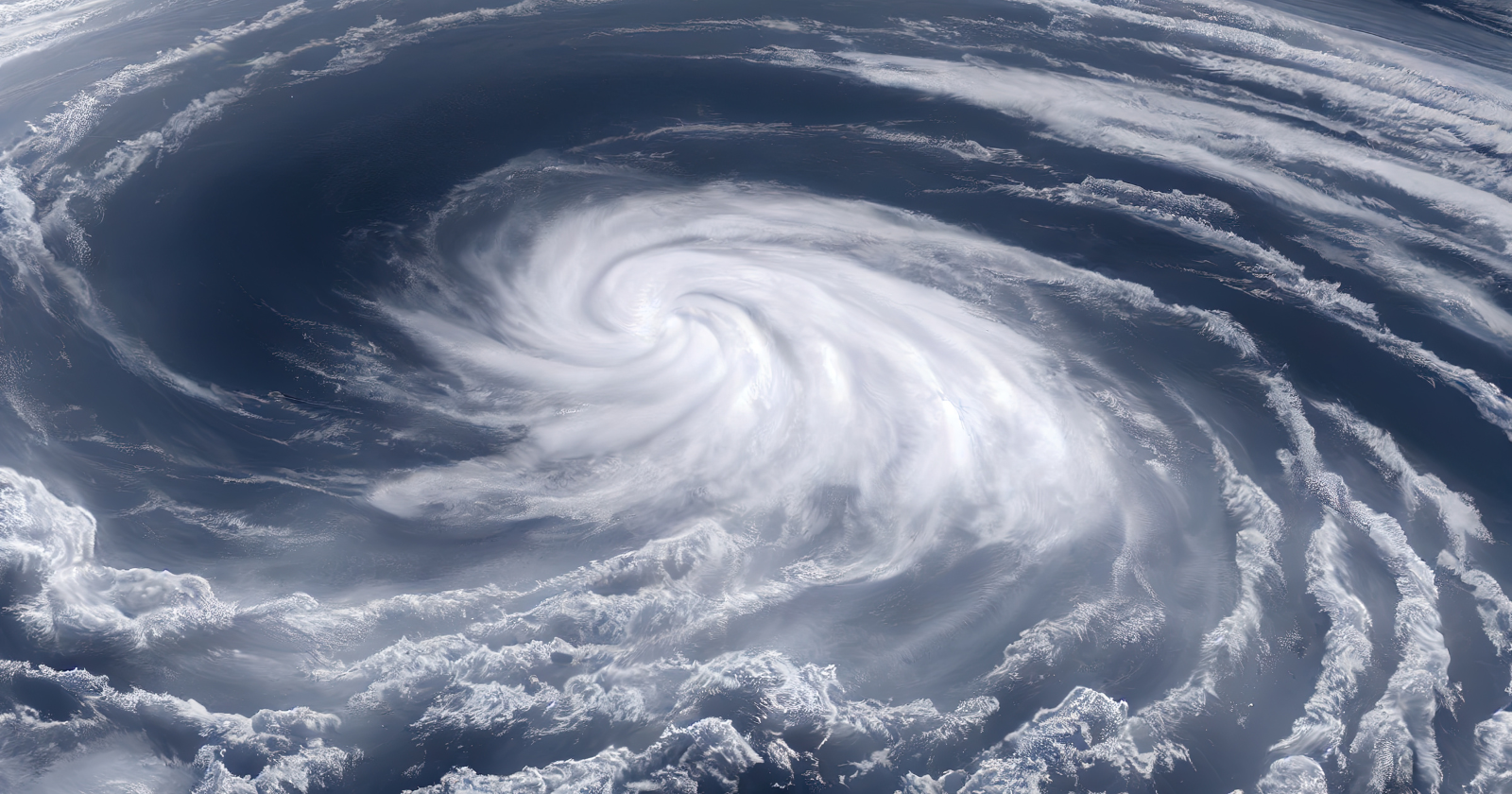
The fastest winds anywhere in the solar system blow on Neptune, reaching roughly 2,000 km/h and driving frozen methane clouds around a planet more than 4 billion km from the Sun. On Earth, a storm needs maximum sustained winds of 119 km/h to count as a hurricane. Put the two side by side and even Earth’s most violent winds are far below Neptune’s peak speeds.
I find that gap hard to make sense of, because it runs backward from what intuition tells you. Neptune is cold, dim and the most distant of the major planets. It should be one of the calmest places out there. Instead it holds the solar system’s wind-speed record. Working out why remains one of the more stubborn open questions in planetary science, and we still don’t fully have the answer.
Where hurricane force actually begins
Start with the Earth number, because it’s firmer than most people assume. On the Saffir-Simpson scale, a Category 1 hurricane means maximum sustained winds of 74 to 95 mph, or 119 to 153 km/h. That 119 figure is the floor. Below it you have a tropical storm; at it you have a hurricane. The most powerful winds Earth produces reach around 400 km/h, and even that is rare and brief.
The known range of Earth’s fastest winds still fits well below Neptune’s peak. That’s what the numbers force on you, and it’s not an exaggeration.
What Voyager 2 actually clocked
The benchmark measurements of Neptune’s winds came from a single flyby. Voyager 2 passed Neptune in 1989. Because the planet has no solid surface, nobody could measure its winds with an instrument on the ground. Instead, experts used Voyager images to track bright cloud features across the planet and work out how fast they moved.
The resulting wind profile showed speeds reaching roughly 1,200 mph, about 2,000 km/h. NASA describes Neptune’s high-altitude winds as supersonic.
More recently, astronomers have used the ALMA telescope array to measure Neptune’s stratospheric winds directly, giving speeds at known pressure levels rather than at whatever height the tracked clouds happened to sit. It’s a different look at the same violent atmosphere, and a reminder that the 1989 snapshot is no longer the only data we have.
The puzzle of the distant, dim planet
On Earth, sunlight is the main engine. It heats the surface unevenly, air moves, and you get weather.
Neptune complicates that story. It sits more than 30 times farther from the Sun than we do and receives roughly one-900th as much sunlight. There is little solar energy out there to push the air around, and yet the planet’s peak winds are faster than anywhere else in the solar system.
The best partial explanation points inward rather than outward. Neptune gives off more than twice as much heat as it absorbs from the Sun, so the storms may be powered from below rather than by sunlight above.
As NASA’s Amy Simon put it, “Winds are probably generated deeper than sunlight can penetrate, so a combination of internal heat and rotation likely produces them.” Note the hedges in her own words. This is a likely mechanism, not a solved one.
There’s a second idea, and it’s an old one. The extreme cold might mean there’s very little friction to slow the winds down. Planetary astronomer, Heidi Hammel described the thinking this way: “We’ve speculated for a long time that the coldness of Neptune and Uranus might lead to near-frictionless conditions and so allow for faster winds.” The framing matters. That’s a longstanding hypothesis, not a confirmed cause.
Why the number keeps moving
One reason you’ll see Neptune’s top wind speed quoted differently is that most estimates come from tracking clouds rather than sampling the air directly. The clouds sit at heights that can be difficult to pin down, and winds at other levels may run at different speeds. Anthony Del Genio of NASA’s Goddard Institute said the problem plainly: “The winds at other altitudes may be slower or faster. We don’t know because we have never dropped probes into the atmospheres of most of the outer planets.”
The winds may also be surprisingly shallow. A 2013 study of Neptune’s gravity placed an upper limit of about 1,000 km on the depth of its atmospheric circulation, corresponding to roughly 0.2 percent of the planet’s mass. Against Neptune’s radius of some 25,000 km, that’s a thin, furious skin of weather over a mostly unknown interior.
And we’ve barely watched it. As Hammel noted, “One year on Neptune is 165 Earth years so we have not had a chance to study the planet with modern tools for very much of its seasonal cycle.” We caught one close look in 1989 and have been observing from a distance ever since.
The planet that holds the solar system’s wind-speed record is also one of the least explored. Until another probe goes out there, the fastest winds known in the solar system will keep belonging to one of the worlds we understand least.