

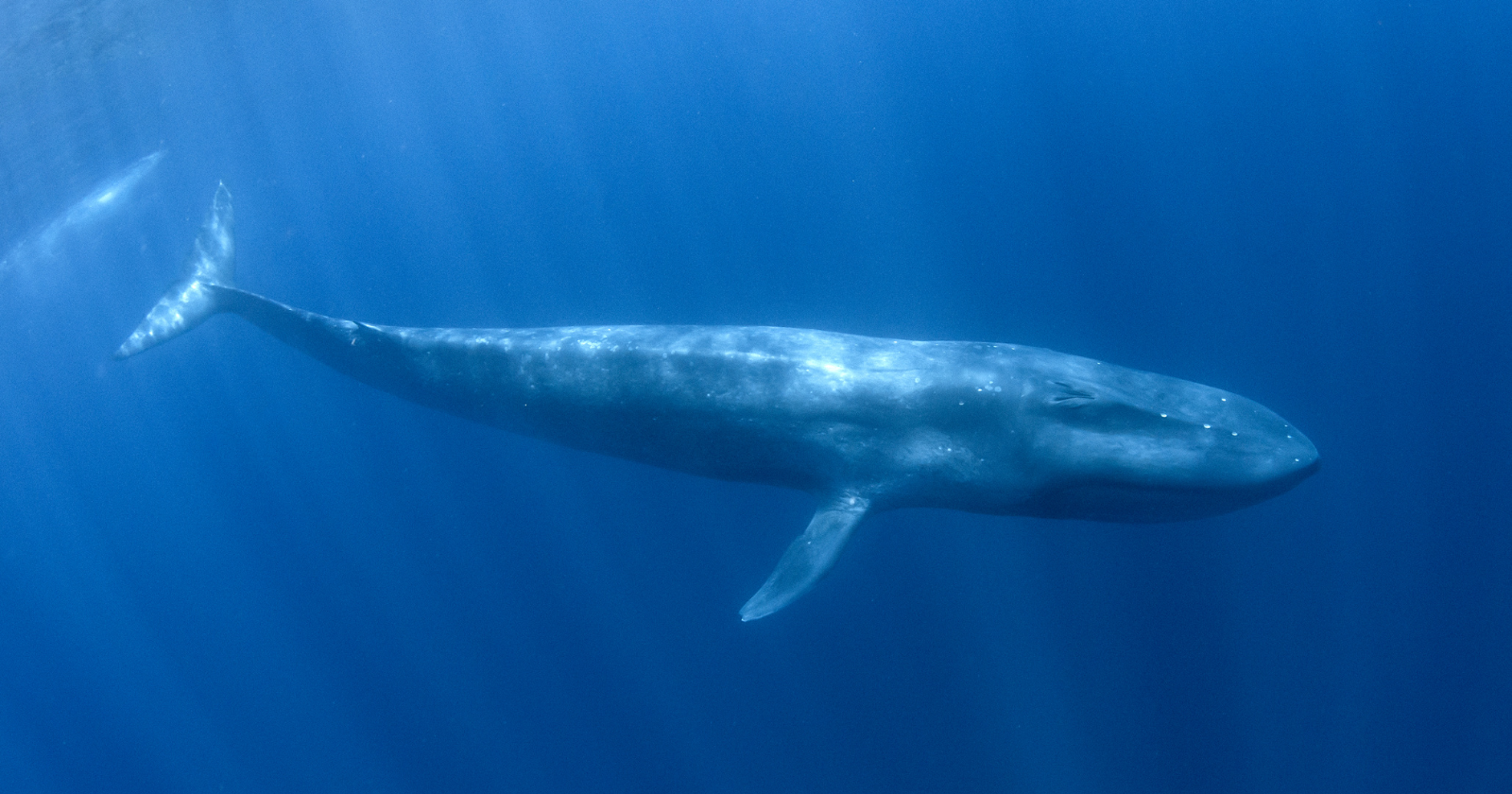
The strangest thing about a blue whale’s heart is not its bulk. It is how close that heart comes to stopping. On a deep foraging dive, the largest heart on the planet can slow to as few as two beats a minute, a pace so far below what physiology predicts for an animal that size that it looks, at first, like an error in the data.
It was not an error. In 2019, a team led by Stanford’s Jeremy Goldbogen, with Paul Ponganis of the Scripps Institution of Oceanography as senior author, made the first recording of a blue whale’s heart rate in the wild. What they found raised a question the whale’s size alone never could: how does a heart that big run that slow, then race back so fast, dive after dive, without faltering?
How do you record the heartbeat of the largest animal that ever lived?
Carefully, and with a long pole. Working in Monterey Bay, co-author David Cade attached a suction-cup electrocardiogram tag near the left flipper of a male blue whale estimated to be about 15 years old. The tag, roughly the size of a lunchbox, was held by four suction cups, two carrying the electrodes that picked up the electrical signal of the heart.
It stayed on for about 8.5 hours of diving before detaching and floating up to be retrieved. The team almost did not believe what came back. “We had no idea that this would work and we were skeptical even when we saw the initial data,” Goldbogen said. Reading the trace was its own task. “With a very keen eye, Paul Ponganis … found the first heart beats in the data,” he recalled. Goldbogen later told Smithsonian the whole attempt felt unlikely: “I honestly thought it was a long shot because we had to get so many things right.”
The results were published on 25 November 2019 in Proceedings of the National Academy of Sciences, under a title that named the puzzle directly: extreme bradycardia and tachycardia in the world’s largest animal. This is a single animal measured once in the field, not a survey of the species, so the pattern is best read as a first window rather than a settled rule.
What did the data actually show?
A heart swinging between two extremes on every dive. During dives that reached as deep as 184 metres and lasted up to 16.5 minutes, the heart rate typically settled to four to eight beats a minute and bottomed out at just two beats per minute. For a body this large, the predicted resting rate is closer to 15 beats per minute, so the diving heart was running far below what its size alone would suggest.
Then came the reversal. The moment the whale returned to the surface to breathe and re-oxygenate, the heart climbed to its highest recorded rate of 30 to 37 beats per minute. There was one wrinkle even at depth. During a lunge to feed, the rate briefly jumped to about 2.5 times the dive minimum, before sinking again.
Why would a heart run itself so close to stopping?
The slow pace is oxygen management. Holding a single breath through a long dive, the whale conserves its limited oxygen by dropping its heart rate and routing blood to the organs that need it most, the same dive response seen across diving mammals, scaled up to the largest body on Earth. The surface surge is the repayment, the heart racing to reload oxygen before the next plunge.
What struck the team was how little headroom remained. The surface rate sat near the whale’s estimated physiological maximum, which led them to suspect the heart may already be working at its functional ceiling. That ceiling, set by body size and the demands of lunge feeding, “can help us understand biological limits to size,” Goldbogen said. The idea that a maxed-out heart is one reason blue whales never grew larger is the team’s hypothesis, not a proven fact, and they have been clear that much more work is needed to test it.
So is the heart really the size of a small car?
Probably not. The comparison is repeated everywhere, but it does not survive a close look at an actual specimen. A preserved blue whale heart weighed roughly 400 pounds, while National Geographic noted that a Volkswagen Beetle weighs around 3,000 pounds, which makes the car framing closer to legend than measurement. A researcher’s suggestion of a small golf cart is nearer the mark, though even that overshoots, since golf carts run heavier than the heart itself. The simpler version holds: it is the largest heart of any animal, and its size is not the most interesting thing about it.
What makes the 2019 recording matter is the method as much as the numbers. One tag, one whale, 8.5 hours. The questions the data invites next are the ones that take a fleet of recordings to answer: whether the same cardiac swing holds across larger and smaller individuals, whether it shifts with feeding, depth, or age, and how close other giants of the ocean run to their own limits. The first beat was the hard part. What it measures next is still open.