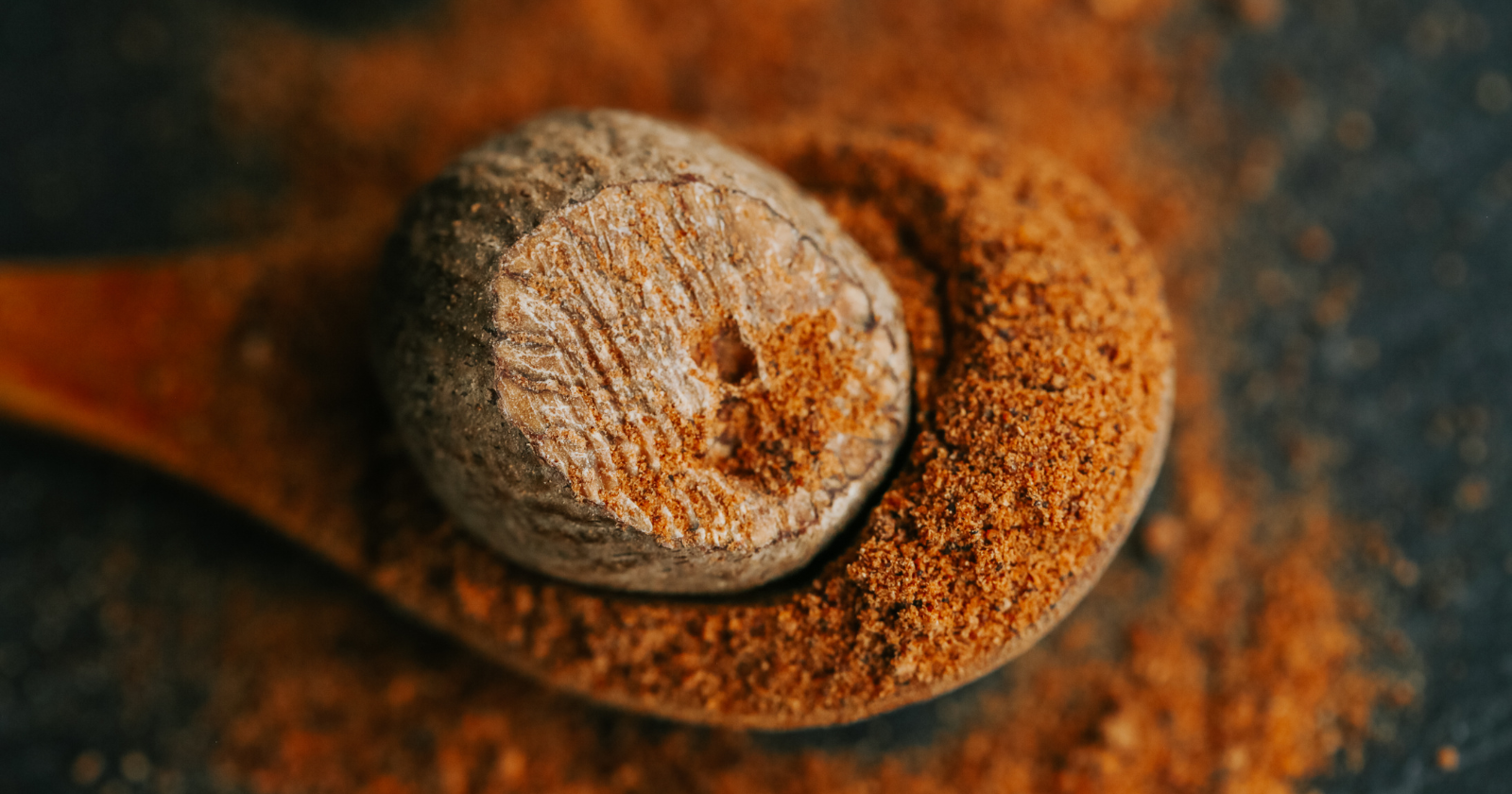
The jar is nutmeg. Roughly forty grams of it, ground or whole, sits in a small glass container next to the cinnamon and the paprika on almost every kitchen spice rack in the developed world. Most people who own one have used it perhaps four times, mostly at Christmas, usually in eggnog or a béchamel sauce. It cost, at the supermarket, somewhere between two and five dollars. It’s one of the most ordinary and least noticed objects in an ordinary kitchen.
Which makes what it used to be worth, and what people were willing to do to control it, one of the more genuinely disorienting stories in the history of trade.
Seven hundred years ago, meaning during the century Marco Polo returned from Asia and Europe was reeling from the Black Death, a small handful of nutmeg was worth more than its weight in gold in most European cities. Not metaphorically. Literally. Merchants who could get hold of a sackful of the stuff in Venice could sell it in London or Paris for a price that would set up their family for generations. Contemporary accounts describe nutmeg trading at markups of thousands of per cent between the point where it left the tropics and the point where it reached the tables of European nobility. A pound of it, in fifteenth-century England, could reportedly buy a small herd of cattle or the freehold on a modest piece of land. It was the kind of commodity people wrote wills about.
The reason was partly medical, partly culinary, and largely mistaken. Nutmeg was believed, during the height of the plague years, to ward off infection. It did not, but nobody knew that at the time, and the belief drove demand well past whatever the ordinary spice trade would have supported. It was also genuinely useful in a European culinary tradition that had almost no other way of preserving or flavouring rich food. And, crucially, nobody in Europe knew where it came from.
The islands nobody could find
The whole world’s supply of nutmeg, in the fifteenth and sixteenth centuries, grew on ten small volcanic islands in what is now eastern Indonesia. The archipelago is called the Banda Islands. It sits about two thousand kilometres from Bali, in the shallow tropical waters of the Banda Sea, and the total land area of the entire island group is smaller than a medium-sized city. The Bandanese, who numbered approximately fifteen thousand people across the whole archipelago, had cultivated nutmeg trees for centuries, harvested the fruits, dried the seeds, and traded them to Malay, Javanese, and Arab merchants who then carried them west along a series of shipping routes that eventually terminated in Venice.
On the subject of nutmeg – there’s more to this spice than most people realize, most importantly, just how dangerous it can be. This video explains more:
Each layer of intermediary added a markup. Bandanese growers received a tiny fraction of what the final consumer paid. Malay traders added their share. Arab merchants added another. Venetian houses added the largest of all, because they were the last link before the European market. By the time nutmeg reached a nobleman’s kitchen in London, its price reflected a chain of transactions so long and so profitable that no single participant knew the full margin.
What none of them had told the Europeans, deliberately, was where the trees actually grew.
According to a peer-reviewed chapter titled “Genocide in the Spice Islands” in the Cambridge World History of Genocide, published by Cambridge University Press, this concealment was the direct reason for European exploration of the eastern Indian Ocean in the fifteenth and sixteenth centuries. Portuguese, Spanish, English, and Dutch expeditions all set out at various points looking for the source of the trade. The Portuguese arrived first, in 1512. They set up trading posts on the Bandas but did not manage to establish exclusive control. What followed, over the next century, was a slow and violent competition between European powers, each of which understood that whoever ended up controlling the Banda Islands would control the world supply of one of the most valuable commodities on earth.
What the Dutch did in 1621
The competition ended with a specific event. According to an academic analysis published in 2021 by Duke University’s Global Financial Markets Center on its Financial Regulation Blog, under the title “The Dutch East India Company at the Dawn of Modern Capitalism: ‘Civilized Dispossession’ on the Banda Islands”, the Dutch East India Company, known by its Dutch initials as the VOC, had been operating in the Banda archipelago since 1599 and had negotiated a series of contracts with Bandanese leaders granting exclusive supply rights to Dutch traders. The Bandanese, whose traditional economy depended on trading with everyone who came to the islands, understood these contracts as one commercial arrangement among many. The VOC understood them as the basis for a legal monopoly. The two interpretations were not compatible.
By 1621, Jan Pieterszoon Coen, the VOC’s Governor-General, had decided that the only way to make the contracts stick was to eliminate the population that kept violating them. Coen assembled a fleet of thirteen ships, sixteen hundred Dutch soldiers, three hundred Javanese prisoners conscripted as forced labour, one hundred Japanese ronin mercenaries, and roughly three hundred enslaved people to serve the expedition. He sailed for the Bandas in February. Over the following months, using pretexts assembled around alleged breaches of the earlier contracts, VOC forces systematically depopulated the islands.
Forty-four Bandanese chiefs, called orang kaya in the local language, were invited to a parley outside Fort Nassau on Neira Island on 8 May 1621 and seized on arrival. Eight of them were executed by dismemberment. The other thirty-six were beheaded. Their heads were displayed on bamboo poles as a demonstration to any surviving villages contemplating resistance. Over the following weeks, VOC troops swept through the remaining settlements. Villagers who resisted were killed. Villagers who fled into the hills were hunted down. Villagers who escaped by boat were pursued.
By the end of 1621, of an estimated fifteen thousand Bandanese who had lived on the islands at the start of the year, approximately one thousand remained alive on their ancestral land. The rest had been killed, enslaved and shipped to Batavia, or had died fleeing to neighbouring islands. According to the Netherlands’ own West Fries Museum reference material for its “PALA – Nutmeg Tales of Banda” exhibition, which examines the Dutch colonial history of the archipelago, the VOC then implemented what Coen himself had proposed some years earlier as a solution to what he called the labour problem. The depopulated islands were divided into plantation blocks called perken, granted to Dutch settlers called perkeniers, and worked by enslaved people brought in from other parts of the Indonesian archipelago and beyond. The perken system continued to produce the world’s nutmeg supply, under Dutch monopoly, for the next two hundred years.
The monopoly held until the early nineteenth century, when British forces occupying the Bandas during the Napoleonic Wars removed nutmeg seedlings and successfully transplanted them to Grenada, Sri Lanka, and Zanzibar. Once the trees were growing outside VOC control, the price collapsed. What had been the most valuable trade commodity in the world for four centuries became, within a few decades of the plants spreading, a modestly priced kitchen ingredient like any other.
Which is where the jar in your kitchen sits, at the end of the story. Two dollars. Forty grams. Ground fine and used at Christmas. The same substance that once drove Europeans to sail across the world in wooden ships, murdered its way through Coen’s expedition, funded the rise of the largest corporation in seventeenth-century history, and ended fifteen thousand years of Bandanese civilisation in the space of a single dry season. Nothing about the spice itself has changed. What’s changed is how many places it grows.