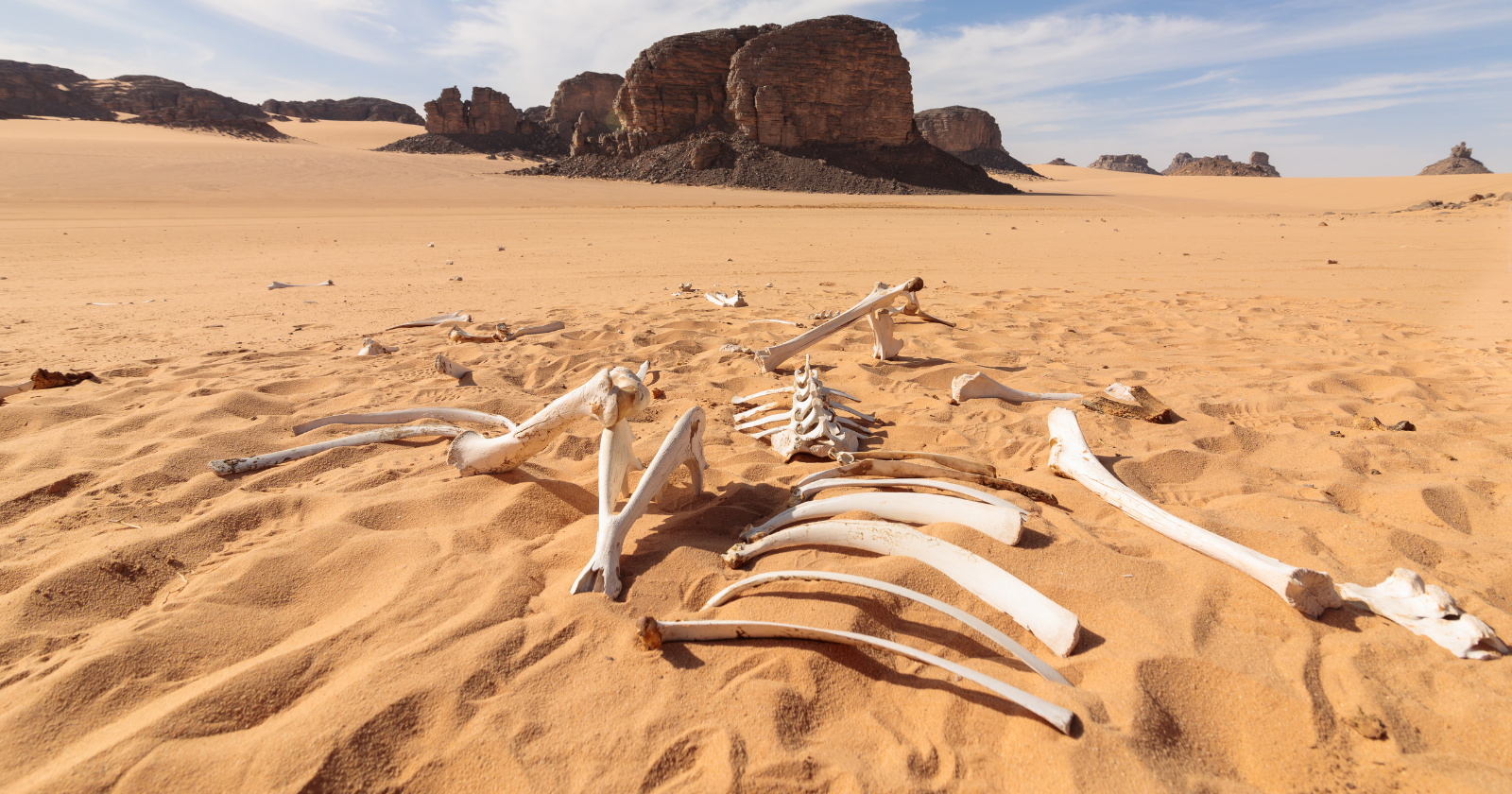
The valley sits about 150 kilometres southwest of Cairo, at the far edge of the Fayum Depression, in one of the driest parts of Egypt’s Western Desert. There is no water for a hundred miles in any direction. There is no vegetation to speak of. The wind, which never really stops in this part of the Sahara, has been sculpting the sandstone for the better part of the last few million years, and the shapes it has produced are extraordinary. What that same wind has also done, gradually and without pausing, is expose almost a thousand fossilised whale skeletons.
The site is called Wadi Al-Hitan, which translates from the Arabic as Valley of the Whales. It was first noticed by European geologists in the 1880s, first properly mapped in the early 1900s, and quietly excavated by scattered expeditions across the twentieth century. What it became, in the last four decades of that century, was the single most important collection of fossil whale skeletons anywhere in the world.
What is buried in the sand
According to the UNESCO World Heritage datasheet maintained by the UN Environment Programme’s World Conservation Monitoring Centre, which inscribed Wadi Al-Hitan on the World Heritage List in 2005, the site preserves the remains of hundreds of whale skeletons dating to approximately 37 to 40 million years ago, during the late Eocene epoch. At that time, the whole area sat under the shallow tropical waters of the ancient Tethys Sea, a warm inland ocean that once separated Africa from Eurasia and has since disappeared entirely as the continents shifted. The whales lived, mated, hunted and died in those waters. When they died, they sank into the mud of the sea floor, which slowly hardened into the sandstone that now sits, exposed and dry, in the middle of a desert.
If the Sahara fascinates you, this video we made on how it feeds the largest rainforest in the world is worth a watch:
Two species dominate the site. The larger is called Basilosaurus isis, which grew to lengths of eighteen metres, roughly the size of a modern humpback whale, though considerably longer and more serpentine in shape. Its skull alone was about a metre in length, lined with vicious serrated teeth that current thinking suggests were used to hunt smaller whales. The other main species is called Dorudon atrox, which reached lengths of around five metres, looked more like a modern dolphin than an eel, and appears to have been one of Basilosaurus’s regular meals. Several juvenile Dorudon skeletons recovered from the site have bite marks on their skulls consistent with Basilosaurus dentition. Whatever else the Tethys Sea was forty million years ago, it was, on the fossil evidence, not a gentle place.
What makes Wadi Al-Hitan genuinely different from every other fossil site of comparable age is not simply the number of whale skeletons, though nearly a thousand have now been catalogued. It is the specific state of preservation. Many of the skeletons are lying largely intact, in the postures they had settled into after death, with the bones still articulated and the finer anatomical details still visible. This is unusual. Most fossil skeletons come apart during burial and reassembly. The Wadi Al-Hitan specimens, for reasons still not fully understood, did not.
The tiny legs
Between 1985 and 1993, Professor Philip Gingerich of the University of Michigan led a series of major excavations at Wadi Al-Hitan. According to the University of Michigan’s own account of Gingerich’s fieldwork, published as part of the university’s news archive, his team made a discovery in 1989 that fundamentally altered what evolutionary biologists thought they knew about the transition of whales from land mammals to sea creatures.
On the flanks of the eighteen-metre Basilosaurus skeletons, tucked against the tail end of the body about two thirds of the way along the spine, were tiny, perfectly formed hind legs.
Not merely stumps. Not vestigial nubs of bone. Legs. Complete with femurs, shin bones, ankles, and jointed toes. Each hind leg was approximately 60 centimetres long. On an animal that reached eighteen metres in total length, they looked, on any first inspection, comically undersized. They would have poked out of the body at the flank of the whale, on either side of the base of the tail, looking like the legs of a small dog attached to something the size of a coach.
The legs were far too small to have supported the animal’s weight on land. They were also positioned wrong for propulsion in the water, being nowhere near the tail, which is where propulsive power in modern whales is generated. On the current best reading of the anatomical evidence, the tiny legs of Basilosaurus were not used for walking, and were not used for swimming. What most researchers now think they were used for is mating. The male whales, on the current biomechanical modelling, likely used the small hind limbs as guides or holdfasts during copulation, allowing the two enormous bodies to align at close range in open water without drifting apart.
This is the moment in the fossil record where the ancestors of every modern whale had become almost fully aquatic, had lost most of what made them land mammals, and yet had retained one specific piece of their four-legged past for approximately ten million years longer than they retained any other. The legs went last. After Basilosaurus, in the fossil record, the legs disappear entirely. Modern whales retain only small internal remnants of the hind limb bones, floating unattached inside the body, doing nothing at all.
Wadi Al-Hitan captures the specific moment when those legs were still there, still functional in a repurposed way, and still visible on the skeleton of an animal that had otherwise almost completely become what modern whales now are.
What the valley preserves, then, is not simply a collection of large ancient bones. It is a snapshot of one of the more thoroughly documented major evolutionary transitions in the mammalian fossil record, caught at a stage that no other site on Earth has captured in comparable detail. The whales here are neither the four-footed land ancestors that walked into the water fifty million years ago, nor the fully modern whales that would emerge on the other side. They are the transitional generation, the ones that had already given up the land, had already grown into eighteen-metre serpentine predators, had already built the vertebral column of a modern cetacean, and had, for reasons that made evolutionary sense at the time, held on to a pair of small hind legs for another few million years because those legs were useful for one specific job that mattered.
The wind in the Sahara keeps working on the sandstone. New skeletons continue to emerge every few years, exposed by erosion in valleys that no palaeontologist has yet had a chance to survey properly. Whatever else the fossil record of whale evolution is going to look like a century from now, the specific chapter that Wadi Al-Hitan writes has already been established. The whales here left their legs behind slowly, and one of the driest deserts on Earth ended up quietly preserving the last generation of whales that still had them.
Kiran Athar is not a palaeontologist or an evolutionary biologist. She writes about natural history, biology, and the ordinary corners of life where the two intersect, drawing on peer-reviewed research and primary-source scholarship.