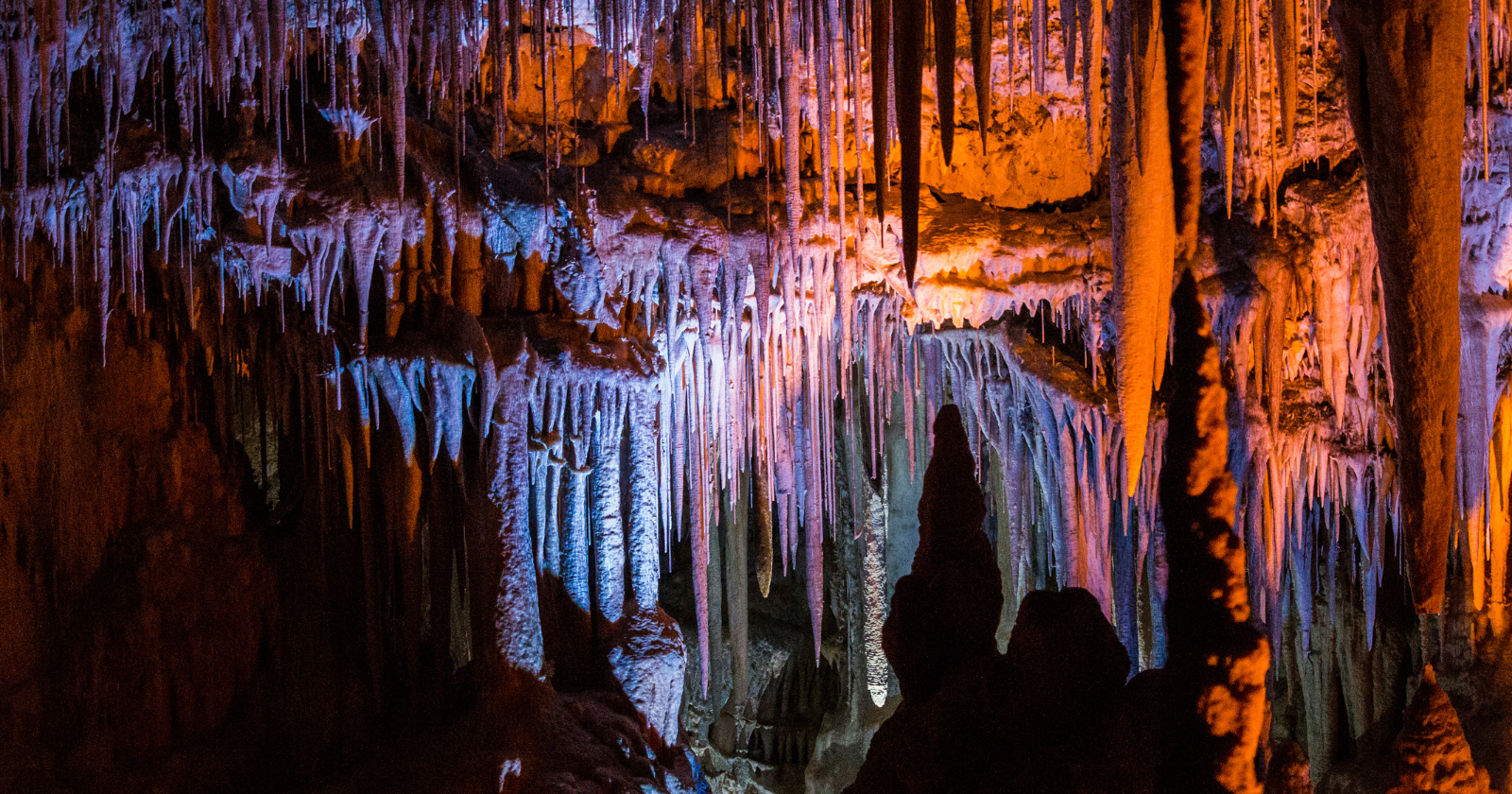
A show cave is what speleologists call any cave that has been developed for public tourism. There are around a thousand of them worldwide. Some are hundreds of thousands of years old and are famous for their prehistoric art. Others are famous for their vast subterranean chambers hung with stalactites the size of freight trains. Almost all of them are, in strict geological terms, extremely stable microclimatic environments where the temperature holds steady within a fraction of a degree year-round, the humidity sits close to saturation, and the CO2 concentration reflects the slow natural exchange between the underlying karst rock and the atmosphere above.
That stability is what allowed the formations inside to grow undisturbed over hundreds of thousands of years in the first place. It is also what makes the caves extraordinarily sensitive to any change in the air composition once the public start walking through them in significant numbers.
The problem is that people breathe. And when a group of forty tourists walks into a small underground chamber and stands there for fifteen minutes while a guide explains what they’re looking at, the collective exhalation of those forty people releases enough warm humid CO2-saturated air into the chamber to shift the entire local atmosphere in ways that the stalactites, quite literally, cannot survive if it happens often enough.
How the chemistry actually works
The mechanism is straightforward once you follow it through. Every exhaled human breath contains roughly one hundred times more CO2 than ambient outside air, along with a substantial load of water vapour at body temperature. When that breath enters a cave whose walls are cooler than the exhaled air, the water vapour immediately condenses onto the nearest cool surface, which is usually the surface of whatever calcite formation the tourists have gathered to look at. The condensed water, having formed from air that was rich in CO2, is now itself rich in dissolved CO2. Rich-in-CO2 water is acidic. Specifically it’s a weak solution of carbonic acid. And carbonic acid, when it comes into contact with calcium carbonate, which is what stalactites and stalagmites are made of, dissolves it. The formation loses a microscopic layer of surface calcite every time the process happens.
If learning about our world fascinates you, check out this video on the silent fire burning under the Arctic:
According to a 2024 peer-reviewed paper in Nature’s Scientific Reports by researchers at the Universidad de Alicante, IAA-CSIC, and CNRS France, led by Marina Sáez and coordinated by Sylvain Mangiarotti and Sergio Sánchez-Moral, the effect at Altamira Cave in Cantabria, Spain, was measured and quantified across decades of continuous instrumentation. Altamira, which was open to public tourism from 1917 through most of the twentieth century, reached CO2 concentrations of nearly 20,000 parts per million during the peak visitor era of the 1970s, when 174,613 people were passing through the cave in a single year. The natural background concentration in the region’s outside atmosphere was around 400 ppm. The concentration inside the cave was, at various moments during the 1970s, up to fifty times that. And on the calculation of a separate 1999 paper by Sánchez-Moral and colleagues, the corrosion rate on the cave’s walls during that period was enhanced by a factor of 78 compared to what would have occurred through natural processes alone.
Altamira closed to the public in 1977 after the effects became undeniable. It reopened briefly with restricted numbers between 1982 and 2002. It closed again in 2002 after biologists discovered actively growing communities of green algae, fungi, and bacteria on the walls, all of which were feeding on the microscopic quantities of skin flakes, hair fibres, and clothing lint that visitors had been shedding into the cave environment over the previous decades. The paintings themselves, which are among the most significant works of Paleolithic art anywhere in the world, are still being conserved. Only a small number of researchers now enter the cave. Everybody else visits a replica built above ground.
What’s happening in the caves still open to the public
The Altamira story is not unique. Lascaux in France, which is the other most famous Paleolithic art site in Europe, closed in 1963 for essentially the same reasons and has never reopened to the public. Chauvet Cave, which was discovered in southern France in 1994 and contains even older paintings than Lascaux, has never been open to the public at all, on the direct recommendation of the archaeologists who found it. Both sites now offer public tours of underground replicas built nearby with painstaking accuracy. Neither of the originals is likely ever to be visited by non-specialists again.
Meanwhile, the show caves that are still open to the public are dealing with the same chemistry at different scales. According to a 2021 peer-reviewed study in the journal Sustainability by Silviu Constantin and colleagues at Romania’s Emil Racoviță Institute of Speleology, monitoring four Romanian show caves over two years of continuous CO2 measurements, the Urșilor Cave in the Apuseni Mountains, which attracts more than 120,000 visitors annually, was found to have CO2 concentrations exceeding 14,000 ppm during peak summer months when up to 200 tourists were entering per hour. Point measurements taken with portable instruments during August 2016 found CO2 levels that briefly crossed the safety threshold for occupational exposure. The recovery of the cave microclimate back to normal levels was measured at approximately two weeks, meaning that during high tourist season the cave never actually returned to its natural state at all. It was in a state of continuous chemical perturbation from June through September.
The Constantin team also documented that the drip water inside the cave had become chemically aggressive to calcite, meaning that the very water dripping onto the formations that visitors were paying to see was now, because of the elevated CO2 environment the visitors themselves were producing, in the process of dissolving those formations rather than adding to them. In other words, the cave was no longer growing. It was corroding. And the visitors were the reason.
The additional complications include what speleologists call lampenflora, meaning the algae, mosses, ferns, and microbial communities that grow on cave walls in the constant illumination of the electric lights installed for the tourists. Lampenflora physically covers the calcite surfaces, blocks the natural light-sensitive processes, and produces its own weak organic acids as it grows, contributing further to the corrosion of the underlying rock. It has proven remarkably difficult to eliminate once it establishes itself. Switching to LED lighting reduces the effect but does not remove it. Chemical treatments select for resistant strains within a few generations of the microbes involved. The most reliable eradication method is total darkness for extended periods, which is exactly what a working show cave cannot provide.
The current international consensus among cave conservation specialists is essentially that the paradox is real and mostly unresolvable. The formations people want to see took hundreds of thousands of years to grow. The corrosion caused by people wanting to see them happens on human timescales, measured in decades rather than geological eras. Every extended visit shortens the future viewing life of the specific chamber being visited. Some caves have responded by drastically limiting visitor numbers, replacing lighting systems, banning group photography with flash, and building airlocks at every entrance to slow the exchange of atmospheres. Others have gone the Altamira route and closed the original site entirely in favour of a purpose-built replica above ground. And the tourists who come specifically because they want to stand inside the actual cave, breathing the actual air, looking at the actual formations, are, in the strict physical sense, the reason those formations may not be there for the tourists who come after them.