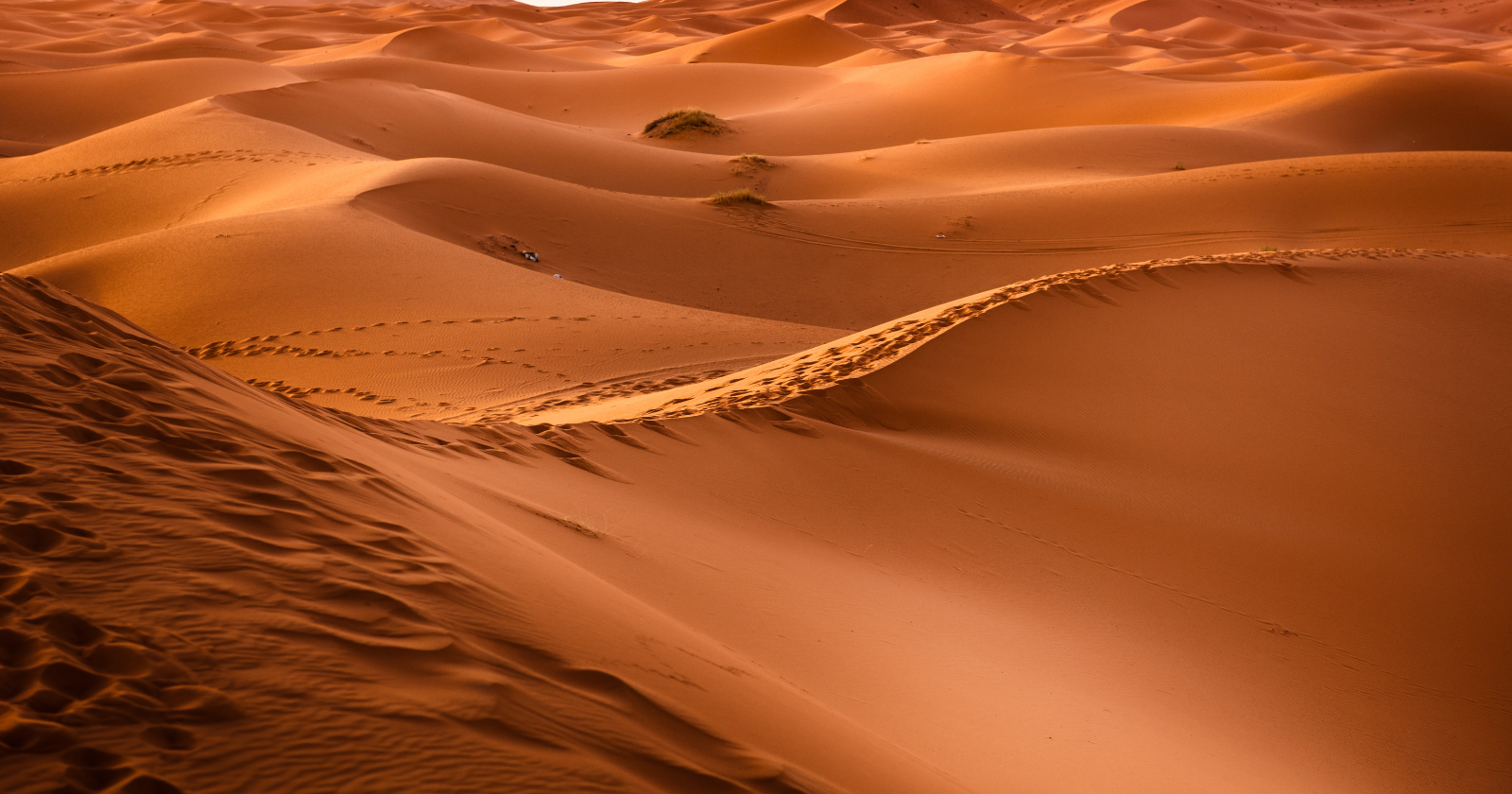
Most people, if they think about it at all, assume the yellow-gold sand they grew up with at whatever beach they went to as children is just what sand looks like. Which is understandable. That’s the version most of the world’s coastline has. But it’s not what sand actually is. It’s what sand looks like in one particular kind of place, on one particular kind of geology, and if you move to almost any other kind of coastline, the colour of the sand changes to reflect what happens to be under the ground there. It’s not incidental. It’s the whole story. What each beach looks like is a small, direct optical record of the specific rocks or organisms that broke down to produce it.
Which turns out to be one of the more useful ways of thinking about sand. Once you understand what each colour is telling you, you can walk onto almost any beach in the world and read the geology of the surrounding area from a handful of the ground.
Sand made from rock
According to the US National Park Service’s own reference material on coastal sediment composition, published in its Coastal Geology series, most of the world’s sand-producing minerals are what geologists call detrital, meaning they’ve weathered out of a solid rock somewhere and been physically transported to their eventual resting place by water or wind. The most common of them, and the reason for the yellow-gold tone of most familiar beach sand, is quartz. Quartz is a compound of silicon and oxygen. It’s colourless when pure and takes on a pale yellow, tan, or gold hue when trace amounts of iron have oxidised on its surface. It’s chemically inert and physically hard, which means it survives millions of years of weathering while softer minerals around it are broken down and washed away. Which is why quartz ends up being the last thing left standing on most temperate-zone beaches: not because there was ever a lot of it in the original rock, but because it’s the only thing that’s still there when everything else has dissolved.
Where there’s no quartz in the parent rock, or where the parent rock is something dramatically different, the sand looks nothing like what most people think of as sand.
On the subject of sand…can you imagine a world without it? This video we made dives into what the future could look like:
Black sand appears wherever a beach is receiving sediment from recently erupted volcanic rock. The dominant mineral is usually basalt, which is a dark iron-rich igneous rock produced by cooling lava. In some cases it also contains magnetite, an iron oxide dense enough to be pulled out of the sand by a strong magnet. Hawaii’s Punaluʻu Beach, Iceland’s Reynisfjara Beach, and several beaches in the Canary Islands are all made of the same thing. Molten rock hit the ocean, thermal shock shattered it into fragments, wave action ground the fragments to sand grain size, and the result was a coastline that from a distance looks the colour of tarmac.
Red sand shows up where the parent rock contains a high proportion of iron, and the sand grains have been exposed to enough oxygen and moisture over long enough time to rust. The pigment is usually hematite, meaning iron oxide, which is the same compound that rusts a garden gate. Prince Edward Island’s beaches in eastern Canada, the Kaihalulu red sand beach on Maui, and parts of the Australian outback all owe their colour to iron oxidation in the underlying sandstone. The redder the beach, the more iron the local geology has been quietly producing over evolutionary time.
Green sand is the rarest of them all. According to the Earth Science Picture of the Day, a service maintained by NASA’s Universities Space Research Association, on the geology of Hawaii’s Papakōlea Beach, only a handful of green sand beaches exist anywhere on Earth. Papakōlea, near the southern tip of Hawaii’s Big Island, is the best known. The mineral responsible is called olivine, a magnesium-iron silicate that forms early in the cooling of certain volcanic magmas and is significantly denser than the ash and rock that ordinarily surrounds it. Where a volcano’s cinder cone is being eroded by the sea, the lighter volcanic ash gets carried out into the ocean and the heavier olivine grains stay behind. Over centuries, the beach itself accumulates as a concentrated deposit of these dense green crystals. The gem-quality version of olivine is called peridot, and it’s the birthstone for August. What sits at Papakōlea is essentially peridot ground to sand grain size and left to accumulate in the wake of a partially collapsed volcanic vent.
Sand made from living things
Everything above involves sand that started as rock. In the tropics, particularly around coral reefs, a different story is unfolding, and it’s producing the other two colours the popular imagination associates with beaches.
Tropical white sand isn’t quartz. It’s calcium carbonate, meaning the crushed and eroded skeletons of marine organisms. Coral fragments, mollusc shells, calcareous algae, and the excreted digestive output of parrotfish, which spend their days scraping algae off coral and passing the ground carbonate through their guts as fine white sand, all contribute to the powder-white beaches of the Bahamas, the Maldives, and much of the Caribbean. A single adult parrotfish can produce approximately several hundred pounds of white sand per year in this way. What looks from a distance like a beach is, at the level of individual grains, the accumulated skeletal output of a functioning reef ecosystem.
Pink sand is the same story with one extra ingredient. According to reporting by The Bermudian magazine, drawing on the Bermuda Institute of Ocean Sciences’ research on the phenomenon, Bermuda’s characteristically blush-pink beaches owe their colour to a specific single-celled organism called Homotrema rubrum. It’s a red foraminifera, meaning a tiny amoeba-like protist that builds a hard shell of calcium carbonate around itself, tinted red by iron oxide the organism incorporates from surrounding seawater. Homotrema rubrum lives in dense colonies on the undersides of coral ledges throughout Bermuda’s reef system. When the organisms die, or when wave action or predation by parrotfish crushes them, the red shell fragments are washed onto the beach along with the ordinary white carbonate sand. The mix of pale white and vivid red produces the delicate rose tint that Bermuda’s tourism industry has been building brochures around for a century. The Bahamas’ pink beaches, particularly at Harbour Island on Eleuthera, get their colour the same way.
What all of this adds up to is that the colour of a beach isn’t decorative. It’s diagnostic. A white beach in the Caribbean is telling you there’s a coral reef nearby. A pink beach is telling you there’s a specific foraminifera colonising the underside of that reef. A black beach is telling you there’s been a volcanic eruption within geological memory. A green beach is telling you olivine-bearing lava has been erupted, eroded, and sorted by wave action for long enough to concentrate the heavier crystals. A red beach is telling you the local rocks are rich in iron and have been oxidising for a very long time.
Which means the yellow-gold beach most people grew up with is telling its own particular story too. The land nearby is old and mostly weathered. The reactive minerals broke down long ago. What’s left, ground down over millions of years, is mostly quartz, mildly rusted at the surface, patient enough to have outlasted almost everything else that was ever part of the rock it came from. Even the most ordinary-looking beach on Earth is a geological fingerprint. Most people just never stop to read it.
Kiran Athar writes about the natural world and the ordinary corners of it where science and everyday experience intersect. This piece draws on institutional reference material from the US National Park Service, Earth Science Picture of the Day, and the Bermuda Institute of Ocean Sciences.