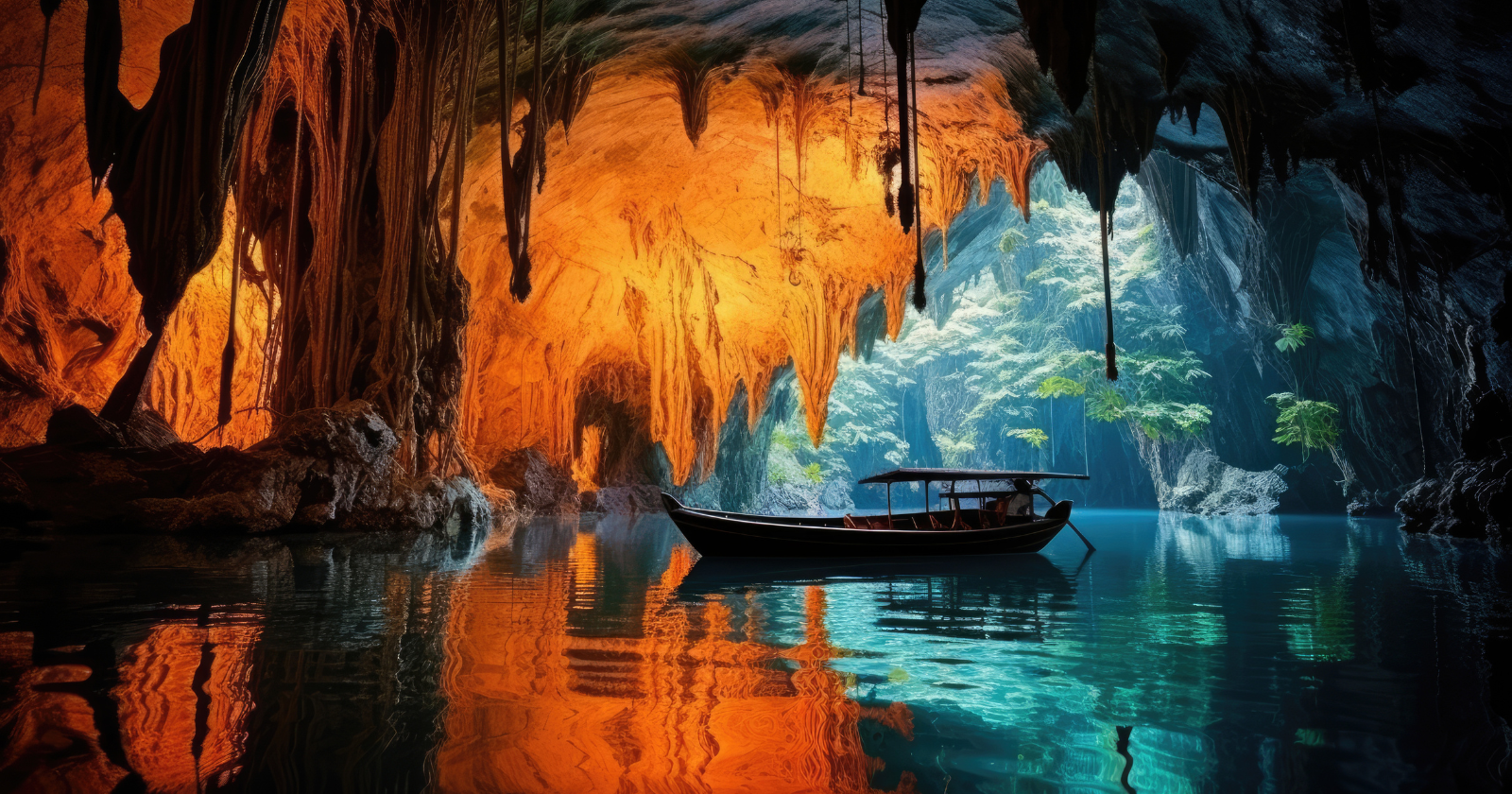
The cave is called Hang Sơn Đoòng, which translates roughly as Mountain River Cave, and it sits in the karst limestone country of central Vietnam, in a national park about halfway between Hanoi and Ho Chi Minh City called Phong Nha-Kẻ Bàng. What makes it unusual isn’t just that it’s the largest known cave passage on Earth by volume, though it is. What makes it unusual is that once you’re inside it, on the accumulated evidence of the small number of people who’ve been in, the categories that ordinarily separate the outside world from the inside of a cave stop working. There’s weather. There’s jungle. There’s a river. There’s light. And the space is on such a scale that most human intuitions about what a cave is supposed to look like just don’t survive contact with the interior.
How the cave was found
The story of the discovery involves one local Vietnamese farmer who wasn’t quite believed for nineteen years. According to the detailed exploration history compiled by Oxalis Adventure, the tour operator based in Phong Nha that holds the exclusive rights to run expeditions into the cave, a forest worker called Hồ Khanh was crossing the jungle of Phong Nha-Kẻ Bàng in late 1990 when a storm forced him toward a limestone cliff for shelter. He noticed a dark opening in the rock face, felt a blast of freezing air pouring out of it, saw clouds billowing from the entrance, and heard the sound of a river somewhere far below. The combination unsettled him. He walked away. And by the time he made it home, he had lost his exact bearings on where the opening was.
Ho Khanh had spent much of his early life foraging through the jungles of the park and had a good working knowledge of the region’s caves. He kept trying to relocate the entrance. Years passed. When members of the British Cave Research Association, led by the experienced husband-and-wife caving team Howard and Deb Limbert, arrived in the area in 2007 to survey the region’s karst geology, Ho Khanh told them about the cave he had briefly seen but couldn’t find. They asked him to keep looking. He kept trying. And in 2008, on another foraging trip through the same stretch of forest, he stumbled onto the entrance again and this time carefully committed the route to memory.
If you enjoy learning about the weird and wonderful parts of our world, check out this video we made on how one side of the world is feeding the other…
On 7 April 2009, Ho Khanh led the British Cave Research Association team to the entrance. Peter MacNab was the first member of the caving team to step inside. Within a few days of the initial descent, the team realised what they were standing in. The cave was five times larger than Deer Cave in Malaysia, which had until that moment held the title of the world’s largest known cave passage. On 14 April 2009, the team formally announced the finding. It took another year to complete the full survey, which required them to climb an internal calcite formation known now as the Great Wall of Vietnam, a ninety-metre-tall barrier of mineral flowstone that had made further progress into the cave physically impossible until the team drilled anchor points and rigged ladders up its face. The final measurements, on their eventual publication in March 2010, gave the cave a total length of just under nine kilometres and an interior volume of 38.5 million cubic metres.
The 40-storey skyscraper comparison, on Oxalis’s own subsequent estimation, isn’t the largest possible framing. A New York City block’s worth of 40-storey buildings could stand inside the cave’s main chamber. A Boeing 747 could fly through the widest sections. Whatever spatial reference the popular science coverage has reached for over the past decade, none of it has quite conveyed the specific scale of what’s actually in there.
What the interior does that no other cave does
The reason the interior looks the way it does comes down to two enormous holes in the ceiling. These are called dolines, and they formed when sections of the cave roof, tens of thousands of years ago, gave way and collapsed inward. What that left were two vast skylights, each hundreds of metres across, that let sunlight, rain, and outside air into the interior of the cave. Which is what makes everything else about Sơn Đoòng possible.
According to reporting by Mark Jenkins for National Geographic magazine, accompanying the 2010 mapping expedition that photographer Carsten Peter documented for the magazine’s May 2011 feature “Conquering an Infinite Cave”, the two dolines produce a specific set of biological consequences. Beneath each one, the shafts of daylight reaching the cave floor have grown two complete jungle patches inside the cave. The Vietnamese botanist Dai Inh Vu, who identified the plants growing under the skylights, found essentially the same species mix as grows in the forest outside. Which is to say the cave contains two ordinary Vietnamese rainforest patches, complete with vines, tree ferns, and full canopy structure, each one enclosed by cave walls hundreds of metres high on all sides. Above them, deep inside the darker chambers, the German biologist Anette Becher documented cave-adapted animals living independently of the surface ecosystem, including wood lice, fish, and millipedes that had lost all pigment through evolutionary adaptation to the darkness. White creatures beneath a black ceiling, in a jungle underneath a hole in the roof.
The weather system comes from the same dolines. According to reporting by AccuWeather drawing on a direct interview with Howard Limbert about the interior conditions, the temperature inside the cave is remarkably stable across the year, sitting between roughly 17 and 25 degrees Celsius depending on the season. Outside, in the surrounding Vietnamese jungle, temperatures reach nearly 40 degrees in summer and drop into the low tens in winter. What happens when warm humid outside air pours in through the dolines and meets the cool constant air of the cave interior is exactly what happens when a warm humid air mass meets a cool one anywhere else on the planet. The moisture condenses. Clouds form. Fog rolls through the chambers. Whole layers of white vapour drift near the ceiling in the summer months, and light from the skylights above scatters through them in ways that produce, on the surviving film and photography, some of the strangest interior atmospheric footage ever captured underground.
None of which is stable in the strong sense. The cave keeps changing. According to the same National Geographic reporting, the same conditions that produce the clouds also, very slowly, keep dissolving the cave itself. Condensation runs down the walls, picks up carbonic acid from the air, and dissolves fractional amounts of limestone from the surfaces it touches. Over millions of years, this is how Hang Sơn Đoòng grew to its current size in the first place. And on the same mechanism, it will continue to grow, imperceptibly, for as long as the river underneath it keeps running and the doline skylights keep letting weather in.
The cave is estimated to be between two and five million years old. Human beings have been inside it for approximately fifteen years. Which means that, on almost any timescale that matters geologically, the whole thing has been forming in exactly the way it currently is, in exactly the place it currently sits, for a period on the order of a thousand times longer than any human has ever known it existed. And now that it’s known, only about a thousand people per year are allowed inside. Which is not many, when you consider that whatever else Hang Sơn Đoòng is, it’s the largest fully enclosed natural space anywhere on the surface of the planet, and it grew all of it in the dark, alone, without any of us watching.
Kiran Athar writes about the natural world and the ordinary corners of it where science and everyday experience intersect. This piece draws on National Geographic’s 2011 expedition-based reporting, direct interviews with the British Cave Research Association leadership published by AccuWeather, and the exploration timeline maintained by Oxalis Adventure, the tour operator that runs expeditions into the cave.