The cheetah, on almost every popular list of the world’s fastest animals, gets first billing. It’s a fair enough call as far as ground-running goes. A wild cheetah at full stretch across the East African savannah can hit somewhere between 70 and 75 miles per hour. Nothing else on four legs comes close. Which is why the cheetah is the answer most people give if asked what the fastest animal on the planet is, and why most people are wrong.
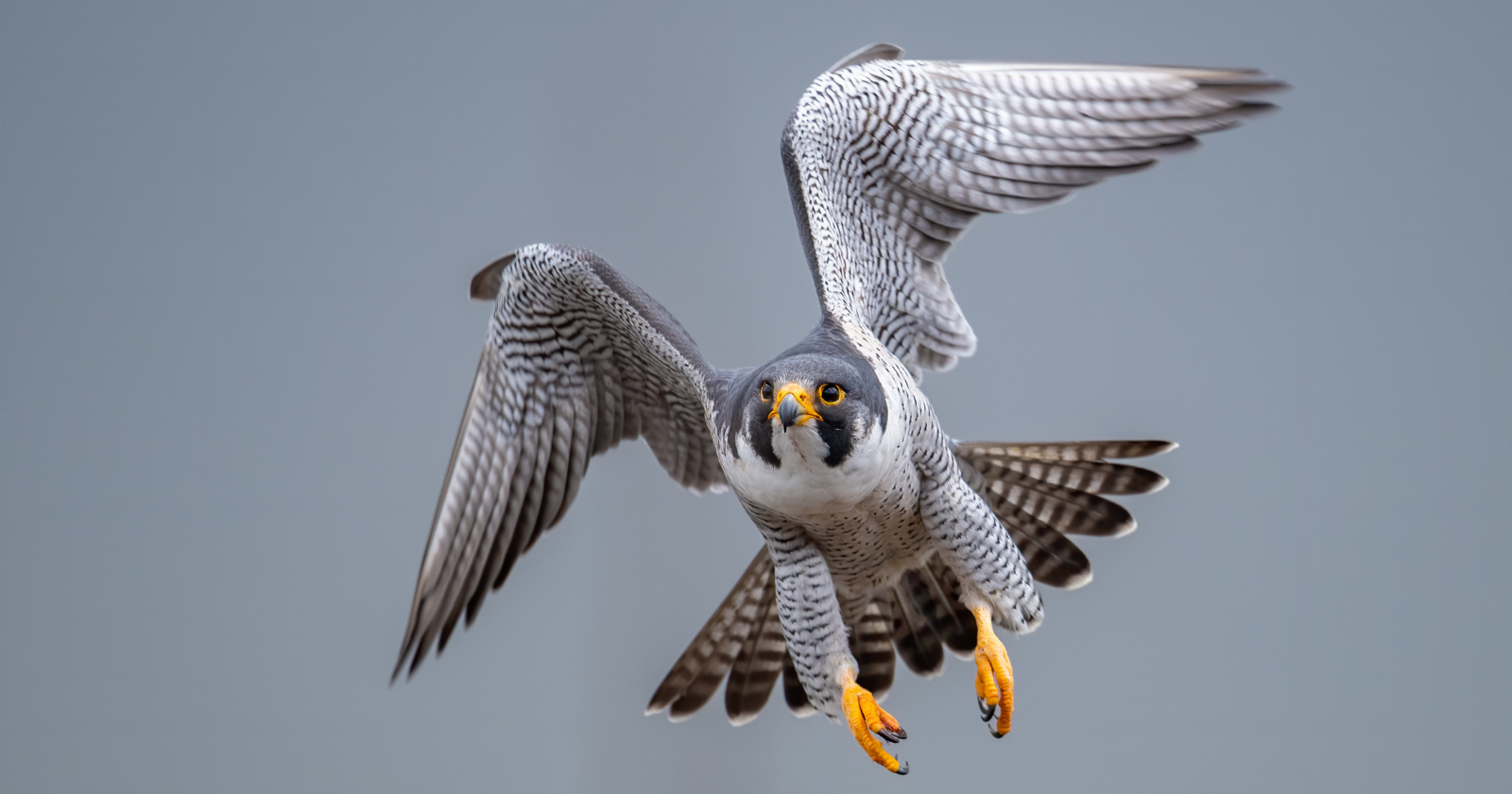
The actual answer, on the accumulated evidence of the last quarter century of aerodynamic research, is a bird about the size of a large crow. It weighs less than a kilogram. It’s called the peregrine falcon. And when it goes into its hunting dive, called a stoop, it moves through the air at roughly three and a half times the speed of the fastest cheetah on the fastest afternoon of its life.
What the stoop actually is
When a peregrine spots prey below it, usually another bird in flight, it does something that no other predator on Earth does in quite the same way. It climbs to altitude, sometimes to several thousand feet, positions itself directly above the target, and then folds. The wings pull tight against the body. The tail closes. The legs tuck up. The head goes down. Whatever was a bird a moment earlier becomes something closer to a small teardrop-shaped projectile, and the projectile drops.
If you love learning about our fascinating animal kingdom, you’ll enjoy this video on the wolves that rebuilt Yellowstone:
The stoop uses gravity in a way most birds can’t. Because the peregrine has voluntarily minimised its wing surface, it isn’t fighting drag the way an ordinary bird in flight is. It’s accelerating almost as if it were an inert falling object, but with a body shape that keeps the airflow smooth and stable rather than chaotic. Small feathered vanes near the nostrils, called nasal tubercles, divert the incoming air so the bird can still breathe at speeds that would otherwise force air into its lungs faster than the lungs can handle. The skeleton is unusually rigid and reinforced. The specific configuration of feathers and body geometry is, on the current understanding of avian biomechanics, one of the more efficient falling shapes any vertebrate has ever evolved.
When the falcon reaches the prey, it doesn’t so much attack as collide. The talons of one foot are balled into a small hard fist, roughly the size and density of a rock. On some hunts the peregrine passes the prey without grabbing it, striking it with the balled foot at full speed. On the impact, most small birds die instantly. The peregrine then circles back around, lands on the falling body, and takes it to a perch to eat. On other hunts the peregrine grabs the prey directly out of the air. Either way, the killing mechanism runs entirely on the kinetic energy of the dive. The falcon isn’t doing damage with muscle strength or venom or teeth. It’s doing damage with the speed at which its body is moving through the air.
How anyone knows how fast they actually go
The obvious problem with measuring how fast a peregrine can dive is that peregrines don’t dive when it’s convenient. They dive when they’re hunting, at whatever altitude, over whatever terrain, in whatever direction the prey happens to be. Trying to point a radar gun at one has been described by researchers as roughly comparable to trying to time a bullet by watching where it hits. For most of the twentieth century, estimates of peregrine dive speed ran anywhere from 70 miles per hour to over 300, depending on who was making the estimate and what method they were using. Nobody had a properly measured figure.
The two studies that changed that took different approaches and measured different things. According to Guinness World Records’ official documentation of the current record for the fastest diving bird, an American falconer named Ken Franklin, working with a female peregrine named Frightful, developed a technique for measuring maximum dive speed by training the bird to skydive with him. Franklin would climb to seventeen thousand feet in a Cessna 172, jump out with Frightful, and time her dive using a combination of a wing-mounted computer, altimeters on his own suit, and camera equipment on a second skydiving cameraman also falling alongside them. In a series of 1999 dives, Frightful was clocked at 242 miles per hour, or 389 kilometres per hour, during a stoop from roughly three miles up. Guinness accepted the measurement as the world record for the fastest bird in flight.
Franklin’s method measured the top speed. What it couldn’t do was show researchers what the falcon’s body was actually doing at that speed. Which is where the second study, and the 60-metre dam of the popular framing, comes in.
According to a 2014 paper by Benjamin Ponitz, Anke Schmitz, Dominik Fischer, Horst Bleckmann and Christoph Brücker at the Rheinische Friedrich-Wilhelms-Universität Bonn and Technical University Bergakademie Freiberg in Germany, published in PLOS ONE under the title “Diving-Flight Aerodynamics of a Peregrine Falcon”, the researchers took the exact opposite approach to Franklin’s. Rather than trying to measure the falcon at maximum altitude, they trained the birds to dive along a controlled reference surface where high-speed cameras could accurately map the changing shape of the body at every stage of the descent. They used the wall of the Olef-Talsperre dam in Hellenthal, Germany, which stands 60 metres high, has a well-marked surface, and points south so that shadows on the images would be minimal. The falcons dived past the dam wall 35 separate times. Two calibrated high-speed cameras and a high-resolution digital camera captured every dive from multiple angles.
The Ponitz study wasn’t measuring top speed, which the dam wasn’t tall enough for the falcons to reach anyway. It was measuring what the falcon does with its body as it accelerates. The wings pull in progressively. The tail spreads and then closes again to make small course corrections. The body forms a specific teardrop shape with the wings held out at approximately fifty degrees from vertical to control the descent angle. The whole thing was aerodynamically extraordinary. From the images and the wind-tunnel work the team did afterwards using a scaled model of a peregrine, they were able to work out that peregrines in a full stoop from sufficient altitude could exceed 320 kilometres per hour before terminal velocity slowed further acceleration.
Which put the peer-reviewed number close to what Franklin’s more controversial 1999 record had claimed. According to Smithsonian Air & Space magazine’s feature on the Franklin dives, which included direct interviews with Franklin about his methods, the falconer’s own summary of the situation was straightforward. Studying falcons from the ground, he said, is like studying sharks from a boat. If you want to know what the animal actually does at full speed, you have to be in the air with it, moving at the same rate, watching what it does. And what it does, on the combined evidence of Franklin’s high-altitude measurements and the Ponitz team’s controlled aerodynamic work, is fly at speeds no other animal on Earth has ever been reliably shown to reach under its own power.
Kiran Athar writes about biology, the natural world, and the ordinary corners of both where science and everyday experience intersect. This piece draws on the Guinness World Records official documentation, a peer-reviewed 2014 aerodynamics paper published in PLOS ONE, and Smithsonian Air & Space magazine’s expanded reporting on the Franklin measurements.