

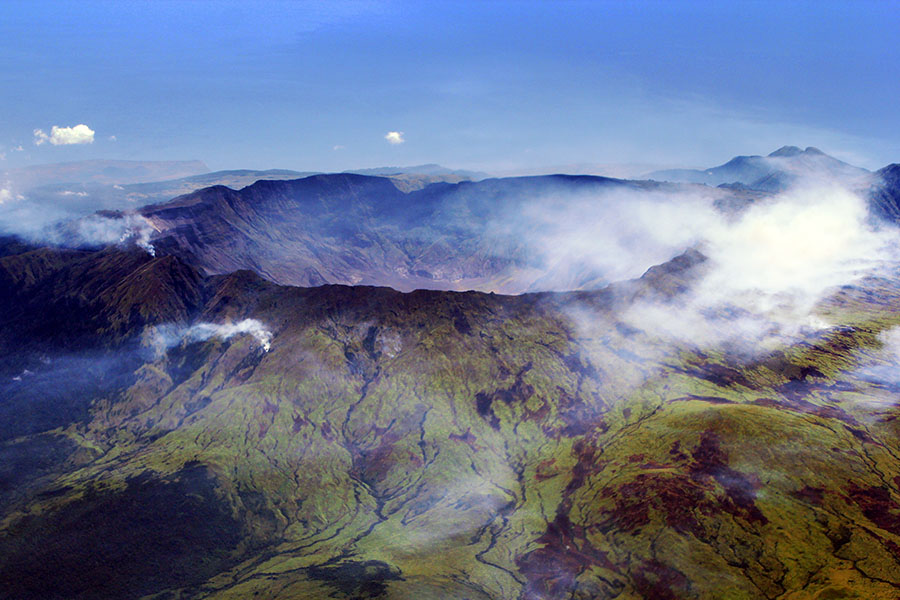
On the evening of 5 April 1815, the residents of Java and surrounding Indonesian islands heard what they believed were cannon shots in the distance. British colonial administrators dispatched troops to investigate, assuming a naval engagement was underway somewhere offshore. The sounds were heard as far away as Sumatra, more than 2,000 kilometres from their source, and continued intermittently for five days.
They were not cannon shots. They were the opening sounds of the largest volcanic eruption in modern human history.
On the evening of 10 April 1815, Mount Tambora on the small Indonesian island of Sumbawa entered its climactic phase. The volcano ejected approximately 160 cubic kilometres of pulverised rock, ash, and pumice into the atmosphere over the following 24 hours, sent a column of ash and sulphur dioxide approximately 43 kilometres into the stratosphere, and reduced its own mountain in height from approximately 4,300 metres to approximately 2,850 metres. The pyroclastic flows that descended the mountain’s flanks killed approximately 11,000 people in the surrounding region directly, in the first day of the event. The famines and disease that followed across the Indonesian archipelago over the next several months killed approximately 60,000 to 80,000 more.
The eruption was, by the available geological measurements, a Volcanic Explosivity Index 7 event, the highest VEI rating documented in modern human historical records since the eruption of Mount Samalas in Indonesia in 1257. The sulphur dioxide injected into the stratosphere spread around the planet over the following months, where it converted to sulphate aerosol and reflected solar radiation back into space. The consequences of that radiative shift, on the available climate evidence, were felt across every continent in the Northern Hemisphere over the subsequent two years.
The mechanism
A peer-reviewed climate model reconstruction of the Tambora eruption, published in 2017 in Nature Communications by John Fasullo and colleagues at the National Center for Atmospheric Research, established the basic physical pathway through which a single volcanic eruption on a small Indonesian island could disrupt the climate of the entire Northern Hemisphere. The eruption injected approximately 60 million tonnes of sulphur dioxide into the stratosphere, which is the upper layer of the atmosphere above approximately 10 kilometres altitude where there is no weather to wash particles back to the surface. The sulphur dioxide converted to sulphate aerosol over the following weeks and months, forming a thin reflective layer that spread around the planet on the prevailing stratospheric circulation.
The sulphate aerosol layer reflected approximately 6 watts per square metre of incoming solar radiation back into space at its peak, on the Fasullo team’s modelling. The result was a measurable cooling of the planet’s surface by approximately 0.4 to 0.7 degrees Celsius averaged across 1816, with substantially larger regional anomalies in the Northern Hemisphere where the cooling concentrated in the summer growing season. The cooling was not uniform. It was unusually severe in northeastern North America, in western and central Europe, and in scattered parts of Asia, where the combination of stratospheric aerosol cover and disrupted atmospheric circulation produced the coldest summer recorded in approximately two centuries.
The Fasullo team’s analysis also identified secondary effects in the ocean and the cryosphere. The sea surface in the North Atlantic cooled measurably, the Arctic sea ice extended further south than the modern average, and the changes in surface temperature gradients altered the prevailing wind patterns over Europe and North America. The 1816 climate disruption was, on the available evidence, not simply a cold year. It was a fundamental reorganisation of atmospheric and oceanic circulation that took approximately two years to dissipate.
The year without a summer
The summer of 1816 was, in the lived experience of people in the affected regions, unlike anything they had ever encountered. In New England, frost fell every month of the year. Crops planted in the spring froze in June and again in July and again in August. The harvest of 1816 across northern New England was substantially less than half of normal, and in many communities was almost entirely lost. The price of wheat in the region more than doubled. The price of oats, used to feed horses on which all overland transport then depended, increased by approximately 800 per cent over the following winter.
In western and central Europe, the same pattern unfolded with similar severity. The 1816 harvest in France, Switzerland, the German states, and the United Kingdom failed across most major crops. Bread prices in some affected regions doubled within months. Riots over food broke out in Ireland, Wales, England, France, and Switzerland during the autumn and winter of 1816 and into 1817. The Swiss government declared a national emergency. The British government dispatched soldiers to suppress food riots in the manufacturing towns of the Midlands.
The death toll in Europe and North America during 1816 and 1817 from famine and the diseases that followed it was substantial but is difficult to determine precisely from the surviving records. Historical demographic studies have estimated approximately 100,000 to 200,000 excess deaths in Europe alone from famine, typhus, and other epidemic diseases in the two years following the eruption. The combined death toll from the direct eruption and the subsequent climate-driven famine and disease was, on the available estimates, well in excess of the 90,000 figure most commonly cited for the eruption itself.
The cholera connection
In 1817, in the Bengal region of British India, an outbreak of a previously regional disease began to spread along trade routes in a pattern that had not been observed before. The disease was Vibrio cholerae infection, which had been endemic in the Ganges Delta for centuries without major geographic expansion. In 1817 and 1818, it spread for the first time outside South Asia, reaching Southeast Asia, the Middle East, East Africa, and southern Europe through maritime trade routes and pilgrim caravans. The first global cholera pandemic, which would kill millions of people across Asia, Europe, and the Americas over the following decades, had begun.
The causal connection between the Tambora climate disruption and the emergence of the first cholera pandemic is suggestive rather than definitively established. The peer-reviewed epidemiological evidence, however, points to several plausible pathways. The climate disruption in South Asia in 1816 and 1817 included anomalous monsoon patterns that altered the salinity and temperature of estuarine waters in the Ganges Delta where Vibrio cholerae lives in its environmental reservoir. The disruption may have produced a strain variant with enhanced epidemic potential, or may have altered human population movements and water supplies in ways that facilitated the disease’s geographic expansion. The precise mechanism is contested in the peer-reviewed literature, but the temporal coincidence between the Tambora climate disruption and the emergence of cholera as a global disease is striking enough that the connection is treated as plausible in the standard epidemiological histories.
Frankenstein at Lake Geneva
In May 1816, a small group of British travellers arrived at the Villa Diodati on the shores of Lake Geneva in Switzerland. The group included the poet Percy Bysshe Shelley, his 18-year-old companion Mary Wollstonecraft Godwin, her stepsister Claire Clairmont, the poet Lord Byron, and Byron’s personal physician John Polidori. The plan had been to spend the summer of 1816 in the mountains, walking, sailing, and writing.
The summer at Lake Geneva did not unfold according to plan. The weather throughout June and July 1816 was, in Mary Godwin’s own description, “ungenial.” Cold rain fell for weeks at a time. Storms produced lightning across the lake almost nightly. The group was confined to the villa for days at a stretch by weather conditions that prevented outdoor activity of any kind. Lord Byron proposed, during one of these confinements, that each member of the group should write a ghost story to pass the time.
Mary Godwin, who would marry Percy Shelley later that year and become Mary Shelley, began work on a story about a scientist who reanimates dead tissue to create a living human being. The story expanded into a full novel over the following twelve months. Frankenstein, or The Modern Prometheus was published anonymously in 1818. Byron’s contribution to the same evening’s competition expanded into “Darkness,” one of the most haunting poems in the Romantic tradition, which begins with the line “I had a dream, which was not all a dream” and proceeds to describe a world in which the sun has been extinguished and the surviving humans are reduced to scavenging among the ruins. Polidori’s contribution became “The Vampyre,” the foundational text of modern vampire fiction.
The literary record of the summer of 1816, on the strongest available reading of the contemporary correspondence and diaries, was substantially shaped by the weather the visitors at the Villa Diodati were experiencing. The unending storms, the failed harvests, the death of livestock in nearby fields, and the visible distress of the local population would all have been part of the daily atmosphere in which Frankenstein, “Darkness,” and “The Vampyre” were composed. The works are not literal descriptions of the climate of 1816, but they were written by people inhabiting a world that had been visibly disrupted by something none of them yet understood.
The island record
A 2023 peer-reviewed study by Nick Wilson at the University of Otago and colleagues, published in Scientific Reports, examined the impact of the Tambora eruption on a global sample of 31 large populated islands. The team analysed contemporary climate records, historical demographic data, and modern climate model reconstructions to test the breadth of the eruption’s effects. The result was that 29 of the 29 islands with sufficient surviving data showed measurable weather and climate anomalies in the 1815 to 1817 period. The disruption was not regional. It was global, and it touched every populated region of the Northern Hemisphere for which records survive, with substantial measurable effects in parts of the Southern Hemisphere as well.
The Wilson team’s secondary purpose was to use the Tambora event as a case study for what a comparable future eruption might do to modern global civilisation. Their analysis suggests that island nations may have some long-term survival value during sun-blocking catastrophes of this kind, because the moderating influence of surrounding ocean reduces the severity of local cooling compared with continental interiors. The Fasullo 2017 modelling, however, suggested the opposite outcome for a future analogous eruption occurring under conditions of contemporary global warming. The increased ocean stratification produced by anthropogenic warming, on the Fasullo modelling, would amplify rather than dampen the surface cooling response to a major volcanic event.
The honest limitations
Several methodological caveats apply to the literature described above.
The exact death toll of the Tambora eruption is genuinely uncertain. The 90,000 figure most commonly cited is the sum of approximately 11,000 direct pyroclastic-flow deaths and approximately 80,000 deaths from famine and disease across the Indonesian archipelago in the months following the eruption. The figure is based on incomplete colonial-era population estimates and may be substantially understated. Death tolls from the European and North American famine of 1816 and 1817 are also approximate and depend on assumptions about background mortality rates that vary across the affected regions.
The causal connection between the Tambora climate disruption and the first global cholera pandemic is plausible but not definitively established. Cholera could have emerged as a global pandemic for reasons unrelated to the volcanic climate disruption, and the temporal coincidence between the two events does not by itself prove a causal relationship. The peer-reviewed epidemiological literature treats the connection as suggestive rather than confirmed.
The literary record of the summer of 1816 at Lake Geneva is contemporaneous and well-documented, but the causal claim that Frankenstein would not have been written without the Tambora eruption is unprovable. Mary Shelley was a writer of extraordinary capability working in a Romantic literary tradition that had been engaging with themes of nature, reanimation, and human limits for decades before 1816. What can be said with confidence is that the specific conditions under which she began Frankenstein were produced by the Tambora climate disruption, and that the atmosphere of the novel reflects the atmosphere of the summer in which it was conceived.
What it means
Several things follow from the Tambora evidence that are worth saying clearly.
The first is that a single volcanic eruption on a small Indonesian island can, under the right conditions, disrupt the climate of the entire Northern Hemisphere for more than a year, kill substantially more than 100,000 people across multiple continents through cascading consequences, and reshape the political, economic, and literary history of the early nineteenth century. The Tambora event is not a hypothetical or a model. It is a documented historical case of how a relatively brief geological event can produce sustained global human consequences on a scale that the popular framing of volcanic eruptions does not typically include.
The second is that the population of the world in 1815 was approximately 1 billion people. The population of the world in 2026 is approximately 8.2 billion. The agricultural systems on which modern populations depend are, on most relevant measures, more efficient and more productive than those of the early nineteenth century. They are also more centralised, more dependent on global trade networks, and more vulnerable to simultaneous disruption in multiple regions than the agricultural systems of 1815. A Tambora-magnitude eruption occurring under modern conditions would, on the Fasullo 2017 modelling, produce a substantially larger surface cooling than the 1815 event produced, in part because of ocean stratification changes driven by anthropogenic warming.
The third is that VEI 7 eruptions occur, on the available geological record, approximately once every several hundred to one thousand years. The Samalas eruption of 1257 was VEI 7. The Tambora eruption of 1815 was VEI 7. The next VEI 7 eruption, on the available statistical evidence, is more likely than not to occur within the next several centuries. The geological systems involved are not predictable on human time scales, and the next event could occur tomorrow, or could occur in 800 years. What is clear from the peer-reviewed record is that the next event will produce consequences comparable to the 1815 Tambora eruption, on a planet substantially less prepared for them than the world of 1815 was.
The fourth, on the strongest current reading of approximately two centuries of geological, climatological, demographic, and literary evidence, is that the most consequential single event in the early nineteenth century may have been a geological one in a place that almost no one in Europe or North America had ever heard of, and the most enduring literary record of that event is a novel about a scientist who creates a living being out of dead matter and then cannot bring himself to recognise it as his own.
Mary Shelley was eighteen years old when she began writing Frankenstein.
The volcano had erupted the previous April.
The summer at Lake Geneva was the coldest in living memory, and nothing in the world that summer was behaving as anyone had expected it to.