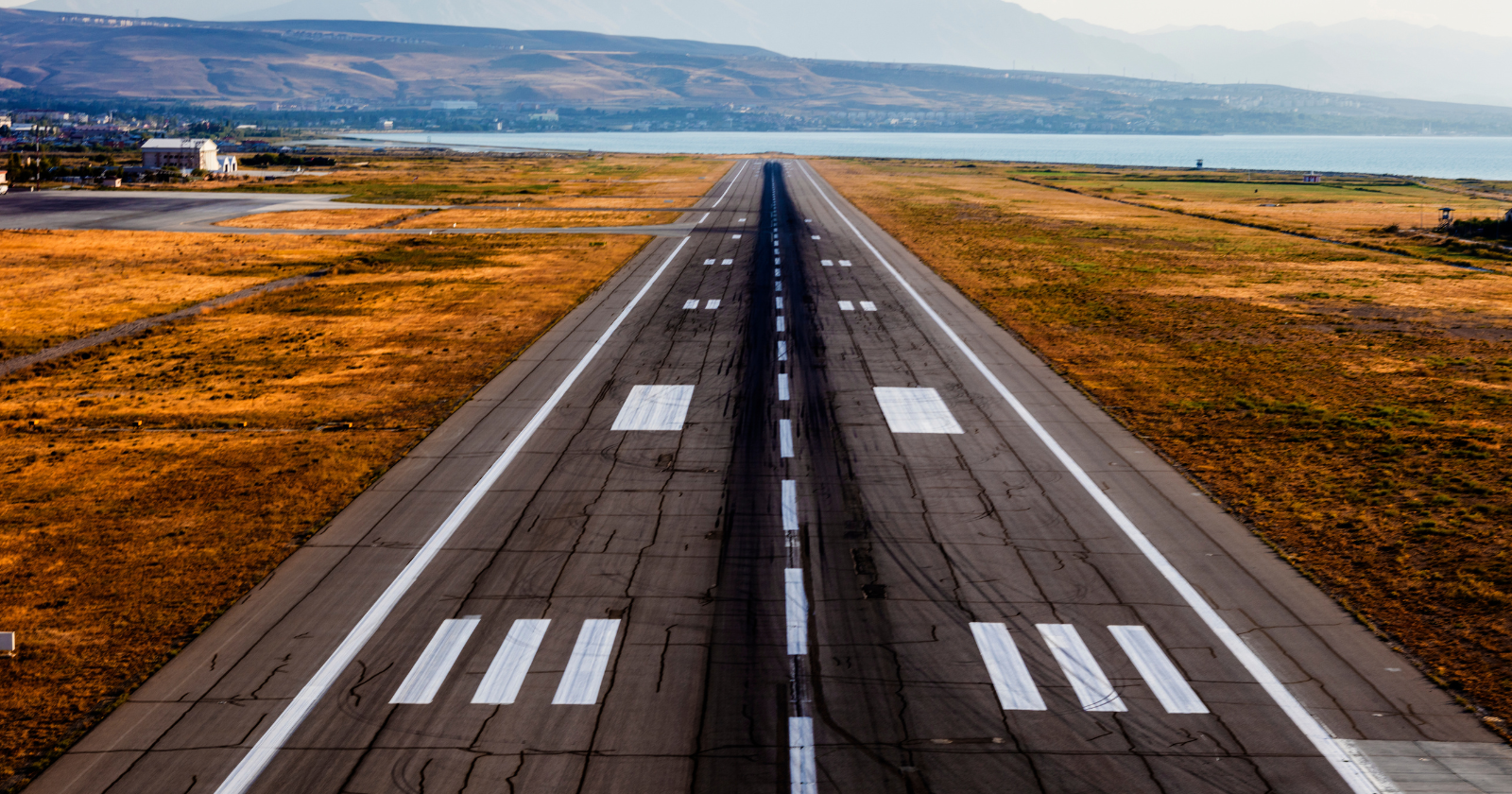
The scene is easier to imagine than to explain. An airport shuts down one of its main runways for a week. A crew arrives with hundreds of pounds of paint and a stack of new metal signs. They spend several days scrubbing the existing numbers off the pavement, painting new ones a few digits higher, replacing every taxiway sign that referenced the old designation, and updating the airport’s charts. When the runway reopens, it has a different name than it did the week before. The gate agents make no announcement. The passengers do not notice. The specific reason the airport had to do any of this originates roughly 2,900 kilometres beneath their feet, in a region of the planet no human being will ever visit.
What is happening down there is not, on any casual reading of the situation, connected in an obvious way to what is happening on the pavement. But it is.
What the numbers actually mean
Every runway in almost every commercial airport on Earth is marked with a two-digit number painted on the tarmac at both ends, and the number is not arbitrary. It is a compass bearing. Take the magnetic direction the runway points in, expressed in degrees between zero and 360, round it to the nearest ten, and drop the final zero. The result is the runway’s official designator. A runway pointing due east, at a magnetic bearing of 90 degrees, is Runway 9. The same runway, viewed from the other end, points at 270 degrees, which makes it Runway 27. Every pilot arriving at the airport reads the number on the pavement and knows immediately which direction the aircraft will be pointing at touchdown.
The system has been the international standard for civilian aviation for the better part of a century. It works cleanly, requires no separate reference material, and lets a pilot line up on the correct heading from several miles out just by reading a two-digit number painted on the ground. It has one problem. The bearing it refers to is not a fixed feature of the planet.
The direction that pilots and their instruments use as north is not the geographic North Pole, which sits at a fixed point at the top of the Earth’s rotational axis. It is the magnetic north pole, which is generated by the flow of molten iron in the Earth’s outer core, wanders across the Arctic on a path that shifts from decade to decade, and does not stay put. When the pole moves, the magnetic compass reading at every airport on Earth shifts along with it. And when the reading shifts by more than about three or four degrees, the rounded number painted on the runway is no longer accurate.
You might also enjoy this video on something none of us realize happens the moment we sit back and relax on a long haul flight…
Why the pole will not stay still
According to reporting from the United States National Centers for Environmental Information, which is the NOAA agency that co-produces the official mathematical description of the Earth’s magnetic field, the Earth generates its magnetic field through convection currents in the layer of molten iron and nickel that surrounds the planet’s solid inner core. That flow is not steady. It shifts, eddies, and reorganises itself over years and decades in ways that geophysicists can measure precisely but cannot fully predict. The consequence, at the planet’s surface, is that the magnetic pole is always moving, and its movement over the past several decades has been dramatic by any historical standard.
Through most of the twentieth century, the magnetic north pole drifted across the Canadian Arctic at approximately fifteen kilometres per year. Around 1990, its speed began to increase. By the early 2000s, it was moving at roughly fifty-five kilometres per year, heading in a fairly consistent direction toward Siberia. According to the 2025 annual report on the World Magnetic Model, jointly produced by NOAA and the British Geological Survey, the pole’s average drift speed over the past year has been thirty-six kilometres per year, well down from its peak but still an order of magnitude faster than the geological baseline the twentieth century led geophysicists to expect.
The rate of change matters because the World Magnetic Model, which is what every navigational instrument on Earth uses to translate between magnetic north and geographic north, has to be updated every five years, and in 2019 the drift became fast enough that the agencies producing the model had to release an unscheduled update ahead of the normal schedule. That update, on the record of the past few decades of geophysical monitoring, was the first mid-cycle correction in the model’s history.
Which airports have had to repaint
According to reporting from the National Business Aviation Association on how the magnetic pole’s movement has been affecting the American aviation system, Tampa International Airport spent the first two weeks of January 2011 renumbering its primary runway. What had been Runway 18R/36L became Runway 19R/1L. More than 140 individual signs and panels had to be swapped. The painted numerals at both ends of the runway were sandblasted off and reapplied. Two more runways at the same airport had to be closed later in the same month for identical treatment.
Tampa was not unusual, on the pattern of the past two decades. Fairbanks International Airport in Alaska, which sits closer to the magnetic pole and therefore experiences its drift more directly, renumbered its runways in 2009 and is scheduled to do so again around 2033. Palm Beach and Miami International both renumbered in the 2000s. London Stansted changed its runway designations in July 2009. Oakland International, from which Amelia Earhart departed for Hawaii in the 1930s, changed its historic Runway 27 to Runway 28 in 2013. Wichita Eisenhower renumbered during a 2019 rehabilitation. Reno-Tahoe International changed its designations in 2022. Austin-Bergstrom in Texas announced its renaming in a viral 2020 Twitter thread that was, briefly, one of the more talked-about pieces of runway maintenance in the history of American aviation. Geneva International in Switzerland required 100 replacement sign panels and roughly 150 kilograms of paint to complete its most recent renumbering.
The list keeps growing. It grows because the process driving it does not stop.
What is worth sitting with, at the end of all this, is the strangeness of the causal chain. A pattern of fluid motion, occurring in the molten iron layer of the planet’s outer core, roughly halfway between the surface and the very centre of the Earth, is at this moment quietly requiring individual airport crews in Florida, Alaska, Nevada, Kansas, Switzerland, and dozens of other jurisdictions to buy paint, hire signage contractors, close active runways for days at a time, and renumber pavement that pilots have been reading correctly for decades. None of the passengers waiting in the terminals are told about it. None of the flight schedules mention it. And the only reason it has to happen at all is that the numbering system for runways, established in the middle of the twentieth century, is quietly anchored to a piece of the planet that is not, on the accumulated evidence of the last century of geophysical measurement, holding still.
The Earth is not, on the whole, a placid object. It just usually behaves as though it were.
Kiran Athar is not a geophysicist or an aviation expert. She writes about science, engineering, and the ordinary corners of the modern world where the two intersect, drawing on peer-reviewed research and primary-source scholarship.