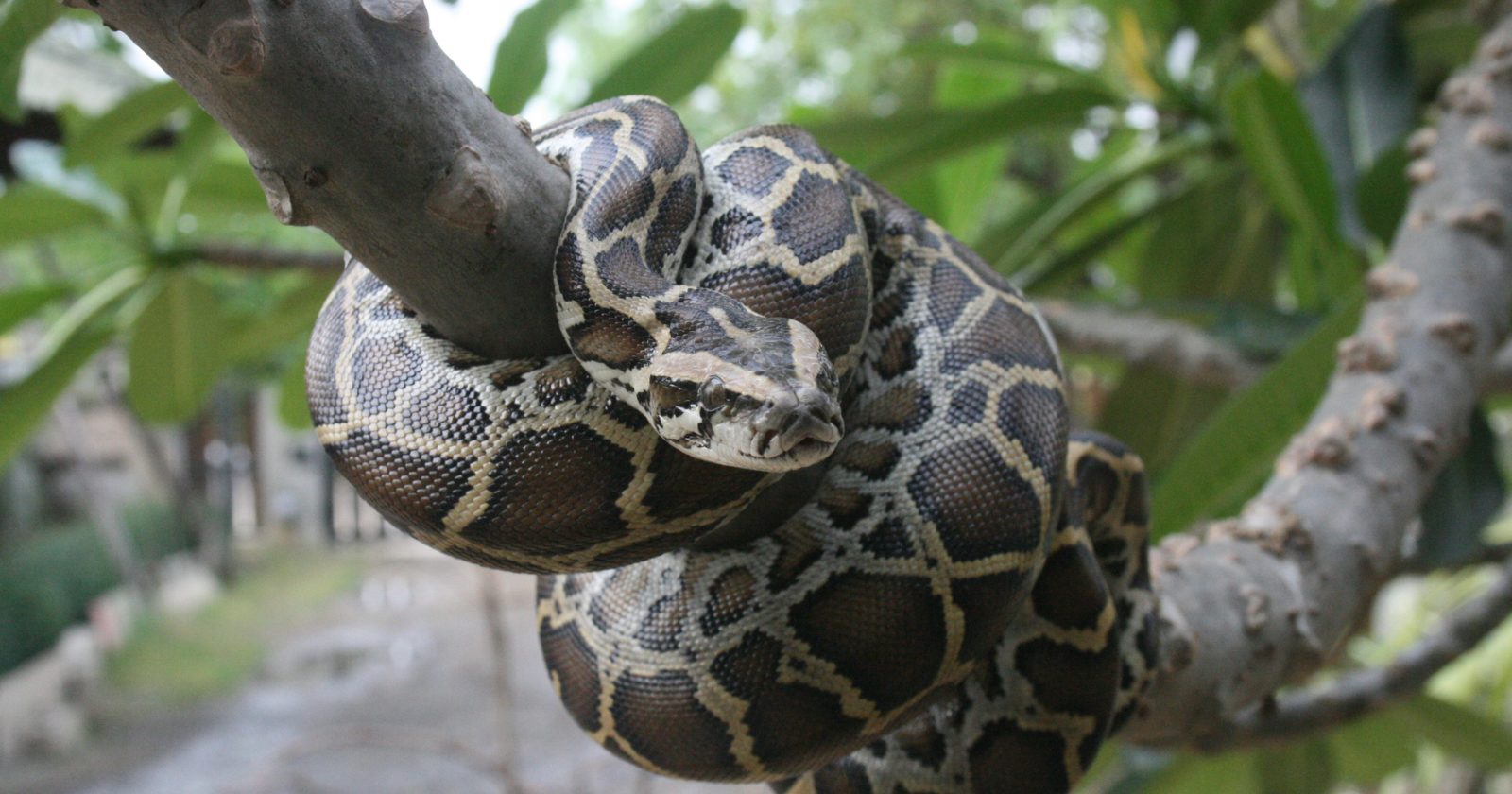
Take a drive down the main road through the remote southern end of Everglades National Park after dark, and you’ll notice something that visitors to the park in the 1990s wouldn’t have. Almost no mammals. Not on the road. Not in the beam of your headlights. Not scuttling off into the sawgrass when you slow down. Where a nocturnal road survey conducted in 1996 or 1997 would have produced regular sightings of raccoons at the water’s edge, opossums crossing the tarmac, marsh rabbits and cottontails feeding on the shoulders, and the occasional bobcat pacing through the scrub, a survey conducted anywhere between 2003 and today would produce, in the same territory, on the same road, using the same methods, approximately none of those things. The mammals aren’t there anymore. What replaced them is what turned out to be the most successful invasive vertebrate species ever documented in a United States national park.
How the snakes got in
Burmese pythons are native to Southeast Asia and southern China, where they occupy a range that extends from Bangladesh through Myanmar and Thailand into southern China and down through peninsular Malaysia. They are constricting snakes, non-venomous, capable of reaching lengths of six metres and weights of ninety kilograms in ideal conditions. In the 1980s and 1990s, they became an exceptionally popular pet in the United States exotic reptile trade, which was, at that point, essentially unregulated. Hatchlings sold for roughly twenty dollars at reptile shows and pet stores. What most first-time buyers didn’t quite absorb before purchase was that a hatchling Burmese python is a snake the length of your forearm, and an adult of the same species is a snake the length of a hallway, whose feeding requirements will quickly outrun the budget and the enthusiasm of any household not specifically set up to handle a large constrictor. Which is why, over the same two decades, a substantial number of pet Burmese pythons were released by their owners into the nearest available patch of Florida wilderness, or escaped from insecure enclosures, or in some cases were freed en masse when Hurricane Andrew tore through the Homestead area in August 1992 and destroyed a breeding facility that had been housing thousands of them.
If you enjoy learning about our animal kingdom, check out this video we made on the invisible wall only elephants can see:
Some of those released snakes ended up in the Everglades. The Everglades turned out to be an ecosystem that matched, almost point for point, what a Burmese python needs to thrive. Warm year-round temperatures with brief cold snaps that would kill only a small percentage of the population. Vast wetland habitat with dense cover and abundant prey. A slow-moving river system suitable for the semi-aquatic lifestyle the species adopts in the wild. And critically, no natural predators of adult pythons anywhere in the region. The result was that a small number of released snakes, dropped into what was essentially their ideal environment, began breeding successfully in the wild. By 2000, biologists at Everglades National Park confirmed that a self-sustaining breeding population had established itself in the park’s remote interior. By 2005, pythons were being removed from the park at a rate of several hundred per year. By 2010, the removals were in the thousands.
What the road surveys eventually showed
The full ecological consequences of that quiet invasion didn’t become clear until a decade or so later, when a team of biologists led by Michael Dorcas at Davidson College in North Carolina decided to compile all the available mammal survey data from Everglades National Park and see what the trend actually looked like. According to the resulting peer-reviewed 2012 paper by Dorcas and ten co-authors, published in the Proceedings of the National Academy of Sciences under the title “Severe mammal declines coincide with proliferation of invasive Burmese pythons in Everglades National Park” and abstracted through the U.S. National Library of Medicine’s PubMed archive, the team’s road surveys totalled 56,971 kilometres of nocturnal driving through the park between 2003 and 2011, using the same methodology that had been applied to comparable surveys in the same locations during the 1990s. The comparison was the point. If the mammals were doing fine, the encounter rates would be roughly the same. If the pythons were eating them, the numbers would drop.
The numbers dropped. Raccoon observations fell by 99.3 per cent between the 1996-1997 baseline and the 2003-2011 survey period. Opossum observations fell by 98.9 per cent. Bobcat observations fell by 87.5 per cent. White-tailed deer observations fell by 94.1 per cent. Marsh rabbits, cottontail rabbits, and grey foxes weren’t detected at all during the 2003-2011 surveys, which suggested that all three species had been driven to functional extinction across the park’s southern interior over the course of a decade. The disappearances were concentrated in the specific area where pythons had been established longest. Where the snakes had arrived more recently, the mammal populations were reduced but still measurable. Beyond the current python range, the same mammals remained abundant. Which meant the correlation was as clean as any invasive-predator study has ever produced.
According to the U.S. Geological Survey’s official position statement on the ecological impact of invasive Burmese pythons in Florida, maintained by the USGS Ecosystems Mission Area as part of its ongoing invasive species reference material, the mechanism behind the collapse is straightforward. Pythons are ambush predators. They wait in the shallow water at the edges of swamps and canals, where mammals come to drink or forage, and then strike, coil, constrict, and swallow whatever they catch. They can consume prey up to their own body weight in a single meal, meaning an adult Burmese python can eat an adult raccoon, an adult opossum, a rabbit, a small deer, and, at the upper end of documented cases, an adult alligator. The prey species evolved in a region where no comparable predator has existed for roughly sixteen million years. They have no instinctive response to a large constrictor. They approach the water. They don’t see the snake. They don’t survive the encounter.
Female pythons in the Everglades produce clutches of up to a hundred eggs per breeding cycle, which they incubate by coiling around and heating with muscular contractions. The reproductive rate is what has made the invasion effectively unstoppable. Wildlife authorities have removed more than twenty thousand pythons from the Everglades since the containment programme began. The population continues to grow. Estimates of the current wild population range from the low tens of thousands to over three hundred thousand, and no reliable count is possible because the snakes are physically difficult to detect in the dense vegetation they inhabit. What the researchers now regard as certain is that the pythons are established permanently, that eradication is no longer realistically achievable with any known technology, and that the containment strategy for the coming decades will focus on preventing further expansion beyond the current range rather than reducing the population within it.
What the Everglades looks like now, at ground level, is a version of the same wetland it was thirty years ago, with the same water, the same vegetation, the same birds overhead, the same alligators in the canals, and one entire trophic level of native mammals essentially removed. The raccoons that used to raid campsite trash bags are gone. The opossums that used to cross the road at dusk are gone. The marsh rabbits and cottontails that used to fill the roadsides are gone. What’s left is the sound of the wetland at night, minus the small warm-blooded animals that used to move through it, plus somewhere between thirty thousand and three hundred thousand very large snakes waiting patiently at the water’s edge for whatever hasn’t yet worked out that they’re there.