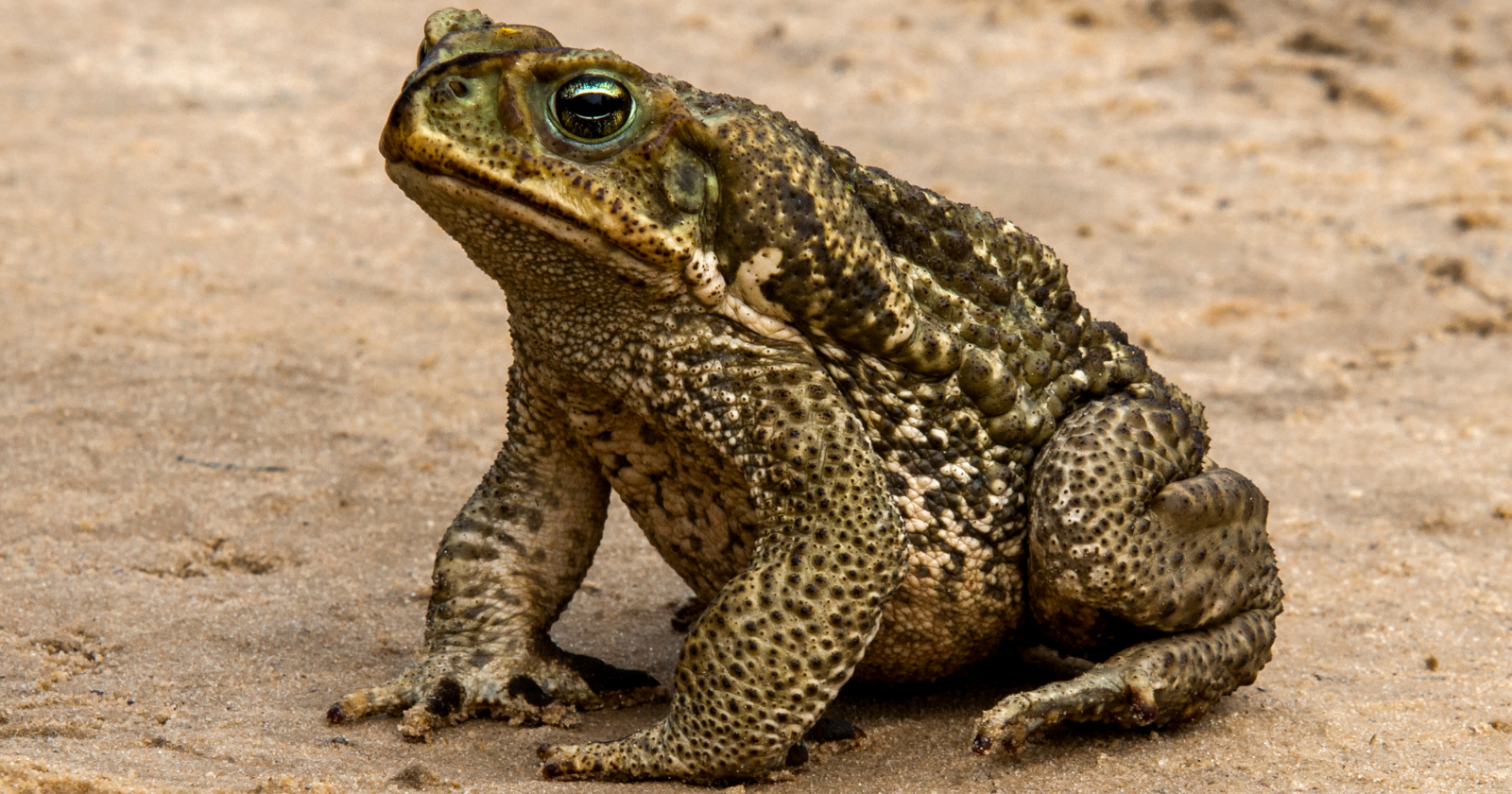
The story of how the cane toad came to occupy roughly one and a half million square kilometres of Australia is, on any modern reading of the historical record, one of the more instructive examples of what happens when a national agricultural bureau decides to solve a pest problem without checking whether the solution can physically reach the pest. It’s the kind of story that gets used in university biology courses now, not because it’s an unusual case, but because it worked so completely as a demonstration of every possible way an introduced species programme can go wrong.
The pest in question was the greyback cane beetle, Dermolepida albohirtum, and it had been quietly destroying Queensland sugarcane crops since the industry began establishing itself along the state’s northeastern coast in the late nineteenth century. The larvae of the beetle lived underground, feeding on cane roots and stunting or killing the plants. The adult beetles lived on the cane stalks, where they laid eggs that produced the next generation of larvae. Both stages of the beetle’s life cycle were, from an agricultural perspective, catastrophic for yields. And by the 1920s, the Queensland Bureau of Sugar Experiment Stations had spent the better part of two decades trying and failing to find a chemical or biological control that would meaningfully reduce beetle numbers.
The specific animal that got imported, and the specific beetle it couldn’t reach
According to the National Museum of Australia’s own reference material on the introduction of cane toads, drawing on the original 1935 documentation and preserved as part of the Museum’s Defining Moments national history series, the Bureau’s approach shifted in 1932 when the plant pathologist Arthur Bell attended a conference in Puerto Rico. There, he heard a presentation on the apparent success of an American toad species, Bufo marinus, in controlling cane beetles in Caribbean and Hawaiian sugarcane plantations. He returned to Australia convinced that the same toad could solve the Queensland problem. Three years later, in June 1935, another Bureau entomologist named Reginald Mungomery travelled to Hawaii, captured 102 cane toads for shipment back to Queensland, and boarded a ship for home. During the journey, one of the toads died. The remaining 101 arrived alive at Meringa Experimental Farm near Gordonvale in far north Queensland on 22 June 1935, and were placed in a purpose-built breeding enclosure.
If you enjoy learning about our fascinating animal kingdom, check out this video we made on the invisible wall only elephants can see:
They bred immediately. Within roughly two months, the 101 imported adults had produced approximately 2,400 offspring, and in August 1935 the Bureau released the entire captive-bred population into sugarcane plantations around Gordonvale. Which is where the plan started to unravel. Nobody at the Bureau, on the surviving documentation, had actually tested whether cane toads would eat cane beetles. And when the toads were let loose on the plantations, they didn’t.
The problem was mechanical. Cane toads are ground-dwellers. They sit low to the earth, hop short distances between resting sites, and eat whatever invertebrates happen to come within reach of their tongue. The greyback cane beetle, in both of its life stages, was not within reach. The larvae lived several centimetres underground in the root zone of the cane, where the toads had no way of accessing them. The adult beetles lived up on the cane stalks, well above the ground level where the toads were operating. The toads, presented with a plantation full of cane beetles they physically couldn’t get to, simply ate whatever else was on the ground instead. Which turned out to be almost everything else on the ground.
Predictably, the beetle populations were not reduced. Statistical analysis of Queensland sugar yields between 1900 and 1949 later showed no measurable improvement in the years following the toad releases. What the toads did do, on the accumulated field evidence of the following ninety years, was thrive. They ate native invertebrates. They ate small vertebrates. They out-competed indigenous frog species for food and habitat. They bred prolifically, producing tens of thousands of eggs per female per breeding season. And they began to spread outward from their release sites in every direction.
Why the spread has kept accelerating
The rate at which they’ve spread is where the story stops being just a case study in ecological miscalculation and becomes something genuinely strange. According to a 2016 peer-reviewed study by Cameron Hudson and colleagues at the University of Sydney’s School of Life and Environmental Sciences, published in PLOS ONE and hosted in full text on the National Institutes of Health’s PubMed Central archive, the invasion has accelerated dramatically over its eighty-year Australian history. In the early decades following the initial 1935 releases, the cane toad range expanded at somewhere between one and fifteen kilometres per year. By the time the invasion front reached the Northern Territory in the 1980s, the rate had climbed to roughly thirty kilometres per year. On the current western front, moving through the Kimberley region of Western Australia, cane toads are advancing at somewhere between fifty-five and sixty kilometres per year.
Which is a strange thing for an amphibian to be doing. Most invasive species arrive at some equilibrium rate of dispersal fairly quickly and then hold roughly steady. Cane toads, on the peer-reviewed field evidence, keep getting faster. And the Hudson team’s work on skeletal morphology suggests why. Toads at the invasion front, meaning the individuals actively pushing westward into new territory, have measurably different bodies than toads from long-colonised eastern populations. Their forearms are wider. Their skulls are more compact. Their hindlimbs, on the CT scan analysis, have shifted in ways that support sustained bounding locomotion rather than the occasional large leaps that ordinary toads use to evade predators.
The mechanism producing these changes is something evolutionary biologists call spatial sorting. Individuals with any genetic trait that increases dispersal speed reach the invasion front first. There, they encounter almost exclusively other high-dispersal individuals, because those are the only toads that also managed to get to the front. They mate with each other. Their offspring inherit the dispersal-enhancing traits from both parents. And the offspring, being even faster than either parent, move even further west during their own lifetimes and mate with each other’s descendants at the next stage of the front. Over decades, the population at the leading edge of the invasion becomes increasingly dominated by animals selected purely for their capacity to keep moving, and the front itself accelerates as a direct consequence.
The current Australian cane toad population is widely estimated at approximately 200 million individuals, spread across roughly 1.3 million square kilometres of Queensland, the Northern Territory, coastal New South Wales, and the northern parts of Western Australia. Modelling by the Hudson team and others suggests the theoretical habitat available to the species covers around two million square kilometres of the continent, meaning the invasion is currently occupying about two-thirds of its ultimate potential range. On the current spread rate, the front is expected to reach the vicinity of Broome, in Western Australia, sometime in the mid-to-late 2030s, and to continue westward toward the temperate coastal zone around Perth over the following decades.
The animals doing this all descended, on the strict genetic history, from 101 toads captured in Hawaii in June 1935 and shipped to a research station in northern Queensland. Nobody involved in the original decision had considered the possibility that the introduction would fail at its stated purpose, thrive beyond any expectation, and adaptively evolve into a faster-dispersing form on a timescale most evolutionary biology had believed impossible. The animals are still spreading. The front is still accelerating. And the beetle they were meant to control is still being managed by chemical pesticides, ninety years after somebody decided that a foreign toad would be a cheaper solution.