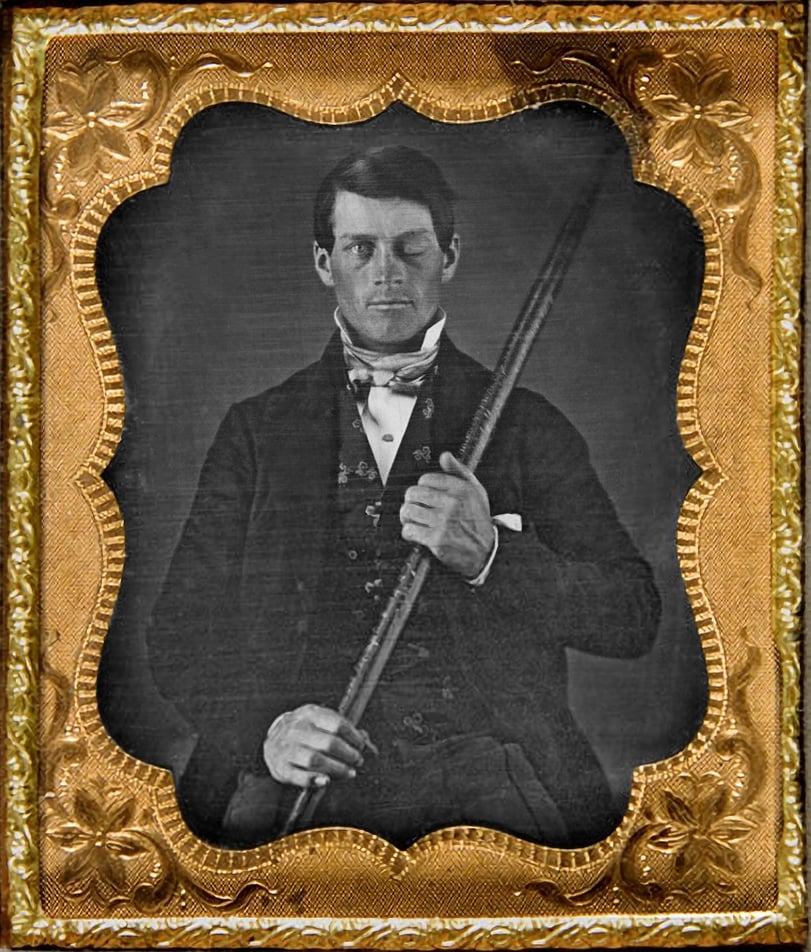
Here’s the thing about the story of Phineas Gage. Almost everyone has heard some version of it. The railway foreman. The tamping iron. The impossible survival. The famous personality change. The line his friends supposedly said afterwards, that he was “no longer Gage.” It sits inside almost every introductory psychology textbook printed in the last hundred years, and it is used to teach one specific lesson, which is that the human personality lives inside the front of the brain, and if you destroy that specific piece of tissue, you destroy the person.
What you were probably not told is that the story you learned in school is largely wrong. And the actual story, on the primary-source record, is stranger and more interesting than the textbook version, in a specific direction almost no one talks about.
What actually happened in Cavendish
According to the primary-source reconstruction assembled by Dr Malcolm Macmillan of the University of Melbourne, published in a September 2008 article in The Psychologist, the journal of the British Psychological Society, the incident took place at approximately 4:30 in the afternoon on Wednesday 13 September 1848, about three quarters of a mile south of the town of Cavendish, Vermont. Gage was 25 years old and the foreman of a construction gang blasting a railway bed for the Rutland and Burlington Railroad through a rocky outcrop.
The tamping iron he was using was specifically shaped for his job. It was three feet seven inches long, an inch and a quarter thick, tapered to a quarter-inch point at one end, and weighed thirteen and a half pounds. Something distracted him at the wrong moment. He began tamping the powder before an assistant had added the sand that was meant to focus the explosive force downward. The iron struck the rock, produced a spark, and the powder ignited.
The iron entered under his left cheekbone, passed through the base of his skull just behind his left eye socket, travelled up through the front of his brain, exited through the top of his skull slightly in front of and to the left of the point where the crown sutures meet, and landed approximately 20 to 25 yards behind him. Fragments of brain tissue landed with it.
Gage was still conscious. His men carried him to a nearby ox cart. He sat propped up against the headboard as it was driven to the Cavendish inn where he was staying. He alighted from the cart unaided. Dr Edward Higginson Williams was the first medical practitioner to arrive. Gage, sitting on the porch, greeted him with the sentence, “Doctor, here is business enough for you.” Dr John Martyn Harlow, the local physician who would go on to write both the original medical report on the case and the far more detailed follow-up twenty years later, arrived about an hour after Williams. The two of them worked together to stem what Harlow later described as a profuse haemorrhage.
Harlow later credited four things with saving Gage’s life. Gage’s exceptional physical condition. The specific shape of the iron, which had not left any lodged fragments to cause pressure inside the skull. The opening created by the wound itself, which drained the massive infection that followed. And the specific portion of brain the iron had passed through, which happened to be the part of the human anatomy best equipped to survive that kind of injury. The full medical account, which reads as extraordinarily as any surgical case notes ever published, appears in Harlow’s original December 1848 letter to the Boston Medical and Surgical Journal, titled “Passage of an Iron Rod Through the Head”.
To learn more about the psychology behind this fascinating story, watch the short video below:
The story you were taught
What most textbook accounts do next is skip forward twenty years. They quote Harlow’s second published report on Gage, delivered before the Massachusetts Medical Society on 3 June 1868 under the title “Recovery from the Passage of an Iron Bar Through the Head”, in which he summarised in fewer than two hundred words what he understood to have happened to Gage’s personality after the accident. Harlow wrote that the balance between Gage’s intellectual faculties and his animal propensities had been destroyed. That Gage had become fitful, irreverent, grossly profane, impatient of restraint, obstinate, and capricious about his plans for the future. That he was, in Harlow’s phrase, “a child intellectually” with the animal passions of a strong man. And that Gage’s friends and acquaintances said, so radical was the change, that he was “no longer Gage.”
Those approximately two hundred words are almost the entire primary-source basis for everything that has been said about Phineas Gage’s personality for the past 175 years. It is worth pausing on that. Harlow’s original 1848 report on the injury, published immediately after the accident, mentioned no personality changes at all. Dr Henry Jacob Bigelow, the Professor of Surgery at Harvard, examined Gage in late 1849 when Gage travelled to Boston to be presented to Bigelow and his medical students. Bigelow’s own account of the case, published in the American Journal of the Medical Sciences in 1850, also reported no personality changes of any significance. The entire modern narrative of Gage as an impulsive, ruined, profane wreck of a human being rests on a single 200-word passage written twenty years after the accident, eight years after Gage had already died, by a physician who was reconstructing his memory of the case from his own notes.
What the modern scholarship has quietly revised
Macmillan, who spent several decades locating and analysing every primary source that has survived about Gage, published his findings in the definitive 2000 volume, the MIT Press book An Odd Kind of Fame: Stories of Phineas Gage. What he documented was not a small correction. The picture that has emerged from careful primary-source work is fundamentally different from the one in the textbooks.
The full composite modern portrayal of post-accident Gage, assembled from generations of textbook writers, is of a man who became “restless, moody, unpredictable, untrustworthy, depraved, slovenly, violently quarrelsome, aggressive and boastful, dissipated, drunken.” He was, according to the modern retelling, unable to hold a job, drifted through fairgrounds and travelling circuses as a human curiosity, and died penniless. That entire picture, on the accumulated evidence of the primary sources, has almost no basis in the historical record.
What actually happened to Gage after his recovery, according to the surviving contemporary documents, was this. He spent some time exhibiting himself at Barnum’s American Museum in New York, a paid attraction rather than a wandering drifter. He then worked for approximately eighteen months at Jonathan Currier’s Dartmouth Inn in Hanover, New Hampshire, running the livery stable and coach line. Around 1852, on Harlow’s own account in his 1868 report, he travelled to Chile with an American businessman who was setting up a stagecoach line in Valparaiso.
He spent several years there driving stagecoaches.
The part that actually matters
Sit with that for a moment because it is where the standard textbook story quietly collapses. Driving a stagecoach in nineteenth-century Chile was not the work of a ruined man. According to Macmillan’s reconstruction of the route Gage almost certainly worked, a driving day began before four in the morning. Gage would have had to rise, prepare himself, feed and groom a team of horses, harness them to the coach, arrive at the departure point punctually, deal politely with fare-paying passengers, load their luggage of up to fifty pounds each, and collect their money. He would then have driven a coach and team over approximately 100 miles of poor roads during a 13-hour working day, often through periods of Chilean political instability that occasionally included active revolution. He did this in a country whose language he did not initially speak.
None of that is compatible with the popular picture of Gage as a permanently disinhibited, impulsive, unreliable wreck. The cognitive and sensory-motor demands of stagecoach driving are extraordinarily high. The social demands of dealing with paying passengers at four in the morning, in a foreign country, six days a week, for several years, are higher still. On the primary-source record, Gage held that job successfully.
The scientific implication of that reality is significant, and it is what makes the case of Phineas Gage genuinely interesting rather than merely dramatic. If Gage’s frontal lobe injury had permanently and comprehensively destroyed the neural machinery for judgement, planning, and social functioning, in the way the standard textbook story implies, then Gage could not have held down the stagecoach job. But he did. What the modern scholarship has quietly documented is that Gage almost certainly made what Macmillan describes as a social recovery, in which the structured demands of his working life provided the environment in which he relearned the lost social and executive skills.
That is a much more interesting scientific finding than the textbook version. It suggests that the human frontal lobe, and by extension the human personality, is genuinely plastic in ways that even modern neuroscience has taken decades to accept.
What the myth actually reveals
Gage returned to his family in San Francisco in June 1859 in a weakened state, worked on farms south of the city for several months, began having epileptic seizures in February 1860, and died from them on 21 May 1860. He was 36 years old. His skull and the tamping iron were later donated to the Warren Anatomical Museum at Harvard Medical School, where they remain.
What his story is remembered for is a lesson it did not quite teach. The confident textbook conclusion, that damaging a specific piece of frontal lobe tissue destroys the specific person who lived in that tissue, was assembled by generations of later writers each embellishing the previous account with details that were not in the original sources. Modern neuroimaging reconstructions of Gage’s actual injury have quietly confirmed that the physical damage was largely confined to the left frontal lobe, almost exactly as Harlow originally described. The definitive study, published by Peter Ratiu, Ion-Florin Talos and colleagues at Brigham and Women’s Hospital and Harvard Medical School in the Journal of Neurotrauma in May 2004 under the title “The Tale of Phineas Gage, Digitally Remastered”, used three-dimensional reconstructions from thin-slice computed tomography scans of Gage’s actual skull to establish that the cerebral injury was confined to the left frontal lobe and did not involve the ventricular system or the major intracranial vascular structures. Van Horn and colleagues, in a 2012 PLoS ONE paper titled “Mapping Connectivity Damage in the Case of Phineas Gage,” extended that anatomical reconstruction to show the specific white-matter connections the iron rod had severed. And a 2022 content analysis by Schleim in Frontiers in Human Neuroscience, titled “Communication About Phineas Gage,” documented how differently the case has been reported across the scientific and popular literature since Harlow’s original letter.
What the primary sources actually document is a man whose personality was profoundly disrupted by a catastrophic brain injury, who was told repeatedly by contemporary observers that he had been permanently ruined, and who then quietly went to Chile and drove a stagecoach for several years. The strangest thing about Phineas Gage is not the iron rod, or the survival, or the personality change that followed. It is the recovery that came afterwards, that almost every subsequent account of him has been too committed to the dramatic version to notice.
Kiran Athar is not a psychologist or a neuroscientist. She writes about psychology, brain science, and the ordinary corners of life where the two intersect, drawing on peer-reviewed research, primary-source scholarship, and published studies.