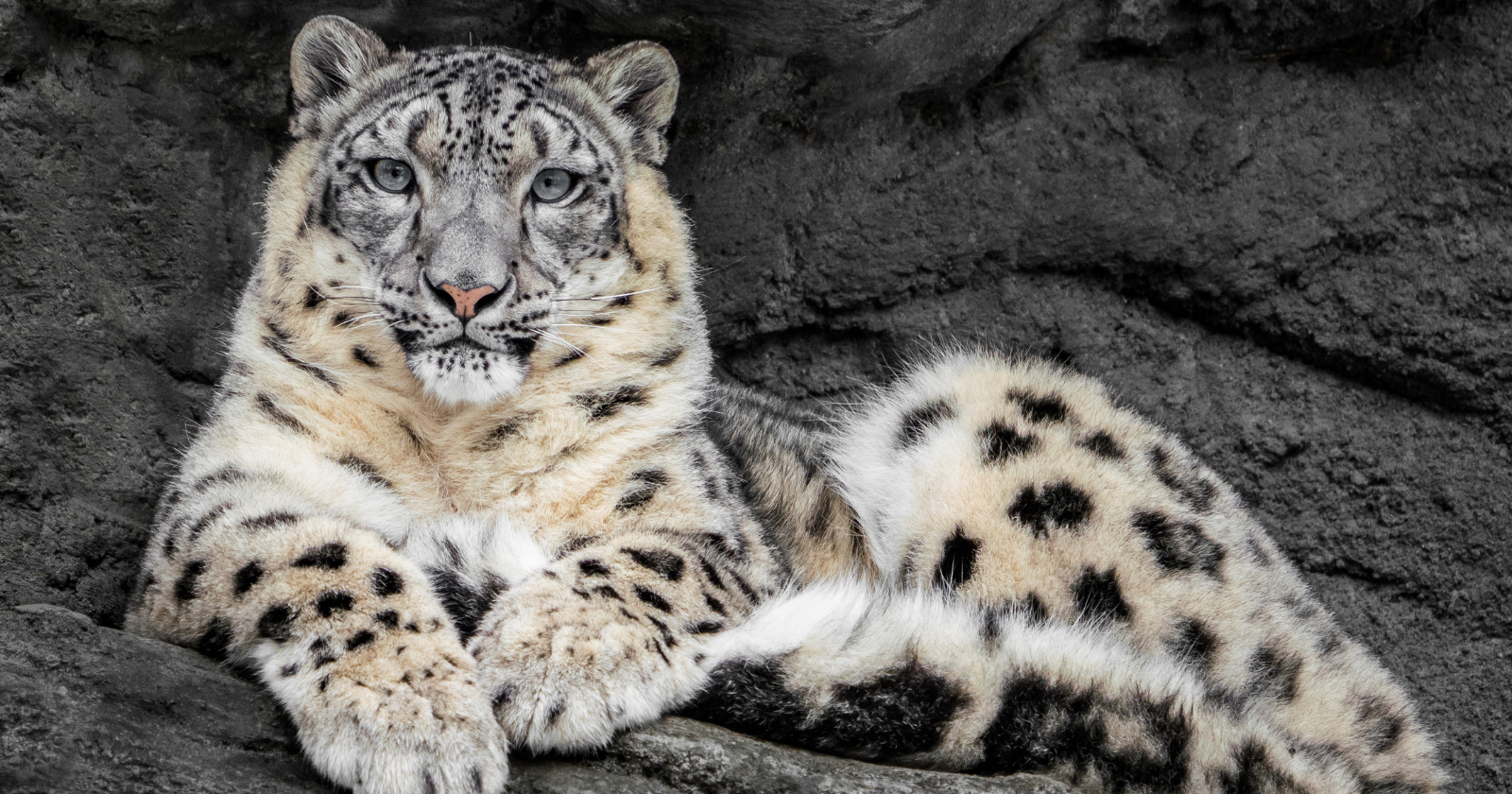
Snow leopards are famously difficult to count. They live above three thousand metres in some of the least accessible terrain on Earth. They’re solitary, nocturnal, and camouflaged well enough that the popular Ladakhi name for the animal translates roughly as ghost of the mountains. Their home ranges run to hundreds of square kilometres per individual. A single researcher hiking a valley for a week can easily miss every snow leopard living in it. Which is why, for the first fifty years of conservation attention on the species, the population figures for Pakistan were mostly extrapolations from small localised surveys, questionnaires handed to village headmen, and the informed judgement of the small handful of biologists who had actually spent time in the mountains where the animals live.
The results were what you’d expect. According to the preprint of a 2026 peer-reviewed paper by Dr Muhammad Ali of the Snow Leopard Foundation and colleagues at Quaid-i-Azam University in Islamabad, working with Pakistan’s three provincial wildlife departments and the Federal Ministry of Climate Change and Environmental Coordination, published in the journal Ecography and hosted in full text on the bioRxiv preprint archive, prior estimates of the snow leopard population in Pakistan ranged from 100 in a 1972 survey, up to 250 individuals in a George Schaller assessment in 1976, up to 400 in a 1997 Malik survey that didn’t specify the area it was extrapolating from, and 300 to 400 in a 2003 Hussain questionnaire-based survey covering roughly three thousand square kilometres. None of these estimates covered more than five per cent of the actual snow leopard range in Pakistan. All of them, on the eventual admission of the researchers behind them, were educated guesses.
What a real count actually looks like
The work that eventually produced a real number began in 2010. A team from the Snow Leopard Foundation, led by Dr Ali, set out to do systematic camera trapping across the actual snow leopard range in northern Pakistan. Which, given the difficulty of the terrain and the sparse distribution of the animals, was going to take a while. Cameras had to be carried on foot into extremely remote valleys. Placement required detailed knowledge of snow leopard sign, meaning pug marks, scent-marking sites, scrapes, and evidence of prey activity. Batteries and memory cards had to survive winters that routinely dropped below minus twenty. And enough of the total range had to be covered to allow the resulting data to be extrapolated across the whole country using proper statistical methods.
If you love learning about our animal kingdom, this video we made on the movements of a young bull elephant in Zambia will fascinate you:
By 2019, the team had placed 828 motion-sensor cameras across 39 per cent of Pakistan’s snow leopard habitat. The cameras remained in the field for a combined total of 26,540 trap days, averaging about a month per camera. They produced 4,712 photographs of snow leopards from 65 separate locations. Snow leopards have unique coat patterns, meaning individual animals can be distinguished from photographs the same way tigers can, and the team’s independent verification protocol identified 53 unique animals across the whole survey. More than half of those animals were photographed only once. Two of them were photographed ten and seventeen times respectively, accounting for a quarter of all the recapture events in the data set.
Running the resulting capture history through a statistical model called spatial capture-recapture, which is standard practice for estimating population sizes from partial camera trap detections, the team arrived at a nationwide population estimate of 155 snow leopards, with a mean density of about 0.16 animals per hundred square kilometres. Higher densities showed up near glaciers and inside protected areas. The Karakoram-Pamir mountain region held the largest single population, followed by the Hindu Kush and then the Himalayan ranges.
Why a second independent method mattered
The team could have stopped there. What they did instead, in parallel with the camera trapping, was run a second independent survey using genetics. From 2017 to 2023, field teams walked high-altitude transects across the same range and collected more than a thousand suspected snow leopard scats. DNA testing back in the laboratory confirmed 235 of those scats as actually belonging to snow leopards rather than to other high-altitude carnivores like Himalayan lynx, wolves, or foxes. A specially developed genetic panel using single-nucleotide polymorphisms, meaning small variations at specific points in the snow leopard genome, allowed the team to identify 56 unique individual animals from the genetic material alone.
Running the resulting genetic capture history through its own separate statistical model, the team arrived at a second nationwide population estimate. According to reporting by the Snow Leopard Trust, the international conservation organisation that partnered with the Pakistani team on the study, the genetic analysis suggested 167 individuals, with a 95 per cent confidence range of 128 to 220. Which was, within statistical uncertainty, the same number the camera trapping had produced entirely independently.
The convergence of the two methods is what makes this study genuinely different from what came before. Two completely separate lines of evidence, gathered by different teams using different techniques on different subsets of the same range over overlapping but not identical periods, produced population estimates that agreed with each other to within about ten per cent. That agreement is what statistical ecologists call methodological triangulation, and it’s the kind of result that turns a plausible number into an operational baseline. For the first time, Pakistan’s conservation agencies have a properly derived figure they can use to measure whether snow leopard populations are increasing, decreasing, or holding steady over the coming decades.
The figure itself, sitting somewhere between 155 and 167 depending on which method you weight more heavily, is considerably lower than the popular estimates that circulated in Pakistani wildlife publications and international conservation reports for most of the previous half-century. It’s not quite as low as the 1972 estimate of 100. But it’s much closer to that end of the historical range than to the 400 figures that had been quoted regularly in more recent decades. Which means either the population has declined substantially over the intervening period, or, more likely on the researchers’ own analysis, that the higher earlier figures were simply overestimates produced by extrapolating from small samples of unusually high-density habitat patches without accounting for the vast areas of Pakistan’s snow leopard range where the animals are considerably scarcer.
The practical implication, either way, is that Pakistan has fewer snow leopards than the conservation community had generally been assuming. The Karakoram-Pamir region, holding the bulk of them, is now a specific and identifiable priority for targeted protection. Prey species like markhor, Himalayan ibex, and blue sheep, on whose populations snow leopards depend for food, need to be safeguarded in the specific valleys the density modelling identified as strongholds. Climate change, which is altering glacier patterns and pushing prey species into new ranges, needs to be tracked against the new baseline the study has established. And any future survey work, whether in Pakistan or in the other eleven range countries the species inhabits, now has a methodological template to work from rather than the questionnaires and expert guesses that preceded it.
None of which brings the number back up. The ghost of the mountains, on the accumulated field evidence of the past sixteen years across northern Pakistan, turns out to be considerably rarer than most of the twentieth-century estimates suggested. That’s the number the country’s conservation programmes have to work with now. And, on the primary source record of the study that produced it, it’s the first time in the entire history of snow leopard research in Pakistan that the number has been anything more than a guess.