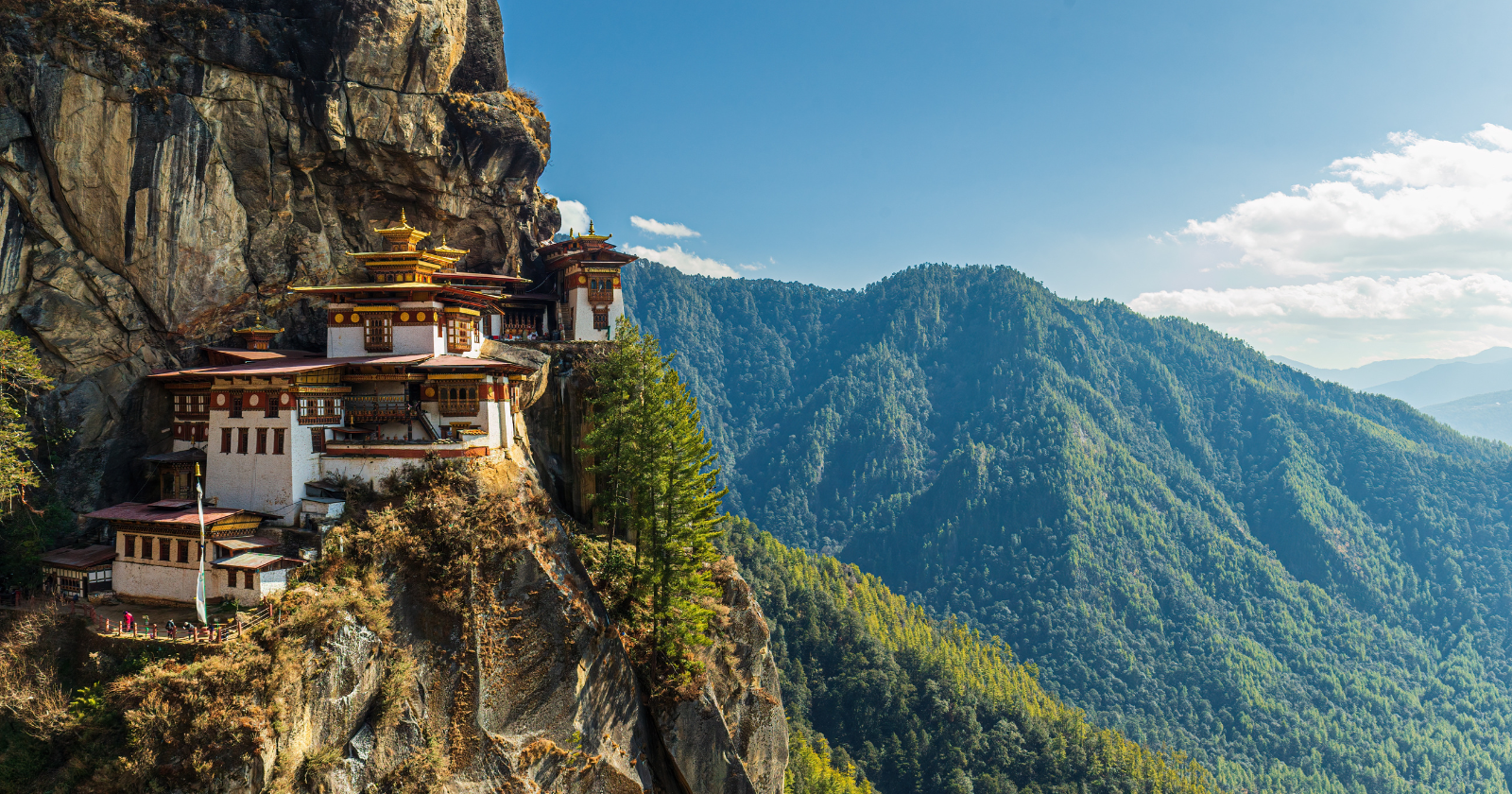
Almost every country in the world has, at some point in the last decade, made a public commitment to reach net-zero carbon emissions by some future date. Some have set the target at 2050. Others at 2060. A few, more ambitiously, at 2040. Almost none of them are on track to actually hit the target they’ve announced, and the aggregate carbon accounting of the international climate framework is essentially a promise about the future rather than a description of the present. Bhutan, a small Himalayan kingdom of just under a million people wedged between India and China, is one of the exceptions. It isn’t aiming for carbon neutrality. It’s already past it. Its forests and other land-based sinks currently absorb several times as much CO2 equivalent every year as its economy emits, which makes it one of only two or three countries in the world (Panama and Suriname are the others) that meet the strict definition of carbon negative.
What the constitution actually says
Bhutan’s 2008 constitution, ratified when the country transitioned from absolute monarchy to constitutional monarchy, contains a clause that no other national constitution anywhere in the world matches. Article 5, Section 3 reads: “The government shall ensure that, in order to conserve the country’s natural resources and to prevent the degradation of the ecosystem, a minimum of 60 percent of Bhutan’s total land shall be maintained under forest cover for all time.” The words “for all time” are what matter. It isn’t a policy target the government could change with a vote. It’s a permanent constitutional guarantee that no future Bhutanese administration can strip out without amending the founding document itself.
The numbers
Bhutan’s latest national forest inventory, based on 2021–2022 fieldwork and published in 2023, estimates forest cover at 69.71 percent, or 2.68 million hectares. That is down from 71 percent in 2016 but remains well above the 60 percent constitutional minimum. Bhutan’s 2025 National Biodiversity Strategies and Action Plan reports that in 2022 the country emitted an estimated 1.74 million metric tonnes of CO2 equivalent while forests, croplands and grasslands offset 11.45 million metric tonnes. Hydropower exports provide a separate avoided-emissions benefit, but are not required to establish the country’s current carbon-negative domestic balance.
It’s easy to protect a forest you never cut down. The harder version is Costa Rica, which lost half its cover and then paid farmers to grow it back. Watch here:
How it works in practice
The constitutional forest rule is the anchor, but it’s supported by a stack of related policies. Export logging is banned entirely. Rural farmers receive free hydroelectricity as an incentive to switch away from wood fuel. Tourism is deliberately restricted through a per-day sustainable development fee that keeps visitor numbers below the level that would degrade the environment. The country’s electricity grid runs on roughly 99 percent hydropower drawn from the rivers that flow off the Himalayan slopes. New vehicle purchases are being pushed toward electric through a partnership with Nissan that began during the Tshering Tobgay premiership. And the broader governance framework the country operates under is called Gross National Happiness rather than GDP, an approach originally articulated by King Jigme Singye Wangchuck in 1972 that treats environmental preservation as one of four constitutional pillars alongside sustainable development, cultural preservation, and good governance.
The fund that keeps it running
Environmental policy at national scale is expensive to maintain, and Bhutan’s total GDP is roughly $2.5 billion, which is not a lot to work with for permanent conservation infrastructure. The Harvard IR piece describes the mechanism the government set up to solve this. In 2017 Bhutan launched Bhutan for Life, a conservation trust fund developed in partnership with the World Wildlife Fund. It combines approximately $43 million in initial private donor capital with a further $75 million committed by the Bhutanese government over 14 years, and is designed to permanently endow the country’s protected area system rather than fund it year to year through the general budget. The 14-year timeline is deliberate. It gives the government time to build additional long-term financing before the initial capital runs out.
Why nobody else has done it
The obvious question is why the model isn’t more widely copied. The uncomfortable answer is that most countries can’t, for structural reasons that have nothing to do with intent. Bhutan started from a low-emissions baseline (its economy was essentially agrarian until quite recently), has a very small population, has enormous hydropower resources per capita, and has a monarchical political tradition that allowed the environmental commitments to be written directly into the founding constitutional document without requiring the messy political process most democracies go through. It also has a geography that happens to be almost entirely forested to begin with. Countries that industrialised earlier, urbanised more heavily, and generate their electricity from coal or gas cannot replicate the arithmetic even if they wanted to.
The catch
Bhutan itself, meanwhile, is one of the countries most exposed to the physical consequences of climate change globally. Its Himalayan glacial lakes are expanding as the ice melts, and glacial lake outburst floods (GLOFs) have already killed people and destroyed thousands of acres of downstream farmland. The Harvard analysis notes that around 2 percent of Bhutan’s glacial lakes have been identified as at high risk of a GLOF event, and the ratio will rise as temperatures continue climbing. A country that has removed more carbon from the atmosphere than it has ever added is, in absolute terms, going to bear some of the worst impacts of the emissions produced by the countries that promised carbon neutrality and failed to deliver. Which is, in the arithmetic of the international climate framework, the whole underlying problem in a single case study.