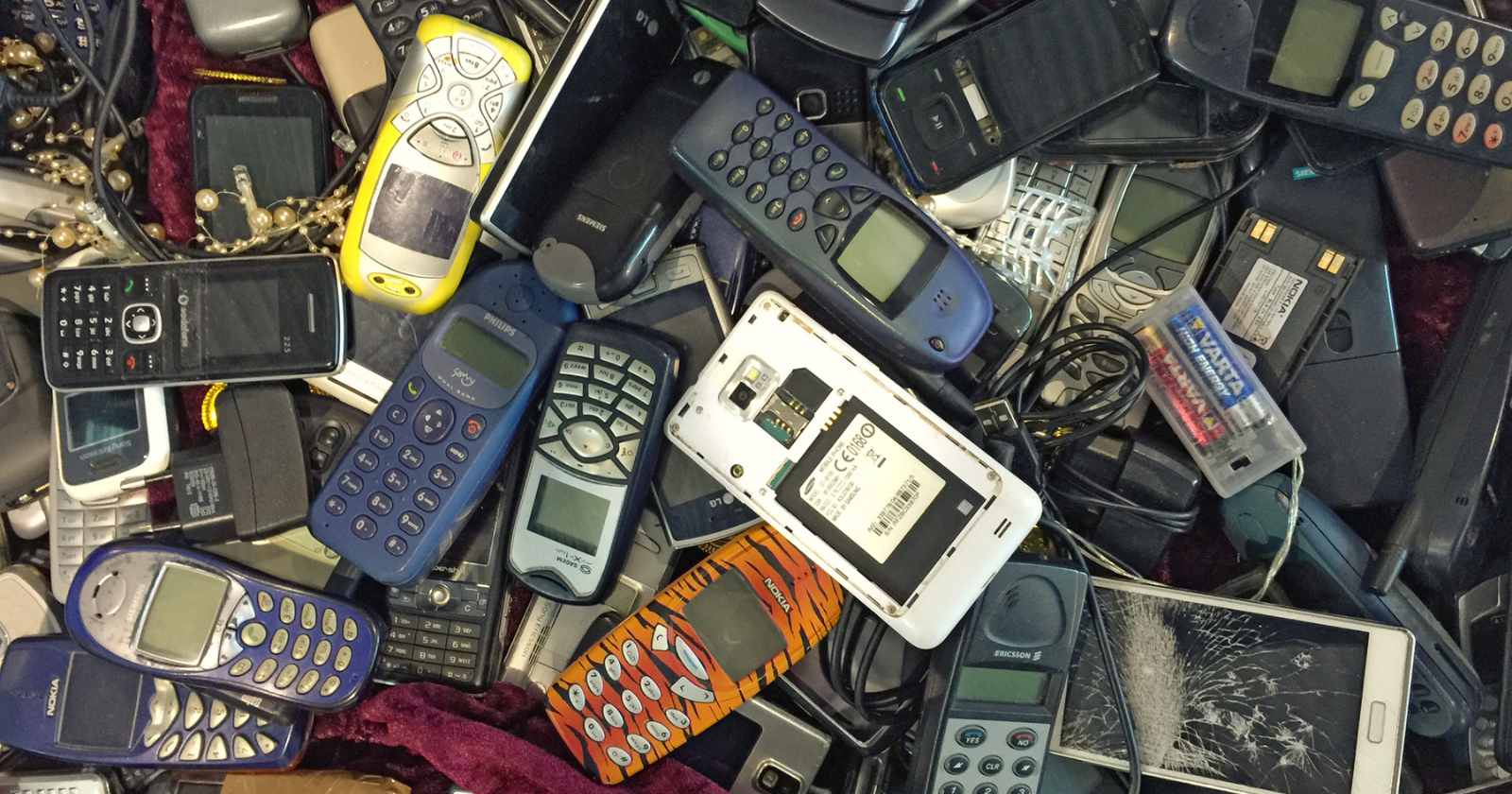
The most valuable gold deposit within a hundred kilometres of you is probably not underground, it is sitting in a drawer inside a phone you have not turned on in five years.
Look inside almost any adult person’s junk drawer, the one at the back of the kitchen or the one on top of the wardrobe, and you will find some version of the same collection. Two or three old phones. A pair of tangled charger cables. A camera nobody remembers buying. A tablet with a cracked screen. A pair of wireless earbuds that stopped holding a charge in about 2022. None of it works well enough to use. None of it is worth enough to sell. And nobody has quite got around to throwing any of it away.
That drawer, on the accumulated engineering evidence of the past decade of materials-science research, contains more gold per kilogram than the ore currently being pulled out of an operational gold mine.
Not slightly more. A lot more.
What the deposit actually contains
The number that matters here is called ore grade, and it is the amount of a target metal contained in each tonne of source material before any processing has been done. According to a 2019 report jointly issued by the UN Environment Programme, the World Economic Forum, and members of the UN E-Waste Coalition, a tonne of discarded electronic waste, meaning phones, laptops, tablets, monitors, and the general accumulated debris of modern life, contains approximately one hundred times more gold than a tonne of typical gold ore pulled out of the ground at a modern mine. The UN report placed the fraction of the world’s current gold supply presently locked up inside discarded electronics at approximately seven per cent.
The reason is straightforward, on the metallurgical evidence, and it is not that phones are made of gold. They are not. A single modern mobile phone typically contains only about 25 to 50 milligrams of gold in total, plus small quantities of silver, palladium, platinum, and copper, most of it used in the printed circuit boards to make reliable electrical connections that do not corrode over time. The gold in any one phone is worth roughly a dollar or two at current spot prices, which is why nobody bothers to try to extract it themselves.
What matters is not the amount per phone. It is the amount per tonne of processed material. A modern mine, on the industry-standard grades reported by the world’s producing operations, delivers something in the range of five to twenty grams of gold per tonne of ore. Anything above five grams is considered a viable commercial deposit. A tonne of end-of-life mobile phones, on the recent processing figures published by formal recycling operations, contains something closer to 140 grams. Which is why the language of urban mining has, over the past decade, started replacing the older language of e-waste recycling among the industrial operations that specialise in this work. What they are running is a mine. The deposit just happens to be located in a warehouse in Belgium or a sorting facility in Sweden rather than three hundred metres underground in Nevada or Western Australia.
According to the 2024 edition of the Global E-Waste Monitor, produced jointly by the United Nations Institute for Training and Research and the International Telecommunication Union, the world generated approximately 62 million tonnes of electronic waste during 2022. The metals contained in that mass were valued, at 2022 prices, at approximately 91 billion US dollars, of which 15 billion dollars was gold alone, 19 billion was copper, and 16 billion was iron. Sitting inside the world’s collective drawer, at any given moment during the year, is roughly the mineral value of the entire annual GDP of a small nation.
On a related note, I came across this video on what mobile phones are quietly doing to us. It’s worth a watch:
Why we are not mining it
Approximately 22 per cent of that global e-waste, according to the same UN report, is being formally collected and processed each year. The remaining 78 per cent is disappearing into landfills, incinerators, informal-sector operations in low-income countries, undocumented shipments across borders, or, most commonly, staying quietly in drawers exactly like the one described at the top of this piece. The estimated value of recoverable natural resources going unrecovered from the 2022 e-waste stream alone came to approximately 62 billion US dollars.
There are two straightforward reasons the deposit is not being properly worked.
The first is that the collection problem is genuinely difficult. Gold ore, once located, sits in one place. It does not distribute itself across seven billion individual human households, in tens of thousands of different physical form factors, made by hundreds of manufacturers using thousands of different proprietary designs. To recover the gold from a phone requires the phone to first travel from the drawer to a formal recycling facility, and every step of that logistics chain, from consumer awareness to municipal collection to sorting to shipping to processing, involves costs that a mine simply does not incur. A gold mine does not need to persuade the ore to show up.
The second reason is that the processing itself, while chemically well understood, requires large-scale industrial infrastructure that a relatively small number of companies globally have built. Formal urban-mining operations of the kind that actually recover gold at commercial yields are concentrated in a handful of specialist facilities in Belgium, Germany, Sweden, Japan, and a few other jurisdictions, operated by companies such as Umicore, Aurubis, and Boliden. They can handle only a fraction of the world’s annual electronic waste generation. The rest either goes through informal-sector recovery, meaning acid baths and open-air burning conducted mostly in West Africa and South Asia under conditions of significant health and environmental harm, or does not get recovered at all.
The result, on the accumulated data of the past two decades of e-waste monitoring, is one of the more genuinely strange phenomena of the modern global economy. The richest gold deposit on Earth, measured by grade, is now the accumulated stock of unused consumer electronics sitting in the drawers, cupboards, garages and small-business storage rooms of ordinary people in ordinary homes across every developed country in the world. The industry that could recover the gold exists, is functional, is chemically well understood, and is quietly profitable. It is also nowhere near large enough to process more than a small fraction of what is actually available. And the material keeps accumulating faster than the industry can grow, because human beings keep buying new phones, and the old ones keep not going anywhere in particular.
Which means the specific piece of counter-intuitive knowledge that came out of the last decade of materials-science and waste-management research is worth sitting with at the level of ordinary experience. Somewhere in your home, right now, there is a small pile of unused electronic devices that a modern gold mining company, if it were free to process them, would treat as one of the richest ore deposits it could hope to find. The reason nobody is currently doing this is not that the gold is not there. It is that the drawer is closed, and the deposit is anonymous, and the accumulated inertia of not quite getting round to sorting the situation out has, on the UN’s calculations, become one of the largest and most quietly consequential resource-mismanagement problems the twenty-first century has yet produced.
Kiran Athar is not a materials scientist or a mining industry analyst. She writes about the natural world, science, and the ordinary corners of modern life where the two intersect, drawing on peer-reviewed research and primary-source scholarship.