

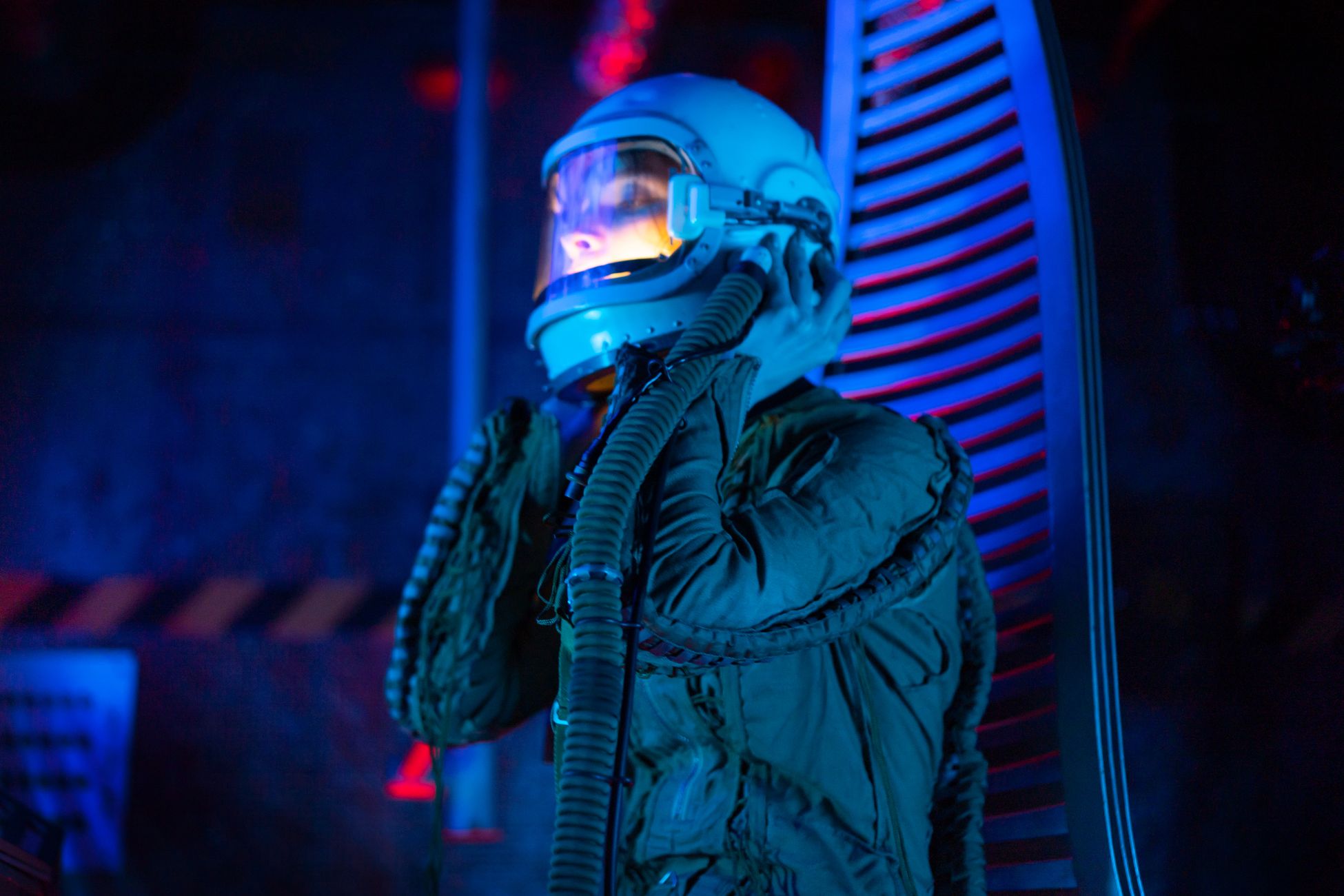
On the Apollo 16 and Apollo 17 missions, astronauts took turns sitting in the command module wearing a helmet that looked like a padded steel colander, and every time one of them muttered “flash” into the intercom, a stack of nuclear emulsion plates strapped around the wearer’s skull recorded a cosmic ray that had just punched through his brain. The device was called the Apollo Light Flash Moving Emulsion Detector, or ALFMED, and its purpose was to prove that the strange streaks and starbursts astronauts had been seeing behind closed eyelids were not hallucinations or fatigue but individual heavy nuclei from deep space crossing directly through the human head.
The flashes had started as a rumor. Astronauts on early lunar missions reported seeing tiny pinpricks of light when the cabin went dark, a phenomenon nobody had briefed them to expect.
By Apollo 12, the crew was describing the phenomenon in careful detail during their post-mission medical debrief, an audio recording of which the Pentagon declassified decades later. Astronauts talked about streaks, dots, and starburst patterns that appeared whether their eyes were open or closed, most vivid when the cabin lights were down and they were trying to sleep.
A helmet built to catch a ghost
NASA’s flight surgeons wanted to know what was hitting these men. The suspicion was that highly energetic particles from galactic cosmic radiation were passing through the retina and optic nerve and triggering phosphenes — visual effects caused by ionization rather than light entering the eye.
Proving it required catching the particle in the act. The ALFMED was the instrument they built to do exactly that.
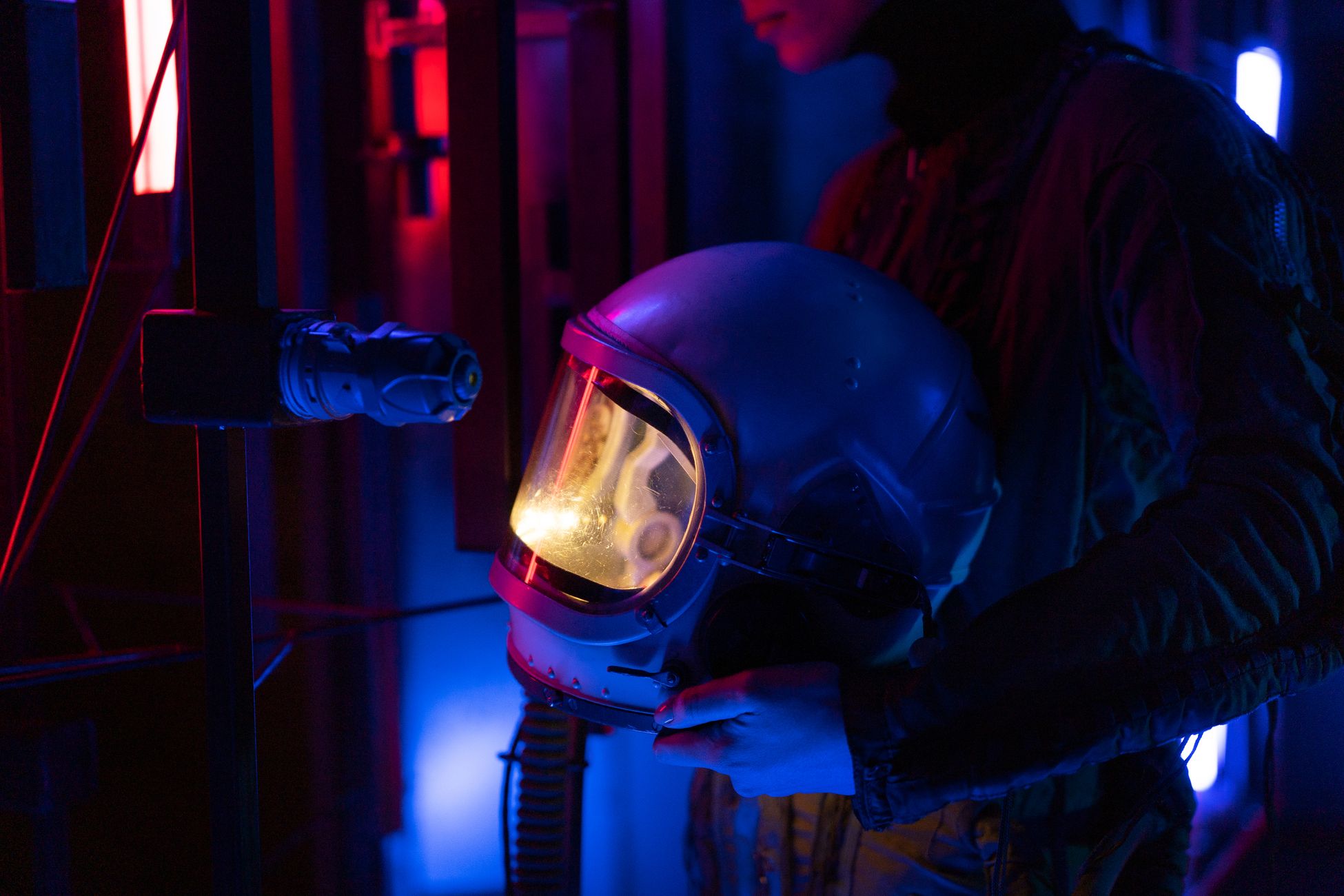
The device was a rectangular frame that fit around an astronaut’s head like an oversized fencing mask, with two layers of nuclear emulsion plates positioned on either side of the skull. Nuclear emulsions are thick photographic films sensitive enough to record the ionization trail of a single charged particle passing through them. If a heavy nucleus crossed the astronaut’s head, it would leave a straight tunnel of damage in both plates, and the geometry of the two hits would draw a line right through his brain.
To connect a plate track to a specific flash, the emulsion layers were mounted on a mechanism that slowly moved during the experiment. When a crewman called out a flash and the exact time it happened, investigators back on Earth could later match the moving position of the emulsion to that timestamp and see whether a particle had crossed the head at that instant.
The Apollo 16 run
The first flight of ALFMED came on Apollo 16. On the outbound coast to the Moon, the device was strapped to Lunar Module Pilot Charlie Duke’s head — Duke was the one seeing the most flashes in the run-up to the experiment — while Commander John Young and Command Module Pilot Ken Mattingly sat in the darkened cabin behind eye shades, calling out their own flashes on cue. The Apollo 16 Flight Journal preserves the intercom traffic in real time: Duke marking flash after flash, Young chiming in with a handful of his own, Mattingly quiet for most of it. Mattingly later described himself as having poor night vision, and by NASA’s summary of the light-flash experiments he was the one Apollo crewmember involved who did not routinely see the phenomenon at all.
The session lasted about an hour. The emulsion plates, developed back on Earth, showed numerous heavy-ion tracks passing through the volume where Duke’s head had been.
Not every flash lined up with a track, and not every track produced a flash. But the correlation was strong enough, and the geometry specific enough, to settle the argument. Something was actually going through their heads.
What the particles are
Galactic cosmic rays are the shrapnel of the universe: protons, alpha particles, and heavier nuclei stripped of their electrons and accelerated to relativistic speeds by supernova shocks, pulsar winds, and — as observations from the Large High Altitude Air Shower Observatory in China recently confirmed — microquasars in the Milky Way. A small fraction of the flux consists of nuclei heavier than helium, and among these are the so-called HZE particles: high atomic number, high energy iron, oxygen, carbon and silicon nuclei that carry enough charge to ionize a dense cylinder of tissue as they pass through it.
On Earth, the atmosphere absorbs almost all of them. The detection of cosmic rays at ground level requires either mountaintop arrays, or, for the deepest signatures, kilometer-scale instruments buried in Antarctic ice — like the sensors of the Askaryan Radio Array, which pick up particles more than 600 feet below the South Pole. Outside Earth’s magnetosphere, where Apollo astronauts spent their translunar coast, the shielding disappears. A single iron nucleus at a few hundred MeV per nucleon can pass cleanly through an aluminum spacecraft hull, then through skin, bone, and gray matter, ionizing a track of molecules along the way.
Why the flash
The visual signature comes from several possible mechanisms, and researchers are still arguing about which dominates. The leading candidate is direct ionization of the retina — a charged particle rips electrons off the rod and cone cells as it passes, and the brain interprets the resulting nerve signal as a point of light. A second candidate is Cherenkov radiation, the faint blue glow produced when a charged particle moves through a transparent medium faster than light moves through that medium. The vitreous humor of the eye is transparent enough to support Cherenkov emission, and the geometry of some reported flashes — long, tapered streaks — matches what a Cherenkov cone should look like.
A third possibility, less well constrained, is that particles crossing the visual cortex directly stimulate neurons there, producing a perceived flash without the retina being involved at all. Astronauts have reported seeing flashes with their eyes closed and their heads turned in ways that make retinal explanations difficult.

What it means for going back
The flashes were the first sign, felt directly by the crew, that human tissue and galactic radiation interact in ways Earth-bound biology has never had to deal with. The bigger concern was what those particles were doing to cells the astronauts couldn’t perceive. A single HZE nucleus doesn’t just ionize a track — it can break both strands of DNA, kill neurons outright, and leave a linear scar of damaged tissue that no antioxidant or repair enzyme evolved to handle.
The National Academies has since laid out the cancer risk framework NASA uses to set exposure limits for astronauts, and cosmic ray dose is the single hardest number to shield against on any mission beyond low Earth orbit. Water tanks help. Polyethylene helps. Aluminum, counterintuitively, can make things worse by shattering an incoming iron nucleus into a spray of lighter, still-dangerous secondaries.
With NASA’s Artemis II having flown its crewed flyby of the Moon in April 2026 and later missions now aimed at the lunar surface, the same particles that lit up Charlie Duke’s retinas half a century ago are once again a central design constraint. Duke University’s analysis of Artemis II mission risks lists radiation exposure as one of the defining medical unknowns of any crewed flight beyond the Van Allen belts, and the flashes are expected to return the moment the cabin lights go down.
The astronauts who still saw them
Apollo crewmen who traveled beyond Earth’s magnetosphere overwhelmingly reported the flashes. Astronauts and cosmonauts on later missions, including those aboard the International Space Station, have described similar phenomena, though at lower rates because low Earth orbit still enjoys most of the magnetosphere’s protection. Long-duration ISS residents have described the flashes appearing like a private meteor shower before falling asleep, with frequency increasing when the station passes through regions of higher radiation.
The ALFMED plates from Apollo 16 and 17 — worn across the two missions by Charlie Duke, Ken Mattingly and Apollo 17 Command Module Pilot Ronald Evans — are preserved in NASA’s archives. Under a microscope, the ion tracks look like scratches on old glass, each one a straight line etched by a nucleus that traveled for millions of years through the galaxy, crossed the last few centimeters of a human head somewhere between the Earth and the Moon, and kept going.
Duke saw dozens of them in a single hour under the helmet. The plates saw more. Every astronaut who has left Earth’s magnetic shield since has been walking through the same rain, and closing your eyes doesn’t help.