

On the morning of September 2, 1859, telegraph operators in Boston and Portland reported equipment sparking and shocks from the keys. The two men decided to unplug their batteries entirely and try sending messages on whatever was loose in the wires. For a period of time, they carried on communication across New England on nothing but the electrical current the sky was pouring into the line.
The storm that did this is now called the Carrington Event, after the English astronomer Richard Carrington, who happened to be sketching sunspots through a projection telescope at his private observatory when two brilliant patches of white light flared up beside a complex sunspot group on September 1. He timed them. They lasted several minutes. He had just become the first human being to witness a solar flare.
Within about a day, the consequences arrived at Earth.
The night the sky turned the wrong color
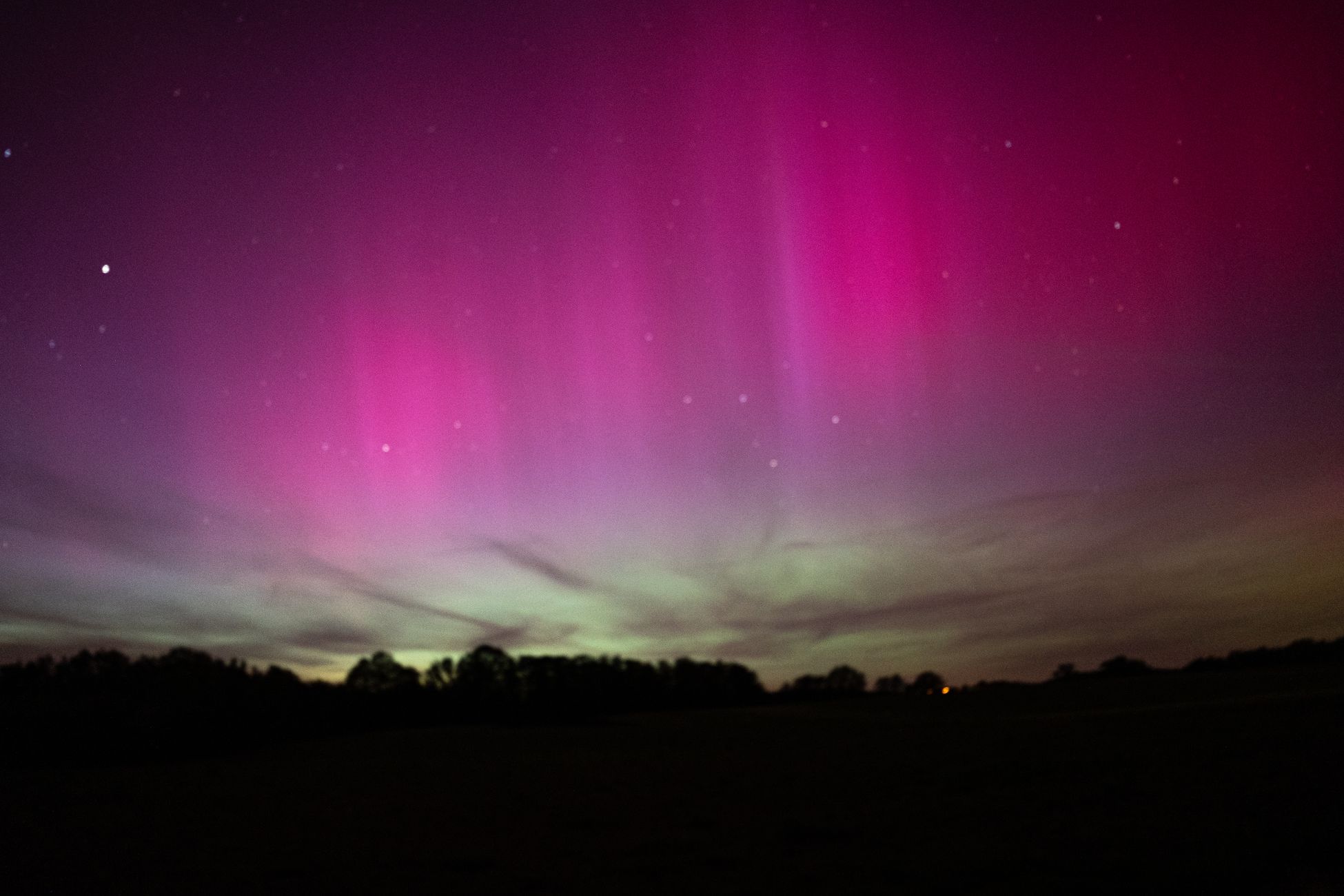
Auroras normally hug the polar regions. During the Carrington storm, they were reported at remarkably low latitudes, including tropical and subtropical regions. Gold miners in the Rocky Mountains reportedly got up and started cooking breakfast in the middle of the night because the sky was bright enough to read by. Ships’ logs recorded red light overhead so intense the crews thought nearby vessels were on fire.
The color was the giveaway. The deep crimson that bled across tropical skies that night is produced by oxygen atoms high in the atmosphere, excited by charged particles slamming into the upper atmosphere. To push that glow down to such low latitudes, the solar wind has to be doing something extreme to Earth’s magnetic field.
It was. A coronal mass ejection — a billion-ton blob of magnetized plasma — had hit the magnetosphere at extremely high speed, several times faster than a typical solar storm. The magnetic field around the planet compressed, rang like a bell, and began to wobble violently.
How a wire becomes a battery
The reason telegraph operators were getting shocked is a piece of physics first written down by Michael Faraday in 1831. A changing magnetic field induces a voltage in any conductor sitting inside it. The longer the conductor, the bigger the voltage. Telegraph lines in 1859 were the longest continuous conductors human beings had ever strung across the landscape — hundreds, sometimes thousands of miles of iron wire bolted to wooden poles, grounded at each end.
When the geomagnetic field above North America began thrashing in response to the CME impact, every one of those wires became an antenna for what physicists now call a geomagnetically induced current. The wobble in the magnetic field drove an electric field through the ground itself. That ground field pushed current up one grounding rod, along the wire, and down the grounding rod at the far end. The telegraph network didn’t need its batteries. The Earth had become the battery.
Boston and Portland, talking on storm current
The most famous exchange survives in published accounts from the era. On the morning of September 2, the Portland operator told the Boston operator that the current was so strong his battery was useless and he was being shocked through the key. The Boston operator agreed; his own line was misbehaving the same way.
The Portland operator suggested they disconnect their batteries entirely and work with the auroral current. The Boston operator agreed. They unplugged. The line went briefly dead, then resumed clean operation. The Portland operator asked how the Boston operator was receiving the writing. The reply indicated that the reception was better than with the batteries on.
For a period of time, the Boston-to-Portland wire carried regular commercial traffic powered by nothing except Earth’s disturbed magnetosphere. Then the geomagnetic field shifted, the induced current reversed polarity, and the operators had to reconnect their batteries — but in the opposite orientation — to keep working.
The sparks, the smoke, the fires
Elsewhere on the network, the storm was less cooperative. Telegraph registers threw arcs. Operators reported being shocked by sparks from the equipment. Paper tape used to record incoming Morse code caught fire inside several stations, and the platen mechanisms scorched the wooden tables beneath them.
Operators across France, Norway, and Australia reported the same phenomena: equipment running with batteries disconnected, equipment refusing to run with batteries connected, sparks jumping from switches, insulation smoldering. Some lines simply stopped working until battery banks were removed.
None of this was understood at the time as a coherent event. The connection between Carrington’s white flash on September 1 and the planet-wide chaos that followed wasn’t established until decades later, when astronomers began correlating sunspot records with magnetometer readings.

Why a copper wire couldn’t sit there quietly
The mechanism is worth slowing down on, because it explains what would happen to modern infrastructure under the same conditions. During a severe geomagnetic storm, the rate of change in Earth’s magnetic field can climb high enough to drive ground-level electric fields of several volts per kilometer.
Run that field along a 200-mile telegraph wire and you get hundreds of volts at the terminals, free, with no operator input. Run it along a 500-kilovolt high-voltage transmission line and you get a slow direct-current bias that saturates the iron cores of grid transformers, making them hum, overheat, and in extreme cases melt internally. This is exactly what knocked out the Hydro-Québec grid in March 1989, leaving six million people without power in a matter of minutes. That storm was a fraction of Carrington’s intensity.
The same physics governs how space weather forecasters today try to predict which storms will couple efficiently into the ground and which will glance off. The orientation of the magnetic field embedded in the incoming coronal mass ejection matters enormously. If it points southward, opposite to Earth’s field, the two reconnect and the storm pours energy in. If it points northward, most of the storm slides past.
What Carrington saw, and what he didn’t know
Richard Carrington was a brewer’s son who had built his own observatory specifically to map sunspots. On the morning of September 1, 1859, he saw “two patches of intensely bright and white light” erupt from the dark interior of a sunspot cluster. He sketched their positions, watched them migrate across the group for several minutes, and saw them fade.
A separate observer, Richard Hodgson, saw the same flash from his observatory. Both submitted notes to the Royal Astronomical Society. Carrington was careful in his paper to avoid claiming the flash had caused the magnetic storm that began hours later, though he noted the coincidence pointedly.
He had no concept of plasma, no concept of a magnetized solar wind, no concept that a sunspot could hurl a piece of itself across 150 million kilometers of space. What he had was a sketch, a timestamp, and the intuition that something physical had crossed the gap between the Sun and his telegraph wires.
What a repeat would do now
Estimates of the economic cost of a direct-hit Carrington-class storm on contemporary infrastructure run from hundreds of billions to several trillion dollars, depending on how many extra-high-voltage transformers fail and how long replacement takes. These transformers are custom-built, weigh hundreds of tons each, and have lead times measured in months to years.
The 1859 storm hit a planet whose only long conductors were telegraph wires. The current planet runs on a continent-spanning mesh of power lines, pipelines, undersea cables, and satellite links, all of which couple to geomagnetic disturbance in their own way. Engineers studying the problem have proposed everything from orbital deflector concepts to grounding upgrades on the most exposed transformers. The cheapest defense, by a wide margin, is advance warning — enough lead time to disconnect the most vulnerable equipment before the shock front arrives.
That warning depends on a string of solar-monitoring spacecraft sitting at the Sun-Earth Lagrange point and reading the magnetic orientation of incoming plasma. Knowing whether the field points north or south buys grid operators somewhere between fifteen and sixty minutes to act. Recent work on space weather monitoring and the behavior of severe geomagnetic events has sharpened those forecasts, but the lead time is still short.
The receipt in the logbook
The Boston-Portland transcript was copied into industry journals of the era. Two operators, batteries unplugged, sending clean Morse code on a current that originated 93 million miles away in a sunspot a man named Carrington had sketched the day before.
The auroras faded by the morning of September 4. The telegraph network came back online. Operators replaced scorched paper, swapped out fused relays, reconnected batteries in their normal orientation. Insurance claims were filed for burned tables and damaged keys. Within a week the story was a curiosity in the back pages.
The Sun is still there. The sunspot cycle that produced the 1859 flare runs on roughly an eleven-year clock, and the cycle peaks of the last two centuries have produced several near-misses — including a coronal mass ejection in July 2012 that crossed Earth’s orbit and missed the planet by about nine days. Had Earth been on the other side of the Sun in early September that year, the wires in the walls would have started humming with current that nobody put there.