

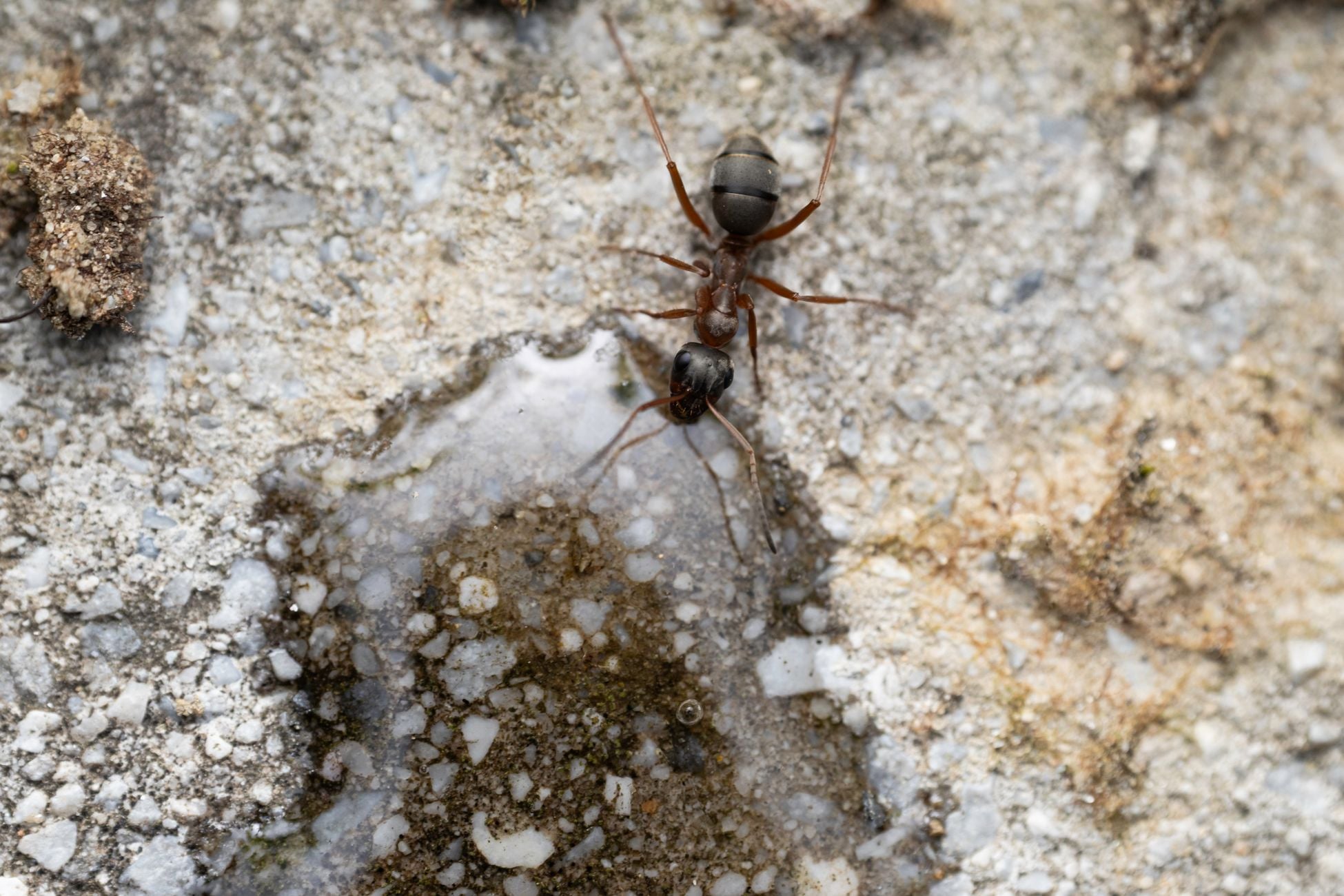
Edward O. Wilson, the Harvard biologist who spent seven decades chasing ants across every continent that has them, used to tell his students that if you weighed every ant on Earth and put them on one side of a scale, and every human on the other, the ants would come close to matching us. Recent research has refined these estimates considerably. The answer, published in the Proceedings of the National Academy of Sciences, was that roughly 20 quadrillion ants are alive at any given moment, weighing about 12 megatons of dry carbon — roughly the combined biomass of all wild mammals and wild birds on the planet put together.
Twenty quadrillion is 20 followed by fifteen zeros. About 2.5 million ants for every living person.
And they are not sitting still. Every year, the world’s ants shift more soil than earthworms do — the animal that Charles Darwin called the most important creature in the history of the world.
The census nobody had bothered to do
Before 2022, the standard figure people cited for the total number of ants ranged somewhere between one and ten quadrillion. A range that wide is not really an estimate. It is a shrug.
Researchers pulled together 489 separate field studies from every continent except Antarctica, covering rainforest floors, savannahs, deserts, boreal forests, and city parks. Researchers had been counting ants for decades using pitfall traps and leaf-litter samples. Nobody had ever added the numbers up.
When they did, the total came in at the upper end: 20 quadrillion individuals, weighing 12 megatons of dry carbon. That is more than the biomass of all wild birds and wild mammals combined, and about a fifth of the biomass of humanity.
The engineers under your feet
An individual ant weighs a few milligrams. A leaf-cutter worker carrying a fragment of foliage back to the nest is moving something the size of a large postage stamp. It seems like nothing.
Multiply it by 20 quadrillion, running around the clock, and the arithmetic changes. Leaf-cutting ants alone, the Atta and Acromyrmex genera of the Neotropics, excavate underground colonies that can extend eight metres below the surface and cover an area the size of a tennis court. A single mature Atta nest in Brazil, when researchers filled it with cement and dug it out, contained roughly 40 tonnes of excavated soil and a network of chambers with a combined volume of about 51 cubic metres.
That is one nest. There are millions of them.
Beating the earthworm at its own game
Darwin spent the last years of his life watching earthworms in his garden at Down House. He estimated that worms brought large amounts of soil to the surface each year, and he argued in The Formation of Vegetable Mould that this slow churning had shaped the ground under every ancient monument in Britain.
Modern soil-science surveys of earthworm activity put the figure between two and 15 tonnes per hectare per year, depending on rainfall, soil type, and worm density. Across the whole planet, earthworms are absent from cold deserts, hot deserts, high mountains, and most of the boreal north.
Ants are almost everywhere. They occupy significantly more of the terrestrial surface than earthworms do, and in the tropics — where worm activity drops off in the dry season — ants keep digging year-round. When soil turnover rates were compared ecosystem by ecosystem, the ant totals came out ahead.
What a colony actually does to a hectare of ground
Field studies in the Brazilian cerrado have measured Atta colonies excavating between 8 and 40 tonnes of soil per hectare per year, depending on colony density. In Amazonian rainforest, leaf-cutter workers strip and process about 17 per cent of the annual leaf production of the surrounding canopy — more foliage than any large mammalian herbivore on the continent.
The excavated soil ends up as loose mounds on the surface, exposed to rain and wind. The tunnels below act like drainage channels. Water that would have run off a compacted forest floor instead percolates down through the ant galleries, carrying nutrients with it.
Roots follow the tunnels. Fungi colonise the walls. The chemistry of the soil around a mature nest — nitrogen, phosphorus, potassium — is measurably different from soil ten metres away.
Fungus farmers, seed movers, aphid ranchers
Leaf-cutters do not eat the leaves they harvest. They feed them to a specific strain of fungus, Leucoagaricus gongylophorus, that they have been cultivating in their underground gardens for about 60 million years — longer than humans have existed as a genus. The fungus breaks down cellulose the ants cannot digest, and the ants eat the fungus.
Other species do other jobs. Harvester ants of the American Southwest collect seeds and store them in granaries, and the seeds they drop or forget account for a substantial share of the dispersal of desert wildflowers. Wood ants in European forests herd aphids on tree trunks, milking them for honeydew and defending them from ladybirds. Army ants in the tropics march in columns of half a million and flush out enough insects and small vertebrates to feed entire species of birds that follow the swarms.
Take ants out of a tropical ecosystem and the forest floor changes within a season. Seedling survival drops. Leaf litter accumulates instead of decomposing. Predator populations that depend on ants as prey collapse.
Why the tropics are so dense with them
The census found that ants are not evenly distributed. Tropical forests and tropical savannahs hold the bulk of the biomass — about two-thirds of the global total. A single hectare of Amazon rainforest can contain more than eight million individual ants.
The number drops off sharply toward the poles. Boreal forests hold a fraction of the tropical density. Tundra hosts almost none. The pattern tracks temperature and productivity: warmer, wetter, more plant matter, more ants.
Which is why the census matters for climate work. Ants move carbon around — burying leaf litter, aerating soil, changing decomposition rates — and any model of tropical soil carbon that leaves them out is missing a mover the size of every wild mammal on Earth combined.
The recent experiments on ant-soil chemistry
Researchers have been trying to work out what happens when you change the substrate ants dig in. A study reported this year found that moderate applications of biochar — the carbon-rich charcoal used in soil restoration — strengthened ant colony behaviour and, through it, several soil ecosystem functions. Higher doses had the opposite effect.
A separate paper found that biochar can reshape ant social structure in ways that ripple out into nutrient cycling and plant growth. The ants are not passive residents of the soil. They are part of the machinery, and if you change the material they work in, the machinery works differently.
The mammals that gave up everything else to eat them
Ants are so abundant, and so nutritious in bulk, that mammals have evolved to eat almost nothing else at least 12 separate times since the extinction of the dinosaurs. Anteaters, aardvarks, pangolins, numbats, echidnas, sloth bears, aardwolves. Different continents, different ancestors, same solution.
And once a lineage commits to eating ants and termites — the tongue lengthens, the teeth shrink, the claws thicken for tearing open nests — it almost never reverses. The food source is that reliable. That inexhaustible. That much of a rounding error away from being infinite.
You would need a food supply of extraordinary depth to justify losing your teeth for it. The ants provide one.
The scale that is hard to hold in the head
Twenty quadrillion is not a number the brain does anything useful with. Try it this way instead. If every ant on Earth were laid end to end, at an average length of five millimetres, the line would stretch about 100 billion kilometres — roughly 670 times the distance from the Earth to the Sun, or about 20 times the distance out to the edge of the heliosphere.
Their combined weight, in dry carbon, matches every wild mammal and wild bird alive today. In wet weight, they outweigh all the wild vertebrates on land put together.
They have been at it for about 140 million years. When the first flowers were opening in the Cretaceous, ants were already there. When the asteroid hit the Yucatán and killed off three-quarters of species on Earth, the ants came through it. When mammoths walked across Beringia, the ants were under their feet.
The soil beneath the story
Darwin’s earthworms shaped Stonehenge. They buried Roman villas. They turned over the ground that grew every crop that fed the rise of civilisation, and Darwin was right to be reverent about them.
The ants are doing more of it than he knew. Under the forest floor of every tropical continent, in the sandy loam of every desert margin, in the cracks of pavements in every city on the planet — galleries are being widened, grains are being carried up, seeds are being buried, leaves are being dragged into the dark.
Sit still on the ground for an hour in almost any warm place on Earth and one will walk across your hand. It is one of 20 quadrillion. It weighs about as much as a grain of sand. Between it and its sisters, they are quietly rebuilding the planet’s topsoil, one milligram at a time, and they have been doing it since before the primates existed to notice.