

A worker pulled alive from a flooded hydropower tunnel on the Nepal–Tibet border roughly 10 days after the late-August flash floods told rescuers he believed others were still alive inside, FOX 9 Minneapolis-St. Paul reports — a statement that, taken at face value by search teams, pushes the operation’s working assumption back from recovery toward rescue. The distinction is not rhetorical. It governs how fast crews cut, how much risk they accept in unstable ground, and how long a site stays staffed around the clock before it is handed to slower, more methodical debris work.
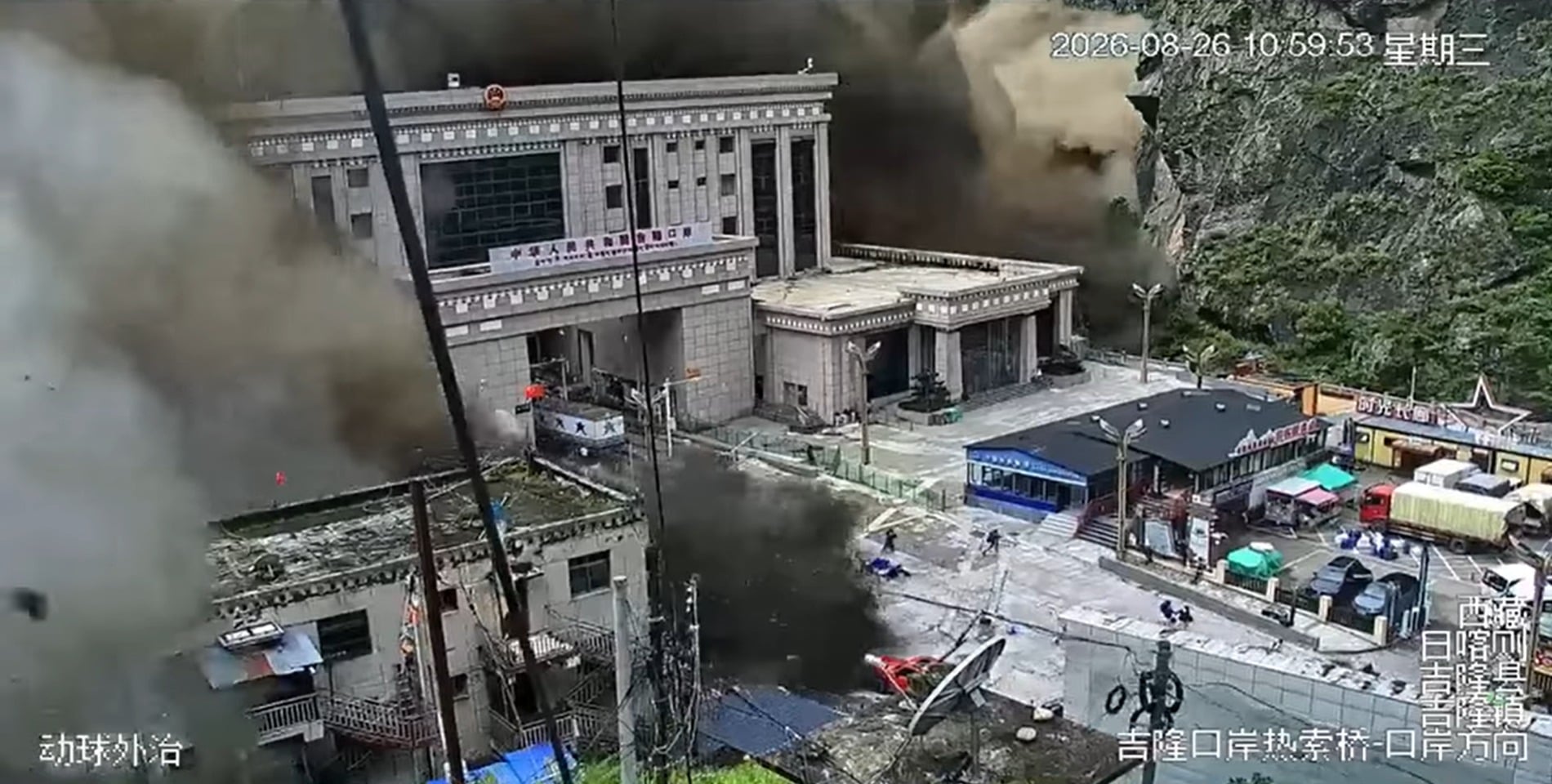
The floods, which struck the Himalayan border region on or about August 26, 2026, tore through valleys on both sides of the frontier and left hydropower infrastructure — access tunnels, headrace works, construction adits — among the hardest sites to reach and the hardest to give up on. Around day nine to ten, search teams reached two workers alive inside the Trishuli 3A hydropower tunnel. International coverage has named them as Sanjaya (also rendered Sanjay) Shah and Kabir Maharjan; both were airlifted for treatment. Al Jazeera reported that an army spokesperson said one of the men had told rescuers more people remained alive inside. The Guardian reported the same rescue from the tunnel.
That relayed belief — survivor to rescuers to spokesperson to wire — is the reason the story is being carried forward rather than closed out. It is not, at this writing, a confirmation of additional living people underground.
What a late find does to the clock
Every large debris and tunnel search runs on an implicit timetable that nobody posts on a wall. Command staff weigh void space, water, temperature, and the interval since the event, and at some point the balance of probability tips: the mission stops being about people who can be saved and becomes about people who can be found. Resources follow that tip. Medical staging thins, heavy equipment moves in, shift rotations lengthen, and the tempo drops from urgent to deliberate.
A survivor recovered at day 10 does not erase that arithmetic, but it does force a recalculation at the sites where the recovery was made. If one void held people alive through a week and a half, the assumptions used to write off comparable voids nearby become harder to defend. Search leadership is left with a narrower but real question: were the conditions in that tunnel section particular to it, or are they plausible elsewhere in the same complex?
FOX 9’s report on the rescue and what the survivor told his rescuers is here:
The station’s account, drawing on the same regional reporting, frames the rescue against the scale authorities have described: more than 5,000 people reported missing, including dozens of Americans, and hundreds of workers believed trapped in tunnels along the affected corridor. Those figures come from agencies working an active, unstable disaster zone, and they have moved from day to day. They should be read as reported totals under revision, not as settled accounting.
A belief relayed is not a rescue confirmed
The care required here is specific. What exists is a survivor’s statement, made after roughly 10 days in a flooded tunnel, relayed by rescuers and then by an army spokesperson to reporters. What does not exist — and what nothing in the current record supports — is confirmation that additional people are alive at that site.
The gap between those two things matters to families reading coverage in Kathmandu, in the border districts, and abroad. A man in that situation may have heard voices, may have been separated from colleagues before losing contact, may be reporting what he knew to be true when he last had information, hours or days before he was reached. Any of those is consistent with the account as relayed. None of them, on its own, establishes that others survived to the point of rescue.
Officials have been careful in similar terms. Communications Minister Bikram Timilsina, per wire coverage, expressed hope that more people would be brought out alive — a statement of intent and possibility, not a claim of contact with anyone still underground. Hope, in a disaster-command context, is a legitimate input into resource decisions. It is not evidence, and it has not been offered as evidence.
What “rescue, not recovery” means on the ground
Operationally, the posture shift is less about new tactics than about time and priority. A rescue posture keeps a site at the front of the queue for personnel and equipment, keeps medical evacuation capacity on standby, and holds open the tolerance for working in conditions that a recovery operation would slow down to avoid. It shortens the interval between deciding to open a section and actually opening it.
It also changes how negative findings are treated. Under recovery logic, an empty void closes a question. Under rescue logic, it moves the search to the next void without lowering the assumed urgency. That difference compounds over days, and in a corridor where hundreds of workers are reported unaccounted for across multiple tunnel sites, it determines the order in which those sites are reached.
Nothing in the current record guarantees that order will produce another live rescue. The floods were severe, the terrain is difficult, and the reported missing counts remain large enough that most of the search will not end in the way this one section did. What the survivor’s account has done, as FOX 9 and the wires have reported it, is deny search leadership the option of assuming otherwise — of treating the tunnels as closed on the strength of elapsed time alone. For now, the assumption on the ground is that someone may still be waiting, and the operation is being run accordingly.