

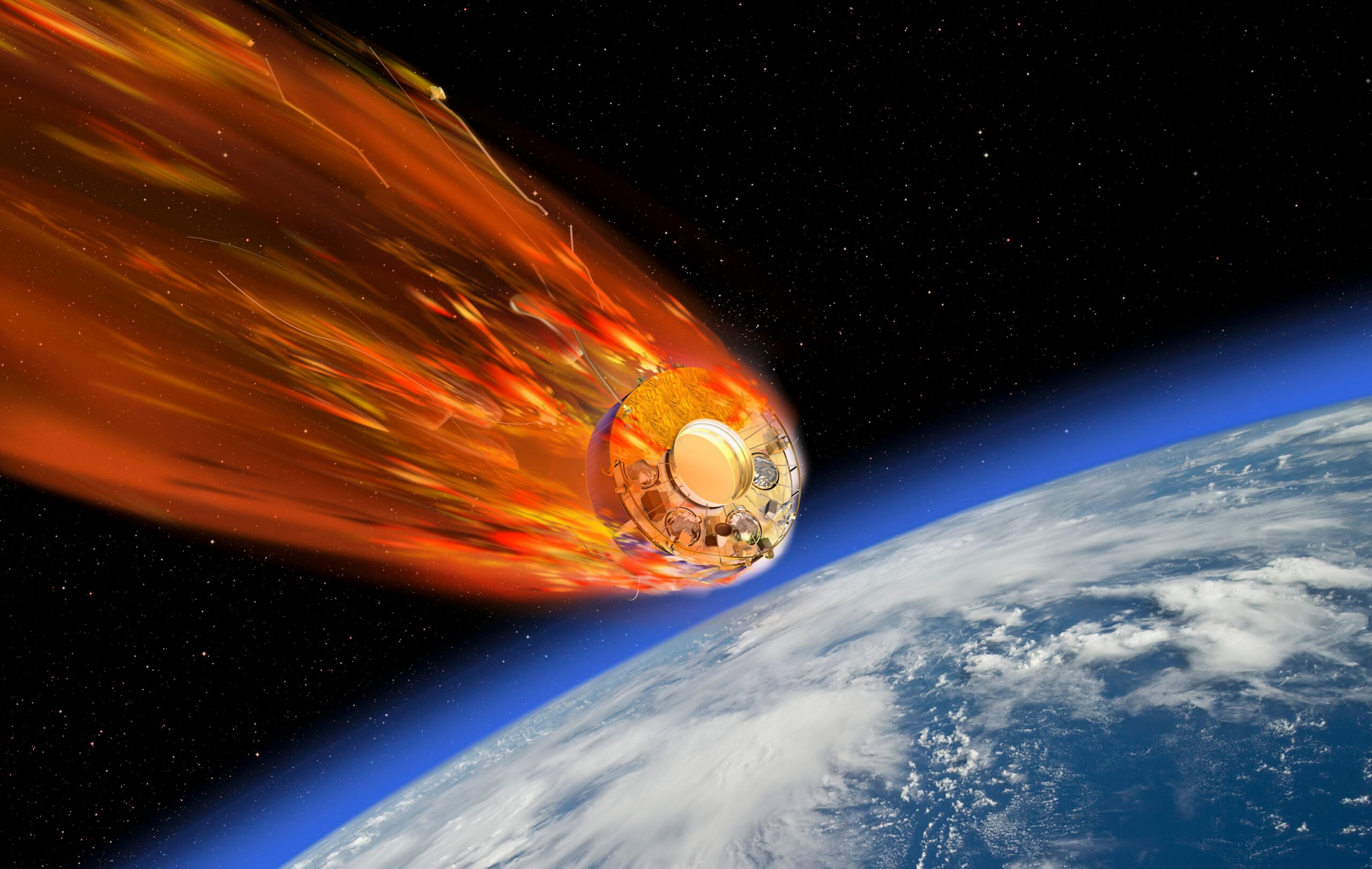
At 21:30:31 UTC on 1 September 2026, the last of four satellites that had flown in formation since 2000 met the upper atmosphere over the South Pacific and stopped existing. Tango, formally Cluster II FM-8, had been steered there on purpose. The previous evening, its sibling Samba had done the same over the South Pacific. Both were observed from a plane, and according to ESA’s Space Safety account of the campaign published on 2 September, 29 of the 30 instruments carried aboard the observation aircraft observed both reentries.
That number is the headline for anyone who works on how spacecraft come apart. Tango’s fall closed 26 years of Cluster operations, and it closed them with a dataset rather than a shrug.
Four satellites, four targeted reentries
Cluster launched in 2000 as a quartet named Rumba, Salsa, Samba and Tango, flying in shifting tetrahedral formations to measure Earth’s magnetosphere in three dimensions rather than from a single point. The science mission ended in 2024. What followed turned the spacecraft themselves into an end-of-life experiment, with ESA manoeuvring each one in advance so that its eventual reentry would occur over a remote region of the South Pacific.
Salsa went first. Then Rumba. Samba reentered on 31 August 2026 at 21:39:38 UTC, the third of the four. Tango followed the next evening at 21:30:31 UTC, or 23:30:31 CEST for the team at ESOC in Darmstadt who sent the final commands and then waited.
The waiting is the part that does not appear in the telemetry logs. ESA reported that contact with Tango through the Kourou ground station was lost about a quarter of an hour before reentry. Philippe Escoubet, Cluster Mission Manager at ESA, reflected on the end of the mission in the agency’s account, describing the attachment that had built up around Cluster during its long life.
After four targeted reentries, ESA described the approach as a proven method of safe end-of-life disposal. Cluster was designed decades before this disposal campaign, so adapting the quartet and then carrying out the sequence successfully gave ESA a repeatable operational record rather than a one-off demonstration.
Fifty seconds at a time, from a plane out of Tonga
The observing half of the operation was airborne. The ROSIE campaign for 2026 put a research aircraft over the South Pacific, flying out of Tonga with cameras and other scientific instruments positioned to watch Samba and Tango break apart. For targeted reentries in a remote ocean region, an aircraft can be positioned close to the predicted trajectory and its route adjusted as the forecast is refined.
The observation windows were short. ESA said the scientists observed Samba and Tango for about 50 seconds on average, tracking the spacecraft across the sky as they fragmented.
Among the sensors were tracking cameras, including a Nikon Z8 operated by the University of Stuttgart’s High Enthalpy Flow Diagnostics Group, or HEFDiG. During Tango’s pass, the pilot banked the aircraft at the right moment to keep the burning spacecraft within the instruments’ field of view for a few seconds longer.
Twenty-nine of the thirty instruments aboard were able to observe both events. The ROSIE payload included imaging systems as well as instruments collecting spectral information that can help identify materials as they melt and vaporise. Those measurements give engineers real-flight data with which to test destructive-reentry models and improve design-for-demise work, aimed at reducing the chance that hazardous spacecraft components survive to the surface.
From reading the magnetosphere to reading the fall
The then and now of Cluster is a study in a mission changing job description. For more than two decades, the four spacecraft flew through Earth’s magnetic environment measuring the particles and fields that govern space weather and examining regions where the solar wind interacts with the magnetosphere. Simultaneous measurements from four separated spacecraft allowed scientists to distinguish changes occurring across space from changes occurring over time.
The reentry campaign was the mission as improvised. Once the science phase concluded in 2024, the spacecraft themselves became part of the experiment: four nearly identical objects of known construction, entering the atmosphere under deliberately planned conditions and observable by instruments positioned in advance. ESA describes the resulting observations as a unique dataset for improving understanding of destructive reentry.
The next step goes inside. ESA says its Draco mission is scheduled for launch in 2027 and is designed to record what happens to a spacecraft during destructive reentry from within. Where ROSIE watches a breakup from an aircraft kilometres away, Draco is intended to gather measurements from the spacecraft itself and preserve the data long enough for transmission.
Tango’s demise was timed to the second and directed over open water in the South Pacific, bringing 26 years of Cluster operations to an end. For the ROSIE team watching from the aircraft, the final passage joined Samba’s in a dataset built from roughly 50 seconds of observation at a time.