
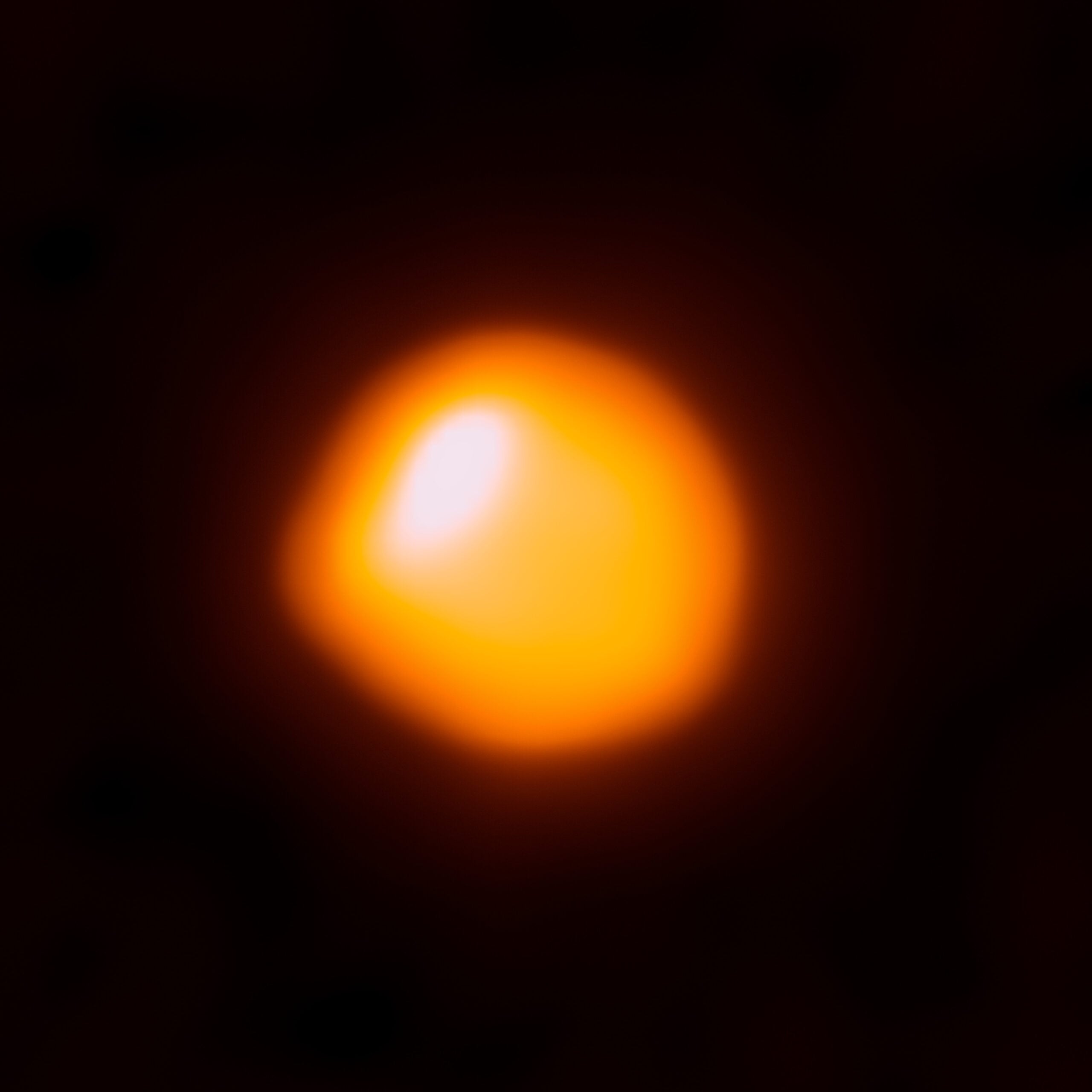
A bright patch on the northeastern limb of Betelgeuse sat in nearly the same place, at nearly the same intensity, in ALMA images taken more than seven years apart — 2015 and 2023 — a persistence that outlasts the lifetimes current models assign to the star’s largest convective structures. That is the central count in new work led by Bill Dent of ESO, described by the ALMA Observatory and detailed in an arXiv preprint of a paper in press at Astronomy & Astrophysics. The 2023 observations used ALMA’s longest baseline configuration, reaching a resolution of roughly 7 milliarcseconds — fine enough to break the star’s disc into patches rather than treat it as a single smeared point of light.
Seven milliarcseconds is a strange unit to hold in the hand, so hold the star instead: Betelgeuse lies about 600 light-years away and carries a radius roughly 800 times the Sun’s. It is one of the very few stars other than the Sun whose surface can be mapped at all, and the map that comes back is not smooth.
A disc broken into patches, and a temperature map
What ALMA resolves at millimetre wavelengths is not the optical photosphere but the lower atmosphere just above it — the layer where the star’s outward flow of material is still being assembled. Across that layer the average temperature comes in around 2300 K. Against that background, the observations show hotter regions toward the northeast and the southwest, and the brightest of them, the northeastern spot, runs up to about 800 K hotter than the gas around it.
That is a large contrast to hold on a surface that is supposed to be boiling. Betelgeuse is a red supergiant, and the standard picture of its outer envelope is convection on a monstrous scale: a small number of enormous rising cells, each comparable in size to a substantial fraction of the visible disc, carrying heat up from the interior, spreading, cooling, and sinking again. The cells are big because the star is diffuse; they are transient because convection is, by nature, a churn. Models of these giant convective structures give them lifetimes — and those lifetimes are the number the new observations run against.
There is a second measurement folded into the same data. The star’s apparent radius is not fixed: ALMA finds variations of up to about 6 percent depending on where and when you measure the edge. A star whose boundary moves by that much is not a sphere with a surface so much as a swollen, ragged atmosphere with a statistical outline.
Why seven years apart is the number that matters
The 2015 comparison is what turns a snapshot into an argument. ALMA had observed Betelgeuse in a similar 0.9-millimetre configuration roughly seven years before the 2023 long-baseline run, and the northeastern hotspot appears in both epochs at nearly the same location on the disc, with similar intensity. The conservative reading of two epochs is a lower bound: the feature has persisted for at least seven years. It may have persisted longer, and nothing in two images can say whether it flickered in between.
Even the lower bound is awkward. If the hotspot were simply the top of one of the large convective cells the models describe, it should have had time to rise, spread, cool and be replaced. It should also have moved, because the material around it demonstrably did: the structure of the molecular gas emission has changed significantly since 2015 while the hot patch has not. The same data show no clear signature of rotation in the extended line emission, which removes one obvious way to drag a surface feature around a star, and leaves the stillness of this one unexplained rather than explained.
That is the interesting shape of this result: it is not a discovery of a new object but a measurement of duration, and duration is what distinguishes a fluctuation from a structure. Long counts are the instrument’s real contribution here. A single epoch at 7 milliarcseconds is a picture. Two epochs seven years apart is a clock.
Clumpy molecules, and an orientation worth noticing carefully
The same data track molecular gas around and above the star. SiO and CO emission show an environment that is irregular and clumpy rather than a smooth outflowing shell — knots and asymmetries in the material Betelgeuse is shedding, consistent with the uneven temperature map beneath it. Whatever is happening at the surface is being written into the wind.
The authors’ own reading is geometric. They associate the hot regions and the departures from radial symmetry with active shocks driven by underlying convective cells, and they note that the patches sit near the star’s proposed poles — which, as the paper puts it, might suggest enhanced and relatively stable polar convection rather than the transient churn spread across a disc that the models produce. That would make the hotspots less a violation of convection than a sign that convection on this star is organised in a way the models do not yet reproduce.
Then there is the orientation. Independent lines of evidence have pointed toward a companion to Betelgeuse, and the ALMA team notes that the direction of the hotspot pattern is intriguing in that light. That is as far as the observations go. They do not establish a direct connection between a companion and the hotspots, and nothing in the temperature map requires one; the alignment is a coincidence worth examining, not a mechanism demonstrated. The honest statement is that a persistent, non-drifting hot region is unexplained, and that a nearby body is one of several things that could in principle anchor a pattern on a star — alongside tides, magnetic effects, stable polar convection, or a longer-lived flow than models currently produce.
More epochs are the test. If the northeastern spot is still in place at similar intensity in another ALMA long-baseline run, the lower bound extends and the tension with convective lifetimes sharpens. If it fades, migrates, or is joined by new spots elsewhere on the disc, the pattern becomes a phase rather than a fixture, and the modelling problem changes shape. Either outcome is informative, which is the rare and useful property of this measurement.
Dent puts the motivation plainly: “Its eventual fate as a supernova makes it fascinating to know what it actually looks like now.”