

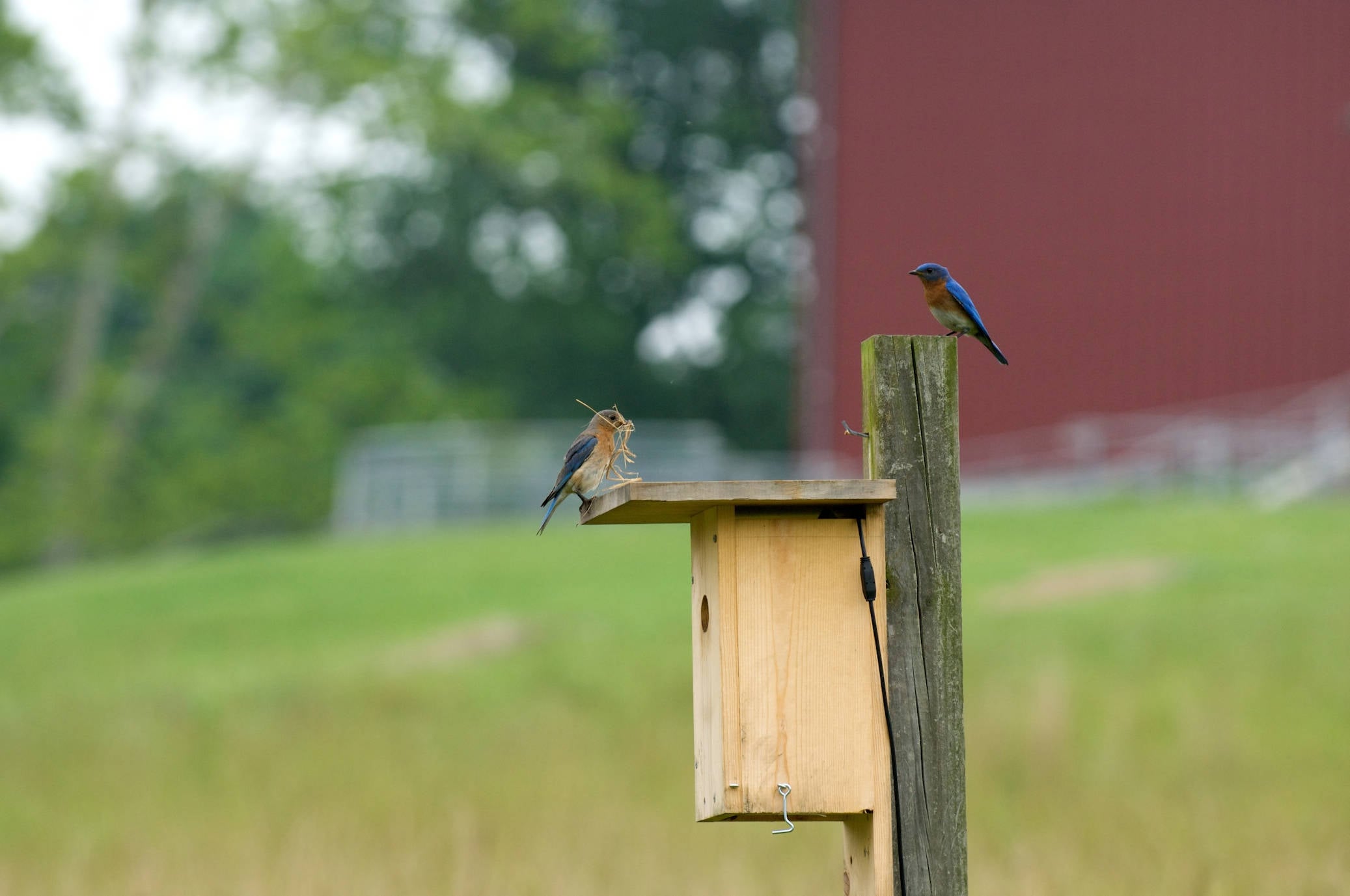
More than 750 nesting boxes now hang on fence lines, park edges, schoolyard posts and backyard trees across eight Texas counties, and every one of them was cut, assembled and put up by the same pair of hands. The builder is Aamir Tinwala, of Coppell, a Dallas suburb wedged between the airport and the prairie remnants of the Elm Fork. The boxes are plain untreated wood — no stain, no sealant, nothing that would off-gas into a chamber where an animal the weight of a few paper clips will spend its first two weeks alive.
Points of Light reports that the boxes serve 16 or more native Texan species. Among them are Carolina Chickadees, Carolina Wrens, Northern Cardinals, Eastern Bluebirds, Purple Martins and titmice — birds that share a habit of raising young inside enclosed spaces, whether a woodpecker’s abandoned hole, a hollow limb, or a rectangle of pine screwed shut on five sides.
What a wooden box replaces
Suburbs subtract cavities. A dead tree comes down for safety; a hollow limb is pruned; a fence post is swapped from split cedar to steel. Each removal deletes a nesting site that took decades of rot and woodpecker labor to produce. The birds that need those spaces cannot excavate replacements themselves — most are secondary cavity nesters, tenants rather than builders — so their local numbers track the supply of holes as closely as they track food.
That is the arithmetic a nesting box addresses. It is a small, dry, ventilated volume with one opening, mounted at a height and orientation the species will accept. Published nest box guidance sizes the entrance hole to the intended occupant, admitting a chickadee while excluding larger competitors, and the design details matter down to the millimeter: drainage holes in the floor, a roof overhang against Texas rain, a side panel that swings open so old nesting material can be cleared between broods.
The Backyard Bird Project, as Tinwala calls the effort, began in middle school after COVID restrictions lifted. He was 12, according to Points of Light. In a first-person account published by Audubon Texas in November 2025, he traces the start to the loss of a pet cockatiel — Coco, in Audubon’s telling — and the attention to birds that followed.
The first public step was a table. Encouraged by his eighth-grade science teacher and a school environmental club, he brought free nesting boxes to Coppell’s Earth Day event and handed them out. Audubon Texas describes what followed as a widening circuit of build workshops across Coppell, Irving and other Dallas suburbs, where participants assemble boxes themselves rather than receiving finished ones — a distinction that turns a giveaway into a supply chain of people who now know how to make the next one.
The logistics of 750 boxes
Building at this scale is a materials problem before it is a conservation problem. Audubon Texas notes that Tinwala’s father supplied untreated lumber from Home Depot, and that his mother handled deliveries, with Nextdoor used to reach neighbors who wanted a box. The picture is domestic and unglamorous: a garage, a saw, sawdust, a stack of cut panels sorted by species.
Consider what 750 boxes means as physical work. Each requires roughly six pieces cut to spec, a drilled entrance, vent gaps, drainage, and fasteners — call it a few dozen operations per unit. Multiplied out, that is tens of thousands of cuts and drill passes. Then each box must travel to a site, be mounted at an appropriate height, and be pointed away from prevailing wind and afternoon sun.
Points of Light counts nearly 64 bird box events over the past six years. Spread across eight counties, that is a recurring cadence rather than a single push — a Saturday morning in a park pavilion, a folding table, a bin of pre-cut panels, and a line of people who arrive knowing nothing about entrance hole diameters and leave carrying a functioning nest site.
Occupancy is where the effort meets biology, and it is worth hedging: not every box is used, and use rates depend on placement, predator pressure, competition from introduced species, and the density of nearby foraging habitat. What a box supplies is opportunity. Whether a Carolina Chickadee takes it up in March is the bird’s decision.
From a Dallas suburb to 24 states
The project did not stay in North Texas. Points of Light reports chapters in 24 states and three countries, a structure that works because the underlying unit is so transferable: a set of plans, a species-appropriate hole size, and someone willing to run a workshop. Secondary coverage has cited smaller figures for the spread; the Points of Light account is the one used here.
Both Audubon Texas and Points of Light mention an international thread — a reported partnership involving house sparrows in India, connected to an effort described as Project Rise. House sparrow declines in Indian cities have been widely discussed for two decades, often linked to the loss of ledges, eaves and crevices in modern building facades. The remedy under discussion there is the same one hanging on fence posts outside Dallas: put the cavity back.
There is a quiet symmetry in that. Across eight Texas counties, more than 750 hollow wooden rectangles are waiting through a winter, each one a few dollars of pine and an hour of labor, each one sized for a specific bird. Come spring, some fraction will fill with grass, moss and hair, then eggs, then a brood that fledges out of a hole cut by a teenager who kept count.