

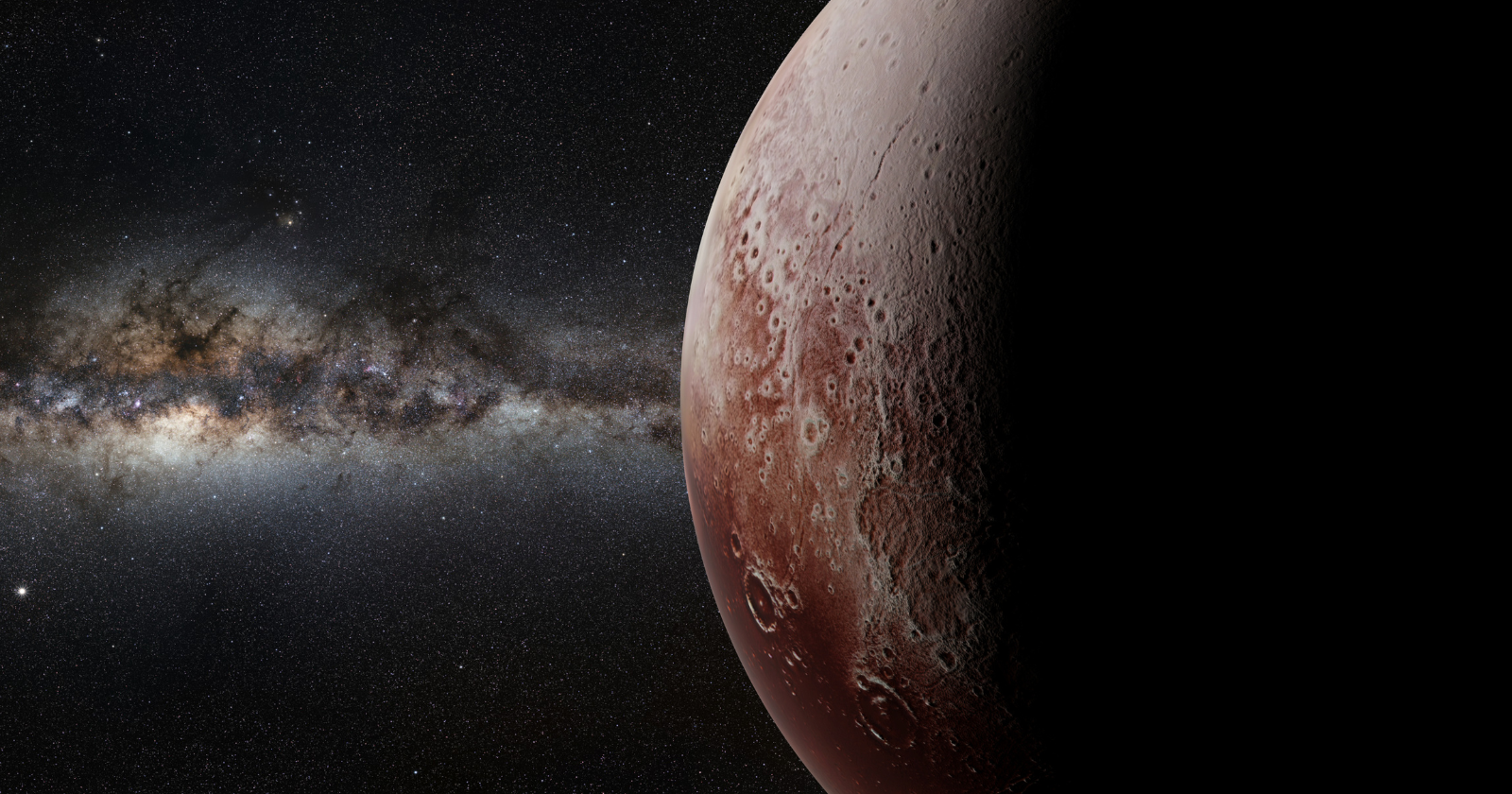
At 7:49 a.m. Eastern Daylight Time on Tuesday, 14 July 2015, the piano-sized robotic spacecraft New Horizons flew past the dwarf planet Pluto at roughly 32,000 miles per hour, at a closest approach distance of 7,800 miles above the surface. The spacecraft had left Cape Canaveral nine years, five months, and twenty-five days earlier, aboard an Atlas V 551 rocket travelling at 36,373 miles per hour — the fastest launch speed ever recorded for a human-manufactured object. At the moment of closest approach, New Horizons was three billion miles from Earth, and NASA’s Deep Space Network antennas were receiving its approach telemetry at one to four kilobits per second. The principal investigator was Alan Stern of the Southwest Research Institute in Boulder, Colorado. Within the following thirty minutes, the spacecraft completed most of the high-resolution photography that would, over the next decade, transform what planetary scientists understood about the ninth planet from the Sun — a designation Pluto had held between its 1930 discovery by the American astronomer Clyde Tombaugh and its 2006 reclassification by the International Astronomical Union.
The specific engineering constraint that made the sub-thirty-minute imaging window the substantive practical limit of what New Horizons could accomplish at Pluto was the specific combination of two physical facts about the mission’s trajectory. First, the specific orbital mechanics of the outer solar system had required New Horizons to fly past Pluto rather than enter orbit around it — the specific gravitational mass of Pluto (approximately 0.2 percent of Earth’s) is substantially insufficient to capture a spacecraft traveling at the specific 32,000 miles per hour that New Horizons required to reach the Pluto system in a nine-and-a-half-year mission duration, and the specific propellant reserves the spacecraft carried were substantially inadequate to slow the spacecraft to the orbital-insertion velocity that a Pluto orbital mission would have required. Second, the specific geometry of a high-speed planetary flyby means that the spacecraft passes closest to the target planet for only a substantially brief interval — in New Horizons’ specific case, approximately thirty minutes of near-closest imaging during which the highest-resolution photographs of Pluto’s day-side hemisphere were captured, followed by approximately several additional hours of progressively lower-resolution retreat imaging as the spacecraft moved rapidly away from Pluto’s night side. The specific total dataset New Horizons collected across the entire nine-day intensive observation campaign around the 14 July closest approach consisted of approximately 6.25 gigabytes of data — a substantially small volume by contemporary consumer-electronics standards, but requiring approximately fifteen months of continuous radio downlink to transmit back to Earth at the specific one-to-four-kilobit-per-second data rate that the Pluto distance permitted.
According to NASA’s institutional mission summary of the New Horizons Pluto flyby and the specific dataset it produced, the substantially most-unexpected single scientific discovery that New Horizons’ July 2015 imaging revealed was the specific existence of a substantial heart-shaped bright region on Pluto’s day-side hemisphere — subsequently named Tombaugh Regio in honour of Pluto’s original 1930 discoverer, whose cremated ashes NASA had (in a specific gesture the mission team had negotiated with the Tombaugh family in the years before launch) installed aboard the New Horizons spacecraft as part of the January 2006 launch payload, meaning that Clyde Tombaugh became, on 14 July 2015, the first human being whose physical remains were transported to the specific astronomical body he had personally discovered. Tombaugh Regio, as subsequent New Horizons imaging progressively revealed, consists of two distinct lobes. The western lobe (Sputnik Planitia, named for the specific 1957 Soviet satellite Sputnik 1 that initiated the modern era of human space exploration) is a substantial nitrogen ice sheet approximately 1,200 kilometres wide by 2,000 kilometres long — approximately three to four times the surface area of the American state of Texas — and approximately four kilometres thick. The eastern lobe consists of high-albedo uplands coated by nitrogen ice that has been transported through Pluto’s thin atmosphere from Sputnik Planitia and subsequently deposited as fresh ice on the upland surface — a specific atmospheric-transport mechanism that continues to operate under the substantial seasonal and mega-seasonal nitrogen sublimation cycles that Pluto’s 248-year solar orbit produces.
The ice sheet nobody expected
The specific geological characteristics of Sputnik Planitia were, by essentially every account of the subsequent planetary science literature, substantially outside the range of what pre-mission planetary scientists had considered plausible for a body as small and cold as Pluto. As detailed in NASA’s institutional summary of the ten most substantial single findings that the New Horizons Pluto flyby produced, the Sputnik Planitia surface is essentially free of impact craters — a specific observation that, in the standard planetary-science interpretive framework, implies that the surface must be geologically young (approximately ten million years old rather than approximately four billion years old, since the specific rate of Kuiper Belt impact cratering across the substantially larger surrounding region of Pluto’s surface implied that a four-billion-year-old surface should be substantially more heavily cratered than Sputnik Planitia appeared to be). The specific mechanism by which a nitrogen ice sheet on a body with a surface temperature of approximately −229°C (approximately −380°F) could be actively resurfacing itself on ten-million-year timescales was, at the specific moment of the July 2015 flyby, substantially unclear. Subsequent analysis of the New Horizons imagery has established that Sputnik Planitia exhibits a distinctive polygonal cellular pattern (each cell approximately ten to fifty kilometres across) that appears to be produced by specific convective overturning of the underlying nitrogen ice — a specific geological process in which warmer nitrogen ice at the base of the four-kilometre-thick sheet rises to the surface and cooler surface nitrogen ice sinks back down, essentially in the same way that boiling water on a stove exhibits convective patterns.
What the flyby actually established
The cumulative scientific consequences of the sub-thirty-minute imaging window on 14 July 2015 have been, per the BBC Sky at Night Magazine’s summary of the specific accumulated scientific findings from the New Horizons Pluto flyby across the subsequent decade, substantially larger than the pre-mission scientific expectations for a spacecraft encounter of the specific mission duration had anticipated. Beyond the specific nitrogen ice sheet at Sputnik Planitia, New Horizons documented water-ice mountains approximately 3.5 kilometres tall along the eastern edge of Tombaugh Regio (subsequently named Norgay Montes and Hillary Montes for the specific 1953 first-ascent mountaineers of Mount Everest); a blue-scattering atmospheric haze approximately 200 kilometres deep composed of complex hydrocarbons produced by ultraviolet-driven chemistry involving Pluto’s specific nitrogen and methane atmospheric components; probable ice volcanoes at Wright Mons and Piccard Mons (subsequent analysis published by Kelsi Singer and colleagues in Nature Communications in 2022 argues these represent substantial cryovolcanic resurfacing events); and evidence consistent with a subsurface liquid water ocean approximately 100 kilometres beneath Pluto’s icy crust — a specific finding that has substantial implications for the broader planetary-science understanding of where liquid water can persist across the outer solar system, and (by extension) where extraterrestrial life might plausibly exist. As reported in Science News’s July 2025 tenth-anniversary retrospective on the New Horizons Pluto flyby and its cumulative scientific legacy, the deputy principal investigator of the mission, Kelsi Singer of the Southwest Research Institute, summarised the specific cumulative research consequences of the sub-thirty-minute July 2015 imaging window in the specific terms: “We all thought Pluto would be a little bit less interesting than we found it; we thought it would be more cold and dead. Since the flyby, we have basically rewritten the textbooks.” New Horizons itself, having subsequently flown past the small Kuiper Belt object Arrokoth on 1 January 2019 (the specific most-distant astronomical body any spacecraft has ever photographed at close range), continues to travel outward at approximately 30,000 miles per hour into the substantial darkness beyond the Kuiper Belt, transmitting engineering telemetry back to Earth at the specific rate of approximately one kilobit per second across the accumulated distance of approximately sixty astronomical units from the Sun that the spacecraft has, at the current 2026 date, progressively covered.