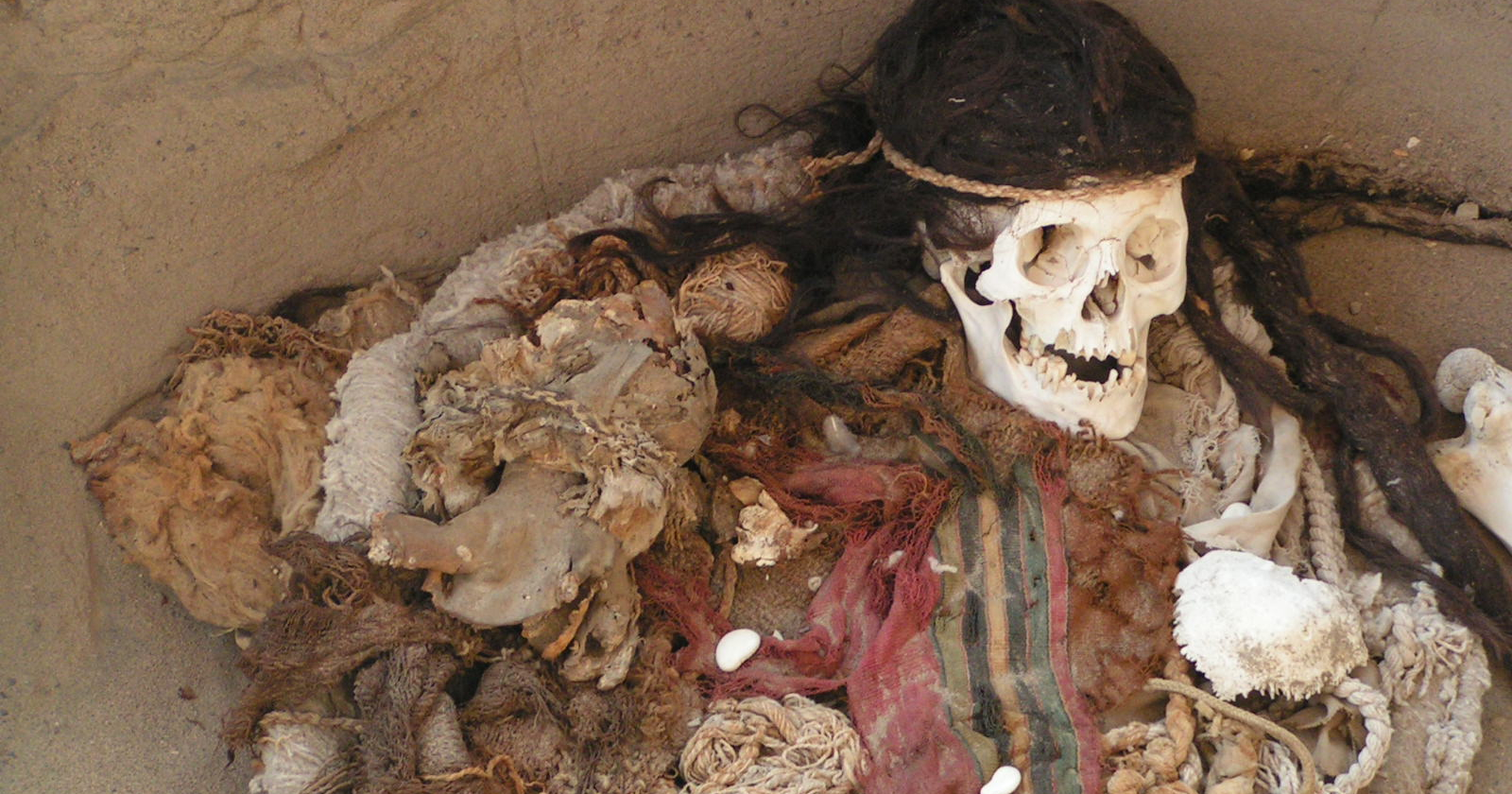
Her eyelashes are still there. So is the flaxen hair, the tasselled white wool cloak, the felt hat and the fur-lined boots, on a woman who lay in a boat-shaped coffin under the Taklamakan Desert for at least 3,500 years. Archaeologists call her the Beauty of Xiaohe, though she wasn’t lifted out of the sand until years after Victor Mair of the University of Pennsylvania first encountered mummies like her. In 1988, in a dark gallery of similarly preserved bodies at the regional museum in Ürümqi, his first thought was that the exhibition had to be a hoax. The textile colours were too bright. The bronzes were too early for that corner of Asia. He stayed about five hours, and it redirected his career.
The faces did all the arguing
High cheekbones, deep-set eyes, brown and reddish hair, and in a few cases heights well over six foot: this is what the Tarim mummies looked like. They wore woven wool, twill plaid at some sites, and went into the ground with wheat, cheese and bundles of ephedra. So the inference wrote itself, and kept writing itself for a century: westerners who had walked a long way east and died at the far end of the walk.
I sympathise with the impulse more than I should. I have an Asian face and an Australian boarding-school vowel system, and strangers have been guessing wrong about where I’m from for most of my life.
Three serious versions competed: Afanasievo steppe herders pushing down from southern Siberia, Bactria-Margiana farmers moving up from Turkmenistan, agropastoralists filtering along the Inner Asian Mountain Corridor. All three were plausible. All three assumed the answer lay somewhere else.
What the genomes said
In 2021 a team based at Jilin University and the Max Planck Institute for Evolutionary Anthropology published genome-wide data from thirteen of the earliest Tarim mummies, dating to 2100 to 1700 BC. Every migration model broke. Feed the statistics an Afanasievo source and the fit fails. Same for the Bactrian oasis farmers, same for the mountain corridor groups.
What did fit was odd. Around 72 per cent of their ancestry traced to Ancient North Eurasians, an Ice Age hunter-gatherer population represented in the paper by a single Upper Palaeolithic Siberian from Afontova Gora. The other 28 per cent traces to ancient Northeast Asians near Lake Baikal. Formation of that gene pool dates to about 9,157 years ago, give or take a thousand, with a hard bottleneck in the data. These people had been sitting there, unmixed, since the early Holocene.
Their so-called Western features came out of the Pleistocene, inherited from a population older than Europe as anyone would recognise it.
The migration story was not wrong. It was pointed at the wrong basin. The same paper found five individuals from Dzungaria, just north over the Tianshan and a millennium earlier, carrying predominantly Afanasievo ancestry. Steppe herders really did come east. They just did not make it over the mountains and into the sand.
The cheese around their necks
Christina Warinner, a Harvard anthropologist and senior author on the study, called the Xiaohe people genetically isolated but “remarkably culturally cosmopolitan”. Their wheat and dairy came from West Asia, their millet from East Asia, their ephedra from Central Asia. The genes stayed put while everything else travelled.
Hardened plaque on the teeth of seven individuals from the lowest layers at Xiaohe tested strongly positive for ruminant milk proteins, matched to cattle, sheep and goat. Not one of them carried the variant for lactase persistence. They fermented and ate dairy anyway. Nobody had told them they were not equipped for it.
The pebble-sized white lumps around some of the mummies’ necks turned out to be cheese. A 2024 analysis in Cell recovered microbial DNA from three samples and pulled out Lactobacillus kefiranofaciens and Pichia kudriavzevii, the organisms inside modern kefir grains. Kefir is supposed to have started in the North Caucasus. The ancient strain sits closer to the Tibetan lineage than to the Russian one.
What thirteen genomes cannot settle
Thirteen genomes from three sites is a narrow window onto four centuries.
The earlier evidence was messier. A 2015 mitochondrial study of Xiaohe remains reported maternal lineages from both ends of Eurasia, several of them normally filed as West Eurasian. The 2021 team sampled the earliest burial layers and read far more of the genome. That gives the newer result more weight. It says nothing about who turned up at Xiaohe afterwards.
Language is still open too. Tocharian, an Indo-European branch, shows up in Buddhist manuscripts from the Tarim Basin written between AD 500 and 1000. The authors are careful to say their data cannot tell us whether the Bronze Age population spoke an ancestral form of it. Genes, pots and words ran on separate timetables here, and anyone who collapses them into one arrow is guessing.
Writing in 2010, Mair called it certain that the people of the Tarim Basin had not arisen from the soil of the region and must have come from elsewhere. He had the best evidence going. Eleven years later the soil answered back. Faces have never been a reliable way of asking where anyone comes from, and it has taken a century of argument and a lot of ancient DNA to establish something that obvious.