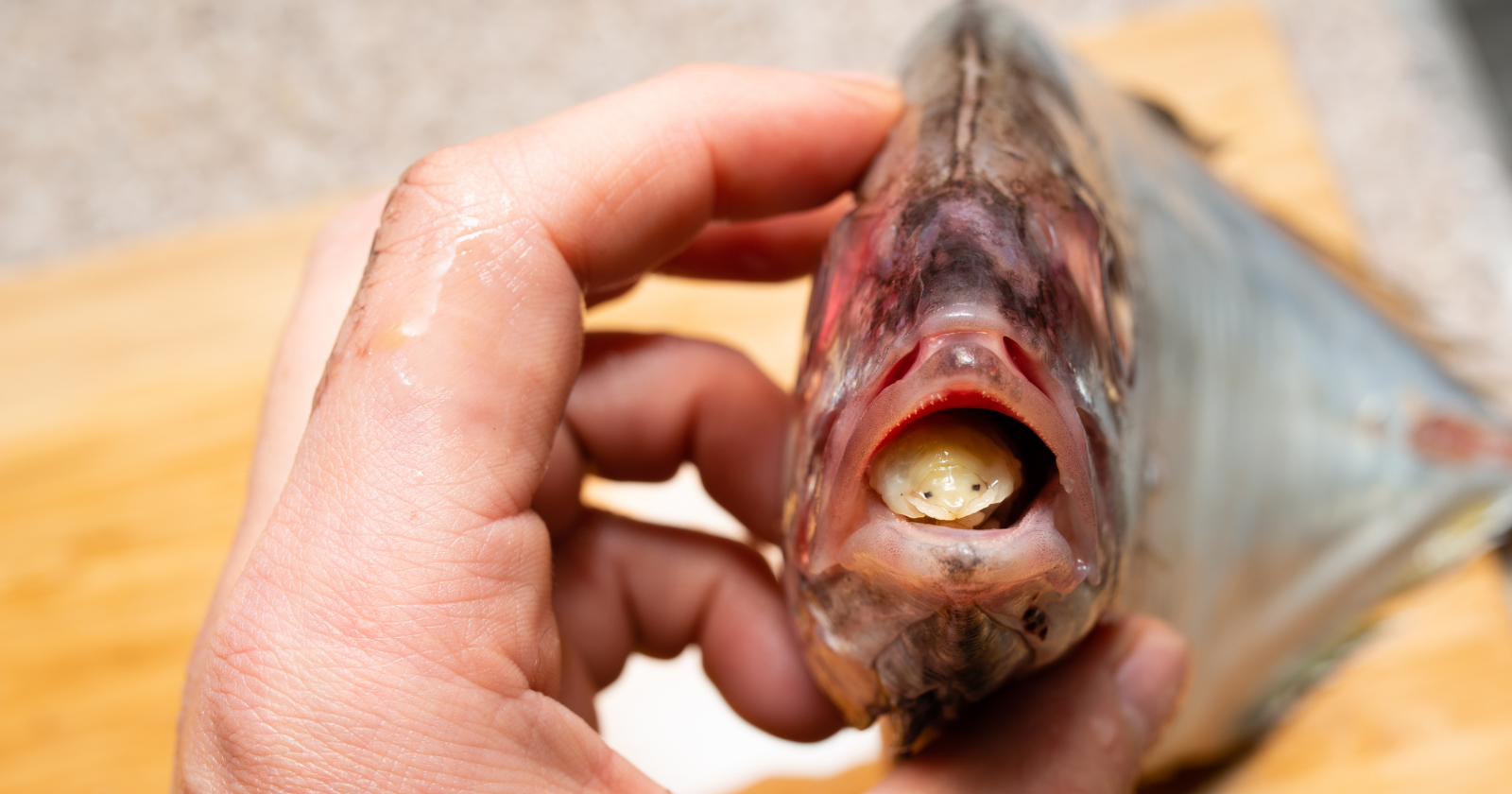
Open the mouth of a snapper lying on a fishmonger’s ice and, every so often, something looks back. Not a tongue. A pale, plated crustacean roughly the length of a thumbnail, wedged into the floor of the mouth on seven pairs of hooked legs, sitting exactly where the tongue should be and doing more or less the tongue’s job.
That animal is Cymothoa exigua, an isopod, which makes it a saltwater relative of the woodlice under the pot plants. Its common name is the tongue-eating louse, and it is one of the few nicknames in zoology that undersells the situation.
What actually happens to the tongue
Nothing eats it. A juvenile isopod swims in through the gill slit, crawls forward along the gill arch and clamps onto the base of the tongue with the hooked tips of its legs, then starts drinking. Stefanie Kaiser, then a postdoctoral fellow at New Zealand’s National Institute of Water and Atmospheric Research, explained in an interview with the American Association for the Advancement of Science that the parasite never chews the organ. It draws blood out of the tissue until the tongue, starved of circulation, withers and falls away on its own.
What is left is a stub. The isopod anchors itself to that stub and stays for the rest of the fish’s life, feeding on blood and mucus while the fish goes on shoving food around with it.
Whether the fish minds is harder to answer.
The whole story rests on two snappers
In November 1979, Richard Brusca and Matthew Gilligan cut open 37 spotted rose snappers caught near Guaymas, in the Gulf of California. Two had a female C. exigua in the mouth and more than 90 per cent of their tongues gone. Both fish were in decent nick, with body fat and full guts, and one had a chunk of fish in its stomach about 20 by 50 millimetres across. The pair published in Copeia in 1983, and that paper is the origin of every “parasite becomes the tongue” headline since, as the Australian Museum’s Melissa Martin has noted.
Two fish. One study. Forty-odd years of internet folklore built on top of it.
That does not make the observation wrong, and it remains the only documented case of a parasite standing in for a host organ. It does mean the tidy version, where the fish carries on happily with a crustacean for a tongue, rests on a very small window.
Everything about the sex is upside down
A single infested fish often carries a couple: one female anchored to the tongue stub, one smaller male tucked into the gill chamber behind her, with fertilisation happening in place. That division of labour comes down to biology rather than choice.
Cymothoids are protandrous hermaphrodites, meaning individuals mature as males first and some later become female. Per Kaiser’s account, juveniles arrive through the gills as males, and the first to reach the tongue site typically flips to female and settles there. The rest stay male in the gills, possibly because pheromones from the female block the switch, though nobody has pinned that mechanism down.
Once fertilised, she broods her eggs in a pouch on her underside and releases juveniles to go and find snappers of their own.
Nobody is confident which species they are looking at
Most of the tongue-parasite photos that circulate get labelled C. exigua by default. Martin’s point is that this is lazy. The family Cymothoidae runs to 383 species across 40 genera, and roughly 100 of those live in fish mouths, spread across eight genera. Plenty look similar enough to fool anyone without a microscope and a key.
The eastern Pacific proved the point in 2025. José Salgado-Barragán and Mayra Ixchel Grano-Maldonado examined 32 mouth-dwelling isopods pulled from snappers on sale in Mazatlán markets and described them in Systematic Parasitology as a species new to science, Cymothoa facimar. It lives in Pacific red snapper and mullet snapper, and it had been filed under the famous name all along, separable mainly by body proportions and the sculpting of its trunk segments. The name has since been formalised in the World Register of Marine Species.
Fishing pressure makes them worse
A cousin species supplies the most uncomfortable finding in this whole area. Maria Sala-Bozano, Cock van Oosterhout and Stefano Mariani compared striped sea bream from two Mediterranean sites, one beside a marine protected area, the other under heavy commercial fishing. Writing in the Biological Journal of the Linnean Society, they reported that the mouth parasite Ceratothoa italica did real damage in the exploited population and almost none near the reserve. Parasite load explained 34.4 per cent of the variation in liver condition among the fished bream, against 0.3 per cent inside the protected zone.
Same parasite, same host, wildly different outcome. Stress a stock hard enough and a passenger it would otherwise shrug off starts to cost it.
It turns up in kitchens
In 2005 a shopper in south-east London bought a red snapper, opened it at home, found a crustacean in its mouth and rang the council. Lewisham’s environmental health team passed it to the Horniman Museum, where the keeper of natural history, Jim Brock, identified it and told Practical Fishkeeping he had seen nothing like it in 13 years on the job.
That’s the quietly unsettling bit. This animal isn’t lurking at some unreachable depth, waiting on a submersible and a grant. It arrives in crates, on ice, through ordinary fish markets, in numbers nobody has properly counted, and one of its species got its name from a market stall.