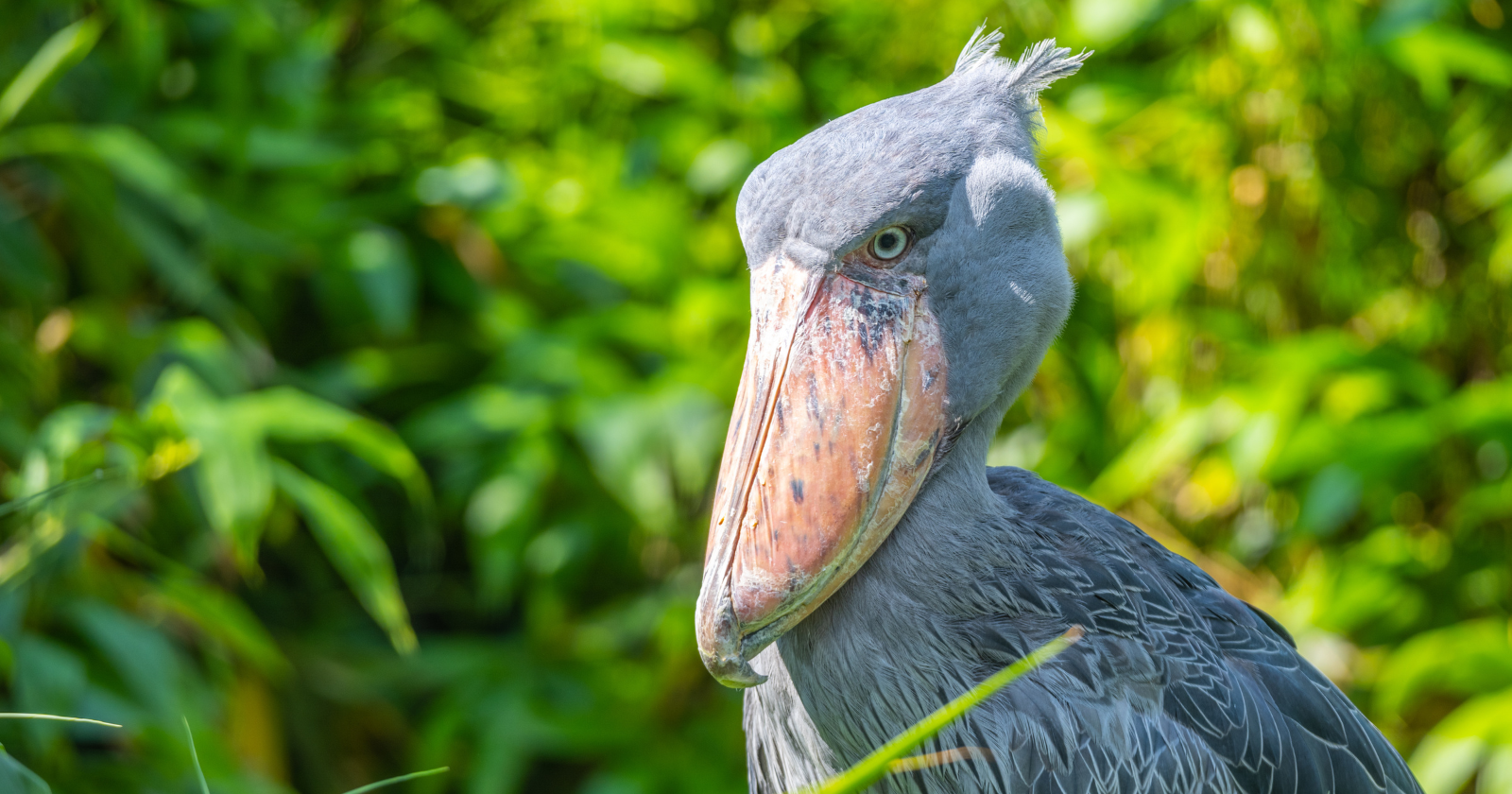
Boats go quiet when the guide points. Out in the papyrus, standing in knee-deep water and not moving at all, is a grey bird about the height of a ten-year-old child, carrying a bill that looks like a wooden clog with a hook filed onto the end.
Nobody on the boat says rare. They say dinosaur.
The shoebill earns that reaction honestly. Animal Diversity Web, run out of the University of Michigan, puts adults at 110 to 140 centimetres tall, and the bill does the rest of the work on the imagination. It is straw-coloured, blotched with grey, hooked, and much heavier than anything a wading bird seems to need.
What that bill is actually for
Shoebills hunt by doing almost nothing, for hours.
The bird stands still, bill angled down and out of its line of sight, and waits. When a fish shows itself, the whole animal drops on it. The San Diego Zoo describes the move as collapsing, which is exactly right: the shoebill throws its entire body weight forward and lets the bill take the impact. Lungfish, catfish and tilapia are the staples. Water snakes, frogs, monitor lizards and young turtles turn up too, and now and then a baby crocodile.
That last one sounds like exaggeration until you look at the tool. Writing for African Parks, which manages the shoebill stronghold in Zambia’s Bangweulu Wetlands, Illana Stein notes the beak reaches roughly 24 centimetres long and 9 wide, with edges sharp enough to decapitate a large fish. The hook holds the prey. The edges do the rest, and also strip out the mat of vegetation that comes up with every strike.
So is it a stork?
No, though almost everyone calls it one. BirdLife International puts the shoebill closer to pelicans, a reshuffle driven by genetic work, not by anything changing in how the animal looks. It is also the only living member of its family, with no close relatives to compare it against, which is part of why the prehistoric impression sticks.
There is nothing else quite like it standing in the reeds next to it.
The sound it makes
In Zambia the local name is mapumambao, the one who drums on wood, and it describes the sound better than any English attempt. Shoebills are mostly silent birds. What they do instead is clatter the two halves of the bill together at speed, and the hollow structure amplifies it into something between a woodpecker and light machine-gun fire. African Parks has recorded captive chicks doing it at three weeks old.
Two eggs, one survivor
The BBC’s 2013 series Africa caught it on camera: an older shoebill chick, a few days ahead of its sibling, attacking the smaller one while the parents look on and eventually walk away. As Discover Wildlife recounts it, the footage is hard to watch and entirely ordinary for the species.
BirdLife notes that females lay up to three eggs but the pair raise only one. The younger chicks function as insurance in case the eldest fails, and if it does not fail, they are usually abandoned. Bangweulu’s conservation team turned that arithmetic into a strategy, lifting surplus eggs from monitored nests and rearing the chicks by hand rather than leaving them to die on the platform.
Why Uganda gets the boats
Shoebills range from South Sudan down to Zambia, but Uganda is where most visitors actually see one, and the reason is logistical.
Mabamba Bay, a 2,424 hectare marsh on the edge of Lake Victoria west of Entebbe, was listed under the Ramsar Convention in 2006 as the only swamp close to Kampala where the bird can reliably be found. That is about an hour from an international airport, in a wetland holding close to 190,000 birds of one kind or another.
The Ramsar listing also records shoebill poaching among the pressures on the site, which is the part the tourism brochures skip. NatureUganda, the BirdLife partner there, has spent years building the ecotourism side of Mabamba precisely because an animal that earns a village money by standing still is worth more alive than dead.
Population estimates vary more than you might expect for a bird this conspicuous. BirdLife’s figure is 3,300 to 5,300 mature individuals; African Parks gives the wild total as no more than 8,000. Both agree the trend is downward, and both list wetland drainage, disturbance and the live bird trade as the reasons.
That decline has produced one of conservation’s stranger images. At the rearing facility in Bangweulu, chicks cannot be allowed to imprint on the humans feeding them, so the carers work through shoebill hand puppets designed by Bill Diamond, a puppeteer whose credits include the Muppets. Africa’s most convincingly ancient-looking bird is being brought up by a glove.