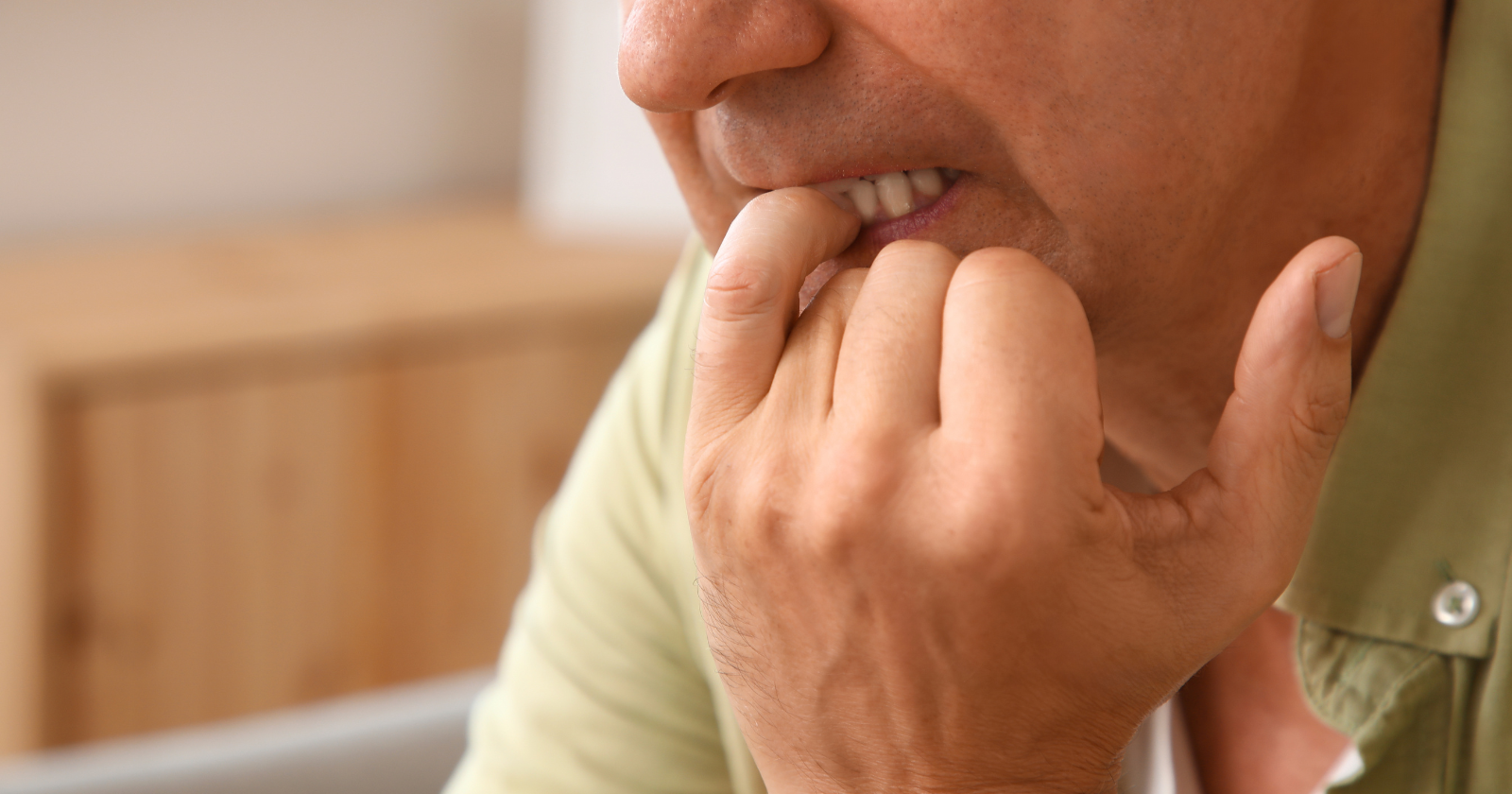
The tidiest person in your office probably has the worst hands.
Chronic nail biting looks like nerves. Ragged edges, chewed cuticles, a habit that seems to broadcast a jittery interior life. When researchers went looking for the emotional states that actually set the behaviour off, anxiety kept underperforming, and the evidence kept pointing instead to a low tolerance for the unfinished.
The most quoted work on this comes out of Montreal. In a 2015 paper in the Journal of Behavior Therapy and Experimental Psychiatry, Sarah Roberts and colleagues compared 24 people who reported body-focused repetitive behaviours (nail biting, skin picking, hair pulling) against 23 who did not. Everyone was walked through four staged situations: a calming video of waves on a beach, a stressful video of a plane crash, a task designed to look easy and turn out to be impossible, and six minutes alone in a room with nothing to do.
Urges spiked in the frustrating and boring conditions. The beach did nothing.
What perfectionism means here
This isn’t the trophy-cabinet version of the trait, the tidy CV and the high standards. The Montreal group had spent years describing something else, which they call organisational perfectionism, a style of planning marked by an unwillingness to slow down and a badly calibrated sense of pace. People with this style try to be productive every waking minute, set standards nobody could meet, and attempt several things at once.
Frustration is the natural output of that arrangement. So is boredom, which arrives faster for someone who treats an idle minute as a defect.
O’Connor described people with the pattern as “unable to relax and to perform task at a ‘normal’ pace,” in a statement from the Institut universitaire en santé mentale de Montréal. His group’s reading is that the behaviour delivers stimulation and a rough form of emotional regulation, which is why it sticks.
Forty-seven participants is a small room, and the sample mixed nail biters in with skin pickers and hair pullers, without isolating nail biting on its own. A rigged laboratory task is also not the same animal as a bad Tuesday, so the perfectionism link is a plausible hypothesis that keeps getting discussed rather than a finding anyone should treat as settled for nail biting specifically.
Where the anxiety story struggles
Ask most people why anyone bites their nails and you will get stress. The data is patchier than that. In a cross-sectional study of 330 medical students at Tanta University in Egypt, 57.3 per cent were active nail biters, and yet scores on the Perceived Stress Scale showed no significant difference between biters and non-biters. Stress severity was not linked to how often or how long they bit.
The clinical picture is similarly unhelpful to the nerves theory. Writing in the International Journal of Environmental Research and Public Health, Debra Lee and Shari Lipner note in a review of onychophagia that data connecting long-term nail biting to obsessive-compulsive disorder is inconsistent. One reported prevalence of OCD among nail biters, 3.1 per cent, sits close to the lifetime rate in the general population anyway.
Anxiety clearly sets off biting in plenty of people, and the two often travel in company. As the engine of the chronic version, though, it keeps failing to turn over.
The habit is bigger than the hands
Somebody parks in the same bay every morning, takes the same seat on the train, and chews a thumbnail raw while the kettle boils. Researchers behind a 2020 study using the Creature of Habit Scale asked whether people who bite, pick or pull run the rest of their lives by that same kind of rote pattern, and reported that the association holds. That suggests these behaviours belong to a broader preference for automatic routine, instead of sitting on their own as isolated grooming tics.
Whether that broader tendency traces back to pacing, temperament, or something else again, it argues against nail biting standing alone as a single isolated tic.
What this changes about treatment
Habit reversal training remains the front-runner. It teaches you to notice the trigger and substitute a competing action, and it holds up across meta-analyses. A head-to-head trial of three self-help techniques, though, found that the technique with the best completion rate was decoupling in sensu, a version performed mentally rather than physically. Adherence matters as much as mechanism.
O’Connor’s team argued for a second front: go after the beliefs about pacing and productivity that generate the frustration in the first place.
Almost nobody is running either. A survey of physicians led by Sigita Lesinskiene found that 60.6 per cent never ask patients about nail biting unless prompted, and that when they do treat it, they tend to hand over bitter-tasting polish or a referral.
Which leaves a slightly absurd situation. The standard advice to a chronic nail biter is to calm down, and calm is the one condition in the Montreal experiment where nothing happened. Nobody has properly tested whether teaching someone to sit still with a half-finished task does more for their hands than teaching them to breathe. Until somebody does, the polish stays on the shelf and the perfectionists keep chewing.