

The case for looking for life on Europa runs through the bottom of Earth’s own ocean. In the late 1970s, researchers exploring the sea floor found dense communities of organisms living in permanent darkness, kilometres down, fed not by sunlight but by chemical energy leaking from hot vents in the rock. Life, it turned out, did not strictly need the Sun. That discovery widened the search for life elsewhere, and it is a large part of why a moon of Jupiter has become one of the most closely watched addresses in astrobiology.
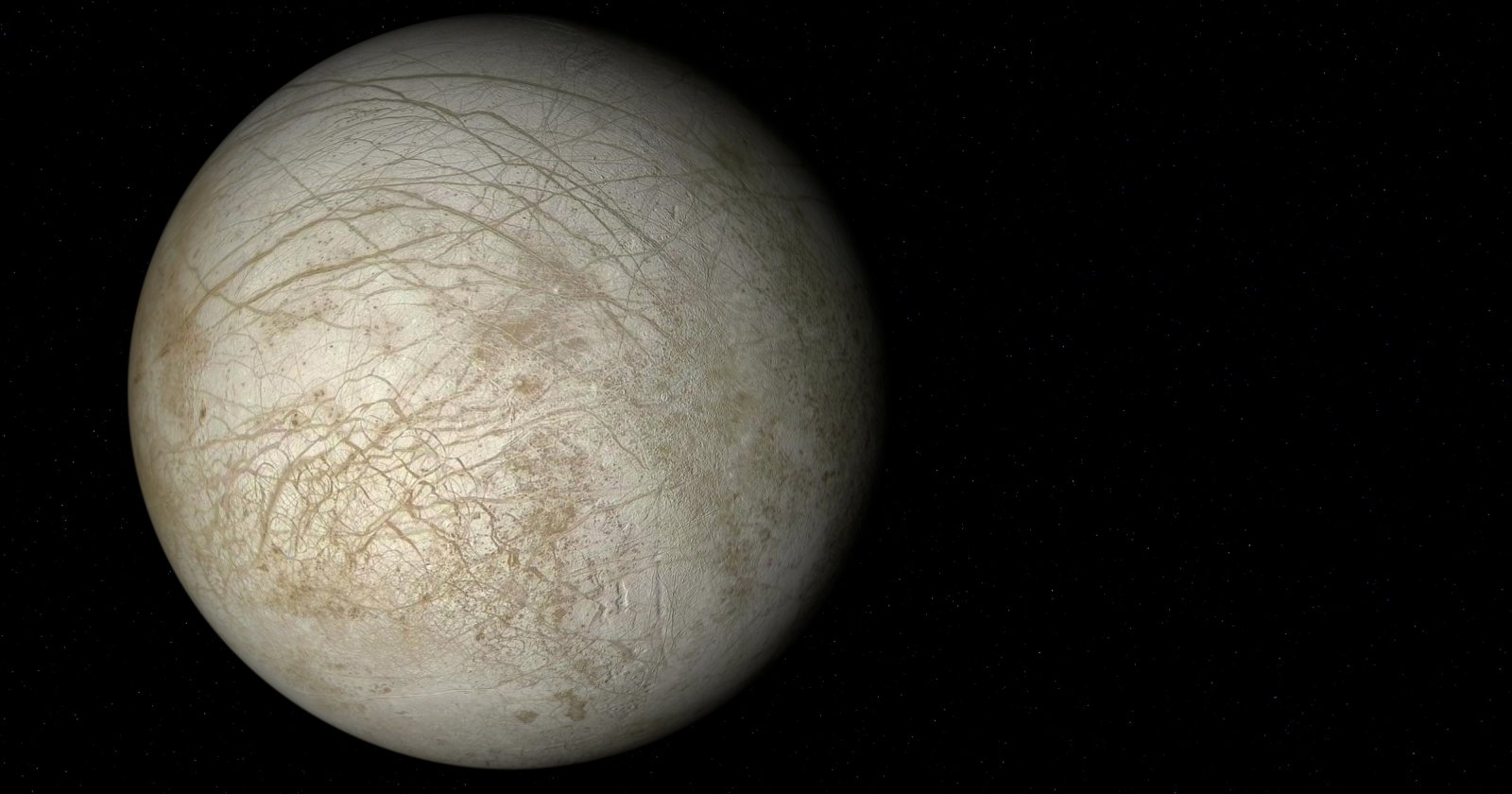
Europa holds a global saltwater ocean beneath a shell of ice, kept liquid by the tidal squeezing it undergoes as it orbits Jupiter. The Galileo spacecraft, which circled Jupiter from 1995 to 2003, gathered the first strong evidence for that ocean. It is thought to hold more water than all of Earth’s oceans combined, sitting on a rocky interior. Water, rock, and a possible source of chemical energy are the ingredients that make the comparison to Earth’s vent ecosystems tempting.
The comparison is worth examining rather than repeating.
What the deep-sea comparison rests on
On Earth, the organisms clustered around hydrothermal vents sit at the base of a food chain that runs on chemistry, not light. Microbes convert chemical gradients into energy through chemosynthesis, and larger creatures feed on them. A 2025 review in Frontiers in Astronomy and Space Sciences, led by Emory G. Barrett and Richard A. Lutz of Rutgers University, traces how the discovery of these communities pushed astrobiology past its older assumption that life needs sunlight and photosynthesis. Once a dark, cold, high-pressure ocean counts as a candidate for life, Europa stops reading as a frozen dead world and starts reading as a place worth the trip.
The reasoning holds as far as it goes. Whether Europa actually has the vents, or anything doing the same job, is the harder question.
A recent paper complicates the picture
In January 2026, Nature Communications published a modelling study that narrows the comparison in an uncomfortable way. Paul K. Byrne of Washington University in St. Louis and colleagues asked whether Europa’s rocky seafloor is likely to be cracking and shifting today, since active faulting is what lets water circulate through rock and come back carrying chemical energy. They worked through the forces that might drive that faulting: tidal flexing, the slow contraction of the moon, convection in its interior, and a water-rock reaction called serpentinisation. Their finding was that none of these appears strong enough to make even weak, pre-existing fractures slip.
Put plainly, the seafloor may be mechanically quiet. If water is only seeping slowly through a thin, already altered top layer of rock, the chemical output would be far weaker than a busy, faulted seafloor would produce. “The energy just doesn’t seem to be there to support life, at least today,” Byrne said. The authors are careful about that last phrase. Both qualifiers matter: the claim is about the present, and about the seafloor specifically.
This is one modelling study, not a verdict.
Where the finding stops short
A quiet seafloor rules out one pathway. Others stay open. Europa’s surface is bombarded by radiation from Jupiter, which produces oxidants in the ice. If that ice allows material to migrate downward, those oxidants could feed the ocean from above, independent of any seafloor activity. Earlier episodes of heating, when the moon was younger and flexed harder, may have driven vents in the past. Low-temperature reactions could continue in shallow rock. Some researchers have also pointed to pockets of liquid water within the ice itself, above the ocean, as possible habitats in their own right.
Byrne has noted that Europa likely retains some tidal heating, which is why it has not frozen solid, and that it may have had considerably more in its distant past. The paper does not say the ocean is barren. It says the mechanism people most often reach for, an actively venting seafloor, looks unlikely under present conditions. That is a narrower and more useful claim than “Europa is lifeless,” which is how the result has sometimes been summarised.
What Clipper can and cannot settle
NASA’s Europa Clipper, launched in October 2024, is built to weigh in on this question without answering it outright. The spacecraft is due to reach Jupiter in April 2030 and to begin a run of close flybys of Europa the following year, roughly 49 of them, carrying nine instruments to study the ice shell, the ocean beneath it, and the chemistry of the surface. NASA has been consistent that the mission is designed to assess whether Europa could support life, not to detect life directly.
A flyby mission measures fields, surface chemistry, and the structure of the ice from orbit. It does not drill to the seafloor, so the faulting debate is unlikely to be closed by Clipper on its own. What the mission can do is pin down the inputs: how thick the ice is, how much exchange happens between surface and ocean, what the surface chemistry implies about the water below. The European Space Agency’s JUICE spacecraft, launched in 2023 and arriving in 2031, will add its own flybys of Europa alongside its main focus on Ganymede.
The ocean is real and the water is abundant. The energy question is open, and one recent line of modelling points away from the classic vent scenario rather than toward it. The measurements that could move the argument are still years from being taken.
The next item on the calendar is not a discovery but a course correction: a gravity-assist flyby of Earth on 3 December 2026 that keeps Clipper pointed at Jupiter.