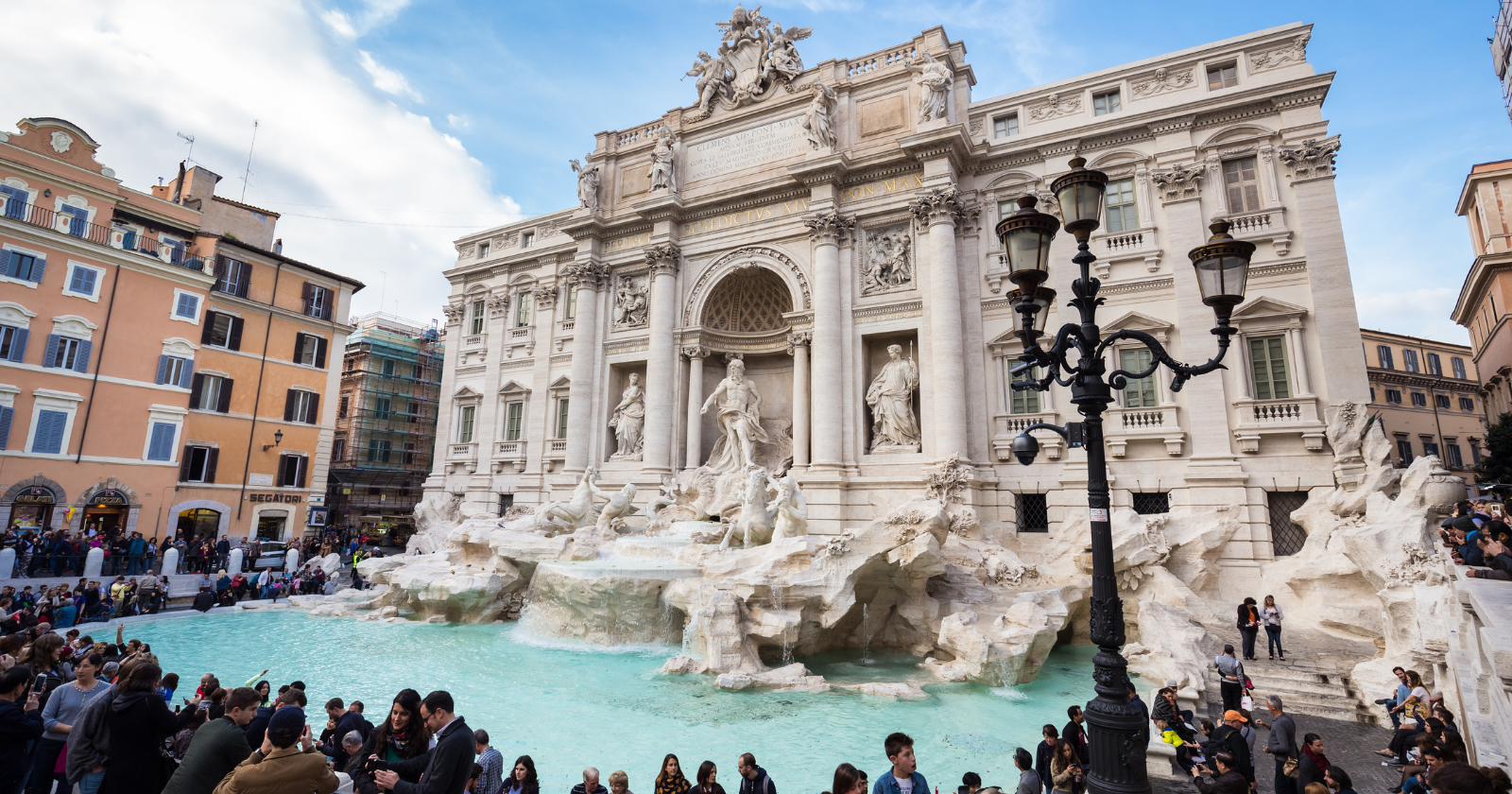
Twice a week the most famous fountain in Rome is switched off, drained and vacuumed like a lounge room carpet.
Workers climb down into the emptied basin with long-handled brushes, sweep the coins into glinting piles, then run a suction hose over each heap until the stone is bare again. Up on the rail, tourists are already waiting with fresh coins in their fists. The cleaning never quite finishes, because the wishing never quite stops.
Roughly €3,000 goes into the water on an average day. Across a year that adds up to about €1.5 million in small change, tossed over the left shoulder with the right hand by people betting on the old promise that they will make it back to Rome one day.
The city keeps none of it.
Where the money goes
Every euro fished out of the basin goes to the Rome branch of Caritas, the Catholic charity, which counts it, converts whatever foreign currency turns up and spends the rest on food relief and social programs across the city. In 2022 the haul came to €1.4 million, as documented by Al Jazeera, which traced the coins as far as a Caritas Emporium, a supermarket funded by the fountain where people on low incomes buy essentials.
A tourist drops a coin for luck. Somewhere across the city, that coin turns into someone’s dinner.
The man with the magnet
“I wasn’t really collecting all that much,” Roberto Cercelletta told police in 2002, moments after thirty-four years of doing exactly that finally caught up with him. Between 1968 and 2002 he waded into the empty basin before dawn armed with a rake and a long, sword-shaped magnet, lifting coins straight off the stone. Romans called him d’Artagnan, after the swashbuckling Musketeer.
Reporting by The Local put his best days at around $1,000. Italian news agency ANSA reported that at the height of one tourist season he lifted 22 kilos of coins out of the basin in a quarter of an hour.
Police left him to it for decades, since for years it was not clear he was breaking any law at all. The coins were nobody’s property until Caritas collected them. It took a front-page story in the New York Times to force the arrest that thirty-four years of dawn raids had not. He died in 2013, aged 62.
The year the mayor wanted the coins
Who owns a wish, exactly? Rome’s council put that to the test at the end of 2018, approving a plan to divert the fountain money into city funds for heritage maintenance from 1 April the following year. Avvenire, the newspaper of the Italian bishops’ conference, ran a front page headlined “money taken from the poorest.”
In coverage by Fox News, Father Benoni Ambarus, then head of Caritas Rome, said the change would strip roughly 15 per cent of the charity’s yearly budget, the slice that funds soup kitchens, social assistance and a homeless shelter. Mayor Virginia Raggi reversed the decision within days and told the Vatican newspaper that nobody had ever meant to take the funds away.
A year later the wishes dried up on their own. Rome sealed the fountain off in March 2020, and by then Caritas had collected only €190,000 for the year, Wanted in Rome reported. A charity budget had quietly been resting on holiday superstition, and the pandemic sent the invoice.
Two euros to stand at the edge
On the fee’s first morning, tourists still lined up to fling a coin over their shoulders, two euros lighter and unbothered. Since 2 February 2026, standing close enough to throw one has cost money. A €2 ticket buys access to the steps down to the basin from morning until 10pm. After dark, the steps are free to everyone, and the view from the piazza above has always been free.
Alessandro Onorato, the city councillor responsible for tourism, said the aim was crowd control rather than income, and that visitors should stop “eating ice cream or pizza on a monument that deserves the proper respect,” in coverage by Euronews. In 2025, Rome mayor Roberto Gualtieri said, around 10 million people had queued for the close-up view, with as many as 70,000 on the busiest days. Roman residents are exempt from the fee.
The coins themselves still go to Caritas. Nobody has touched that part.
So the transaction now runs two ways. Two euros buys the right to stand at the water. Whatever lands in the basin afterwards still buys someone a meal, on the strength of a promise nobody can enforce. The queue has not got any shorter.