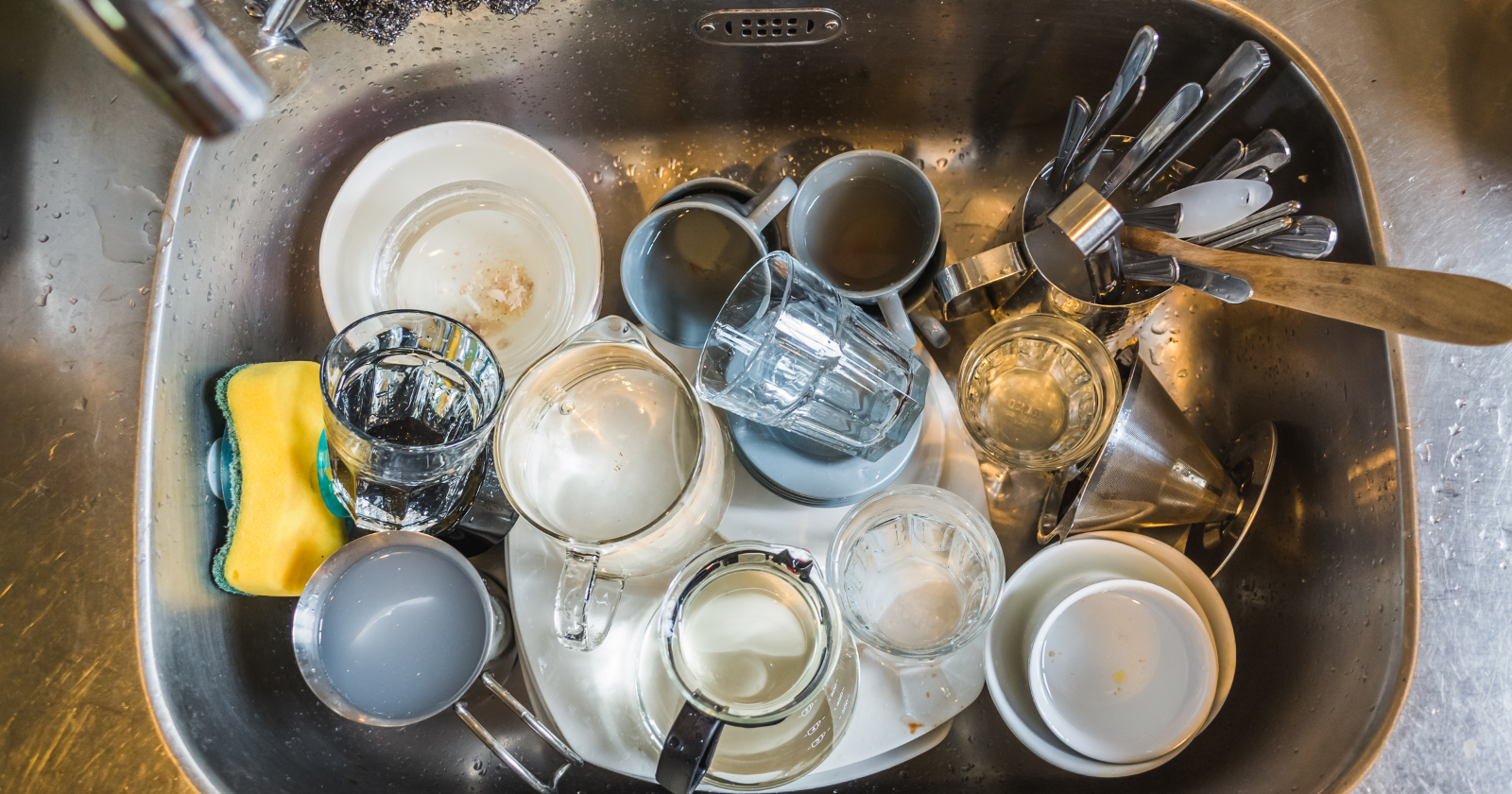
There’s a particular argument that has played out in millions of households, in roughly the same form, for as long as people have been living together.
One person looks at the sink full of dishes and feels a small surge of irritation. Why hasn’t this been dealt with? It would take ten minutes. The other person, the one who left the dishes there, is sitting on the couch, not because they don’t see the dishes, but because the gap between seeing them and being able to summon the energy to wash them feels, in this moment, larger than they can cross.
The first person reads the pile as a character flaw. Laziness. Inconsideration. A failure to notice or care. The second person experiences it as something else entirely. They’re not lazy. They’re depleted. And the pile is sitting there because something else, often invisible to everyone in the household, has already taken what it would have cost to clean up.
I’ve been watching this dynamic up close in my own home since my daughter was born. My wife and I are both, by temperament, the kind of people who keep a clean kitchen. The dishes always got done before we became parents. Now, sometimes, they don’t. And the reason isn’t that we’ve gotten lazy. The reason is that a baby has been added to our lives, and our daily energy budget hasn’t expanded to match what the day now requires. The dishes are, on the harder days, the most honest piece of information in the house.
This is a piece about reading that information correctly, in your own life and in the lives of the people you live with.
Why the small task is the one that breaks
There’s a body of psychological research, going back to the late nineties, on something called ego depletion or decision fatigue. The original work was led by social psychologist Roy Baumeister, and the basic finding was that self-control and decision-making seem to draw from a limited pool of mental energy. Use that pool too much, and the next decision, even a small one, becomes harder than it should be.
Some aspects of Baumeister’s original ego-depletion model have been challenged in replication studies. But the core observation that people make worse decisions and resist tasks more when their cognitive resources are depleted has held up in multiple frameworks. A widely cited paper on the construct, published in the journal Innovation in Aging, defined decision fatigue as a state in which depleted internal resources lead to procrastination, avoidance, and a reluctance to engage with tasks that require any further self-regulation.
In plainer language, after enough small drains on your willpower, you stop being able to do small things.
This is the part most people misunderstand. The dishes don’t take much. Ten minutes, maybe fifteen. On a normal day, with a normal energy reserve, you wouldn’t think twice about doing them. The reason they go undone isn’t that they’re hard. It’s that they’re being asked of someone whose budget for “one more thing” has already gone to zero earlier in the day, and not necessarily for visible reasons.
If you’ve ever looked at a small task and felt, for no clear reason, like it was an immense ask, you weren’t being dramatic. You were registering an honest signal about the state of your inner battery.
The invisible drain most households don’t see
A lot of the depletion in modern households doesn’t come from the visible chores. It comes from what researchers now call the mental load.
A landmark 2019 study by psychologists Lucia Ciciolla and Suniya Luthar, published in the journal Sex Roles, gave one of the first quantitative looks at this. They asked mothers about the cognitive and emotional management of their households, things like remembering schedules, anticipating needs, planning the week, monitoring the kids’ wellbeing. Their finding was striking. Mothers overwhelmingly reported being the primary captain of household management, and the more cognitively responsible they felt, the lower their personal wellbeing and relationship satisfaction.
A more recent 2024 paper in the Archives of Women’s Mental Health extended these findings. Researchers at the University of Southern California found that mothers spent roughly twice as much time on cognitive household labor as fathers, and that this invisible cognitive work, far more than the physical chores themselves, predicted increased stress and depression risk.
Why is the cognitive load so much heavier than the physical one? Because cognitive labor doesn’t end. Anyone who has cooked dinner knows that the dinner ends. The mental work of running a household, the constant background process of remembering, planning, anticipating, monitoring, never gets to clock off. It’s running while you’re at your job. It’s running while you’re trying to relax. It’s running while you’re trying to sleep.
By the time the visible task arrives, the dishes, the laundry, the email that needs replying to, the person being asked to do it has already been doing dozens of invisible cognitive tasks all day. The pile in the sink isn’t the start of their workload. It’s the part you can finally see.
What the pile is actually telling you
I’ve talked about this before but one of the things I’ve come to value most about Buddhist practice is the discipline of reading reality clearly, without imposing the story you’d prefer onto what’s actually in front of you.
Most household conflict about chores fails this test. The pile of dishes is, factually, just a pile of dishes. The story laid on top of it, “you don’t care, you’re lazy, you don’t respect this house,” is something added by the observer.
If you read the pile clearly, without the story, what does it actually tell you? It tells you that someone in your household had a day where the energy required to do that small task was greater than the energy they had left. That’s it. The pile is data.
The interesting follow-up question is: what does that data tell you about the rest of the day? About the rest of the week? About what’s been quietly costing this person more than your household has been acknowledging?
Most households don’t ask this question. They argue about whose turn it was. They make pointed comments. They feel resentful. The pile sits there generating tension because both parties are reading it as a moral document instead of a practical one.
The healthier move, when you walk into a kitchen full of dishes the other person didn’t do, isn’t to assume the worst. It’s to ask, gently, “what was today like for you?” The answer often explains the dishes more clearly than any reasonable scolding could.
The version of this in my own marriage
My wife and I had to renegotiate a lot when our daughter arrived. Pre-baby, we both kept the house in a particular way and didn’t really have to talk about it. Post-baby, the energy required to maintain that standard suddenly exceeded what either of us, separately or together, could always provide.
What changed wasn’t our character. We didn’t become lazier. We became drained in ways that aren’t always visible from the outside, particularly in the first year of parenthood when sleep is broken and the cognitive load of managing a small human is constant.
What we learned, slowly and with some friction, is that the chores undone weren’t the problem. They were the indicator. When the kitchen was a mess, it usually meant that one of us had hit a wall earlier in the day that the other hadn’t fully understood. The fix wasn’t to push through and clean up. The fix was to talk about what had drained us, redistribute what could be redistributed, and let some of the visible standards drop on the harder days.
This isn’t a lesson I learned from a parenting book. I learned it from watching my own resistance to small tasks and realizing that resistance was almost always information I’d been ignoring. The night I left dishes in the sink wasn’t the night I’d suddenly become a worse partner. It was the night something else had taken more than I’d registered, and the dishes were where the running balance finally tipped negative.
What this looks like outside the kitchen
The dishes are just one example. Once you start reading depletion this way, you see the same pattern everywhere.
The unread emails sitting in your inbox. The phone call you keep meaning to return. The pile of laundry on the chair. The book you wanted to read still sitting on the bedside table. The friend you’ve been meaning to text back for two weeks. The doctor’s appointment you keep rescheduling.
These aren’t necessarily signs of a character problem. They’re often signs of an energy problem. They’re the visible marker of an invisible deficit. Treating them as a willpower issue, or as a moral failing, almost always makes them worse, because the strategy people use to “fix” them is just to push themselves harder, which deepens the depletion that caused the pile in the first place.
The actual fix is usually upstream. It’s not “clean the dishes.” It’s “figure out why doing the dishes felt impossible, and address that.” Maybe you took on too much at work. Maybe the cognitive load at home isn’t being shared. Maybe you’ve been performing emotional labor you haven’t been credited for. Maybe you’re sleep-deprived. Maybe you’re depressed and haven’t named it yet. The pile is pointing at something. It’s worth following the pointer.
The Buddhist version of compassionate noticing
There’s a practice in Buddhism sometimes called clear seeing, which sounds like it would be easy and isn’t. It’s the discipline of looking at a situation, including a situation involving someone you live with, and seeing what’s actually happening rather than what you’ve already decided is happening.
Applied to a kitchen full of dishes, clear seeing means dropping, for a moment, the explanation you’ve already constructed. Maybe your partner isn’t lazy. Maybe they’re not trying to take advantage of you. Maybe the dishes aren’t a power play. Maybe what you’re looking at is a person whose day has cost more than they had, and you, as the person they live with, are positioned to see something they haven’t yet been able to articulate.
This kind of seeing is harder than it sounds. It requires you to suspend your own grievance long enough to ask a real question. It also requires you to extend it to yourself, to notice when your own piles are talking, and to listen instead of self-recriminating.
In Buddhist terms, this is part of what compassion actually means. Not pity. Not lowering your standards. Just an honest willingness to read the situation clearly, including the parts of it that are tired and overwhelmed and not performing optimally.
Final words
If you live with someone and you’re frustrated by their unfinished tasks, here’s the small experiment I’d offer.
Before you say anything, ask one question. “What’s been the heaviest part of today for you?” Then listen, without using the answer as ammunition.
You’ll usually learn something you didn’t know. There will be invisible work they’ve been carrying that you weren’t tracking. There will be a piece of mental load that’s been quietly draining their reserves. There will be context that explains the pile in front of you in a way that reframes it from character flaw to honest signal.
If you’re the one whose tasks are piling up, here’s the same experiment in reverse. Before you criticize yourself, ask the same question. What’s been the heaviest part of today? What’s been costing you more than you’ve acknowledged? The pile isn’t a verdict on who you are. It’s information your inner system is trying to surface.
The healthiest households I’ve seen are not the ones with the cleanest kitchens. They’re the ones where both people have learned to read each other’s piles as data instead of indictments. Where unfinished tasks prompt curiosity rather than blame. Where the question “are you okay?” gets asked before the question “why didn’t you do this?”
The dishes aren’t dishes. They almost never are. They’re a small, visible record of how the day has actually gone for the person standing in front of the sink. The households that read that record well stay close. The ones that don’t end up arguing for years about something that was always pointing at something else.