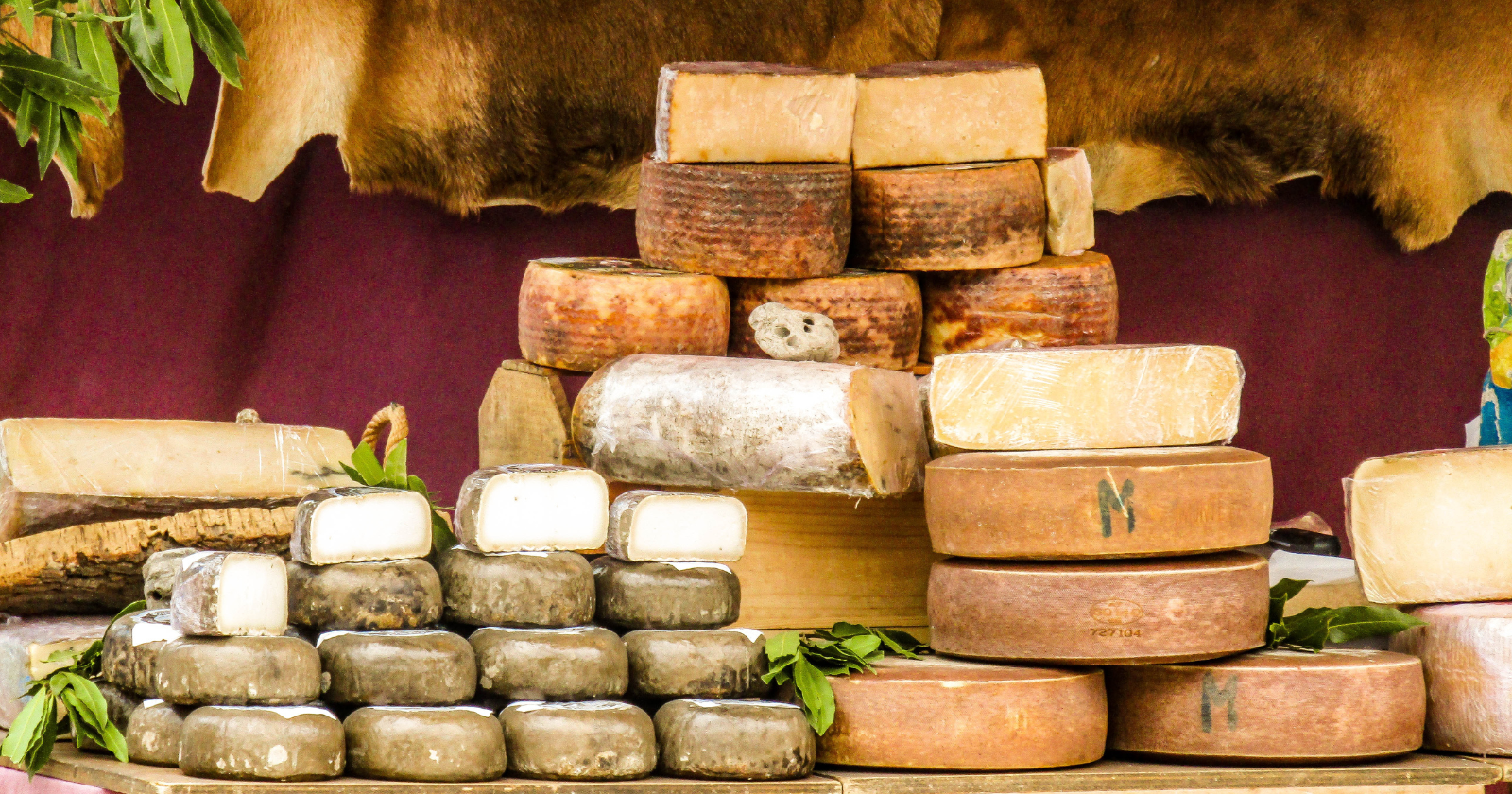
Somewhere in Sardinia tonight, someone will pry the lid off a wheel of pecorino and watch the contents jump.
The cheese is casu marzu, casu martzu in Sardinian, and the jumping is not a fault. It starts as an ordinary sheep’s milk pecorino. Instead of being sealed and left to age undisturbed, the wheel is deliberately opened: cuts made in the rind, or the top lifted off entirely, then left in a dark, ventilated room where the cheese fly Piophila casei can find it and lay eggs.
The larvae hatch and tunnel through the paste, and their digestive enzymes do the rest. Britannica’s entry on the cheese describes the result as soft and closer to gorgonzola than to the firm wheel it began as, weeping a liquid Sardinians call lagrima, tears. A ripe wheel holds larvae in the thousands. They are eaten alive, and the species earns its English name, the cheese skipper, by flicking itself several centimetres into the air.
What is actually prohibited, and by whom
Brussels usually gets the blame. The chronology puts Rome first.
Italy’s foundational food hygiene statute, Law 283 of 1962, already prohibited foods containing live larvae or parasites, which made commercial sale of casu marzu illegal on the island decades before the European Union had a hygiene package to speak of. The EU regulations adopted in 2004 and 2005 then set out production standards that open-air artisanal colonisation cannot meet, closing the door across the single market.
What makes the case odd is what sits alongside the prohibition. The cheese also appears on Italy’s national register of traditional agri-food products, added in 2004. It is, on paper, both protected heritage and a food that cannot legally be sold. An application for protected designation of origin status was refused. So casu marzu is made, given away, traded quietly and eaten at family tables, while remaining absent from every shop counter in Europe.
Where the “most dangerous cheese” label came from
In 2009 Guinness World Records gave casu marzu the title of most dangerous cheese, on the reasoning that the larvae can survive stomach acid, pass into the intestinal wall and cause vomiting, abdominal pain and bloody diarrhoea. CNN ran the same framing in a widely read travel feature, and the phrase has followed the cheese ever since.
The medical literature is more equivocal. Swallowing fly larvae is described as intestinal myiasis, which parasitology reviews generally classify as pseudomyiasis: accidental, usually self-limiting, and caused by larvae passing through rather than establishing themselves. The review of myiasis published in Clinical Microbiology Reviews lists Piophila casei among the uncommon agents implicated in such cases, with presentations ranging from nothing at all to abdominal pain and rectal bleeding depending on how many larvae are involved. A 2024 paper in the Journal of Clinical Microbiology, examining a different fly family, notes in passing that in these spurious-passage cases there is no evidence the larvae use human intestinal tissue as food, though their secretions and the spines on the cuticle can irritate the gut lining.
Guinness’s title rests on a mechanism the case reports have not actually established.
Food-safety regulators are objecting to something else. A wheel left open to the air for months ripens under conditions nobody is measuring, alongside whatever else arrives with the flies.
The Sassari experiment
In 2005 Sardinian producers went looking for a way through, and enlisted the University of Sassari. The published attempt appeared in the Italian Journal of Food Safety in 2010, with Mazzette as lead author, and it is worth reading for how uneven the results were.
Three batches of two cheese types, a holed paste and a firm paste, were produced in duplicate. Half were exposed to Piophila casei in a conditioned store room and half kept protected, then sampled at 0, 10, 30, 60 and 90 days. Colonisation did not behave consistently between batches. The holed-paste wheels were colonised more readily and showed more intense breakdown of proteins and fats. The microbiological readings, the authors report, were strongly affected by the process conditions, and the paper closes by discussing whether controlled production is advisable rather than declaring it solved.
That is a long way from a protocol a regulator could sign off on.
What little research exists
A National Geographic feature published in May, reported on the island by Brett Martin, found two microbiologists at Sassari, Severino Zara and Francesco Fancello, arriving at the same problem from the other direction. Zara went looking for scientific literature on the cheese some years ago and found very little. Both thought the gap regrettable, particularly on the larva itself, and neither claimed to know whether it is harmful, beneficial or neither. An entomologist colleague began work on producing the cheese under laboratory conditions about a decade ago, and nothing appeared to come of it. Their explanation was straightforward: funding follows problems, and as far as the people making and eating casu marzu are concerned, there is no problem.
Martin also noted that nobody he met on the island could recall a single arrest or fine connected to the cheese.
The petition, and what happened to it
A petition asking that casu marzu be readmitted as a food producible in the EU, under specific production, labelling and marketing rules intended to safeguard consumer safety, reached the European Parliament and was declared admissible by the petitions committee on 8 November 2023. The committee notice records the Commission’s starting position: Italian authorities had assessed the cheese as dangerous and restricted its domestic market, and on that basis it would not be authorised elsewhere in Europe.
It went no further. Martin reports the petition, which he dates to 2024, was summarily rejected, the cheese dismissed as a “contaminated and decayed product”. Any route to legal sale would have to start in Rome, with Italy revisiting a judgement it made in 1962, and nothing so far suggests that is on the table.
What is thinning the supply is not enforcement. Hotter summers have disrupted the cheese fly’s life cycle, making colonisation less predictable than it already was. Estimates of total production are guesses, one of them putting it above 200,000 pounds a year. Last season one shepherd family near Cala Gonone got four or five usable wheels out of roughly sixty, and a wheel whose larvae have died is considered inedible.